Reporting by Helen McCloskey and Naomi Kotani
Since the presidential inauguration on Jan. 20, President Donald Trump has signed over 150 executive orders — directives given by the president to the federal government. This number is more than any other American president in the modern era. Many of these, according to Jodi Short, a law professor at University of California, San Francisco, violate statutory law or the Constitution.
“The president would rather not have to work through the legislative process … [because] it requires the expense of political capital,” Short said. “[He] knows that the judicial process moves very slowly … so even if an executive order is unlawful, a judicial remedy may come too late, or it may not come at all. [Trump] is trying to remake our government and remake our understanding of constitutional democracy to allow for authoritarian executive rule.”
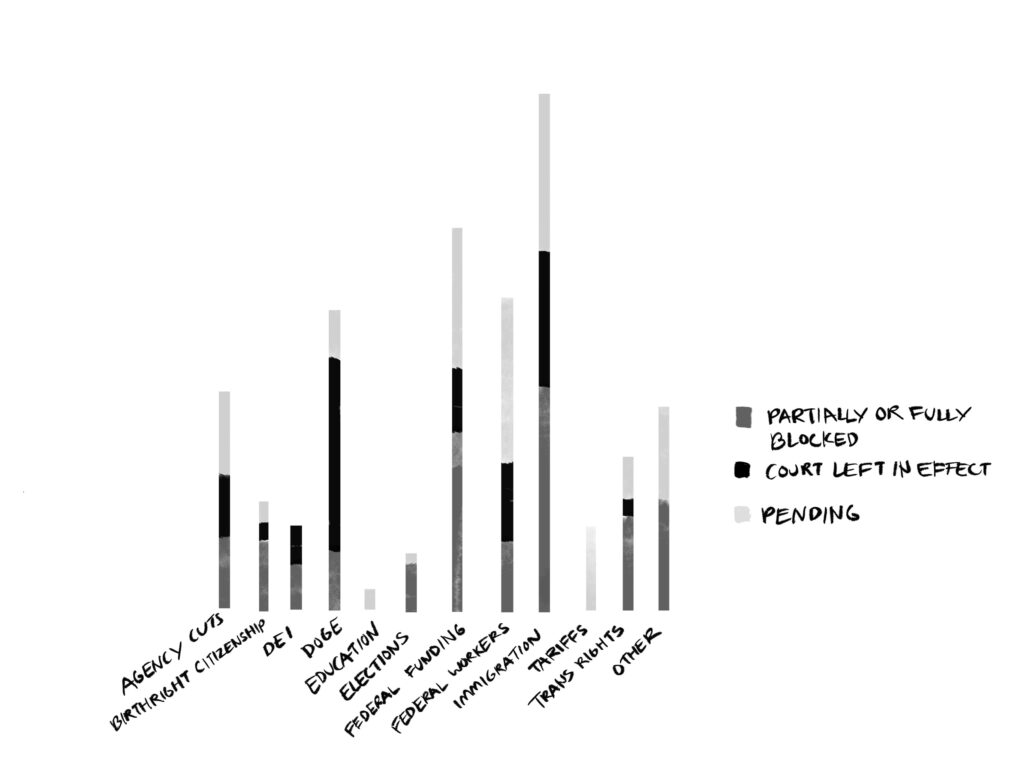
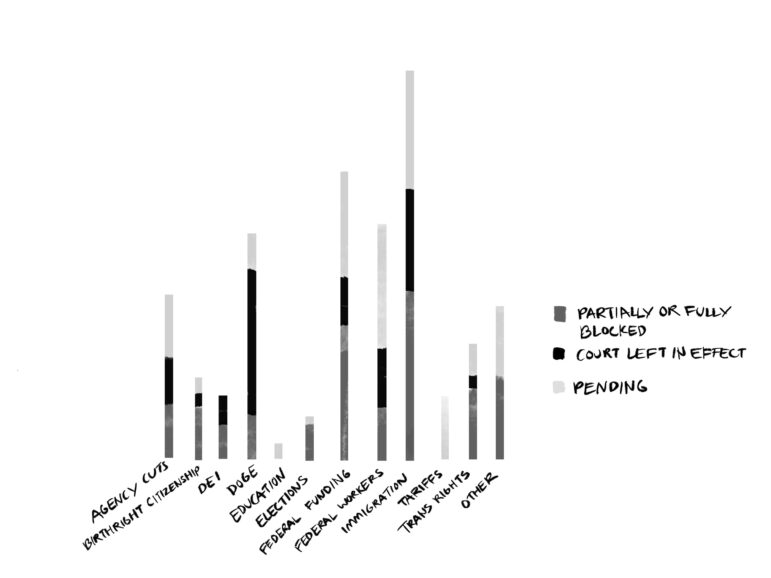
As of May 19, there have been over 200 legal challenges to Trump’s executive orders in his second term.
DEPARTMENT OF EDUCATION
On March 20, Trump signed an order that aims to shift some of the responsibilities of the Department of Education to the states. The ED, created by Congress in 1979, oversees most of the federal involvement in and aid to education.
Only 8% of funds for elementary and secondary schools across the country come from the federal government, according to the ED. The San Mateo Union High School District is a basic aid district, meaning most of its money comes from local property taxes as opposed to state or national funds. However, it is classified as a Title I district and thus receives some federal funds, but those funds make up less than 2% of the total district budget. Still, other districts that serve more lower-income communities often rely more on these federal resources.
Trump’s order says that Secretary of Education Linda McMahon will be tasked with “ensuring the effective and uninterrupted delivery of services, programs and benefits on which Americans rely.”
“If it means figuring out which states need what, and letting states administer it and making sure they get the resources to do it, then it’s not so much of a problem,” Felder said. “If it’s just cuts to education, then the lower income communities that need more support from the federal government are [going to] suffer more.”
The order mentions that programs receiving federal funding must end practices of diversity, equity and inclusion. It does not address how these will be vetted, but College of San Mateo professor of political science Lee Miller detailed one possibility.
“There [is an] enormous number of school districts [in the U.S.], and an even larger number of schools that make up those districts,” Miller said. “So the question is, how long is it going to take [the administration] to investigate each and every one? The focus has been primarily starting out on Ivy League universities [but] I imagine it’s going to start filtering down. I don’t think they’re going to have an investigative corps that’s going in and looking into every school. What is probably going to happen is that somebody is going to complain, and it will reach whatever level of authority it needs to reach before they cut off funding.”
The ED facilitates services providing federal financial aid, but it is unclear how this will be impacted under the order. It does not explicitly say where the funds will be reassigned to, only that they should be returned to “an entity equipped to serve America’s students.”
Although this executive order has gained much pushback, with multiple teachers’ unions filing lawsuits, there is still some support for its intentions.
“Federal unelected officials [shouldn’t] … influence curriculum,” said junior Arun Yama. “State-level officials are more representative of their constituents than federal and elected officials who kind of act invisibly.”
While the order could affect many of the ED’s functions, the department will not be fully shut down unless Congress approves its closure.
CLIMATE
Trump has produced several executive orders relating to climate, including one that increases coal production and another that reviews energy sources and Environmental Protection Agency actions to determine whether to stop or change regulations on them.
In Executive Order 14162, signed Jan. 20, the U.S. also withdrew from the Paris Agreement, an international treaty to keep the global temperature within 2 degrees Celsius of the temperature before industrialization.
“This is [occurring] as prices [for renewable energy] are starting to come down, and as they’re starting to be affordable and more prevalent,” said freshman Jerry Hong. “[These changes are] not very productive, and it’s prioritizing an industry that won’t yield a very good outcome in the long term. It might give a short term boost to the economy. It might give some ill-fated hope to people who think that this is the future, but something needs to be done about it.”
These executive orders could lead to growth in nonrenewable forms of energy, such as the coal industry, while sources of renewable energy would be limited.
“[The oil and coal industries will] feel more emboldened to keep [producing oil and coal] when they need to totally stop and pivot to clean energy,” said UC Berkeley doctoral student Coryna Ogunseitan. “Trump thinks it’s good to have jobs mining coal, when it’s really detrimental to [workers’] personal health and environmental health.”
America’s withdrawal from the Paris Agreement could have global implications.
“It’s not conducive to international cooperation,” Hong said. “So even in international organizations, long-time partners with the U.S., global cooperation is going to break down [with] less trust. At this point, it’s very hard to imagine that we’ll be preventing 1.5 degrees [Celsius] of average temperature increase.”
Executive Order 14260, which calls for the review of climate change laws and their removal if they are deemed unconstitutional, explicitly mentioned California’s Cap-and-Trade program, which limits greenhouse gas emissions for businesses in the state.
ANTISEMITISM
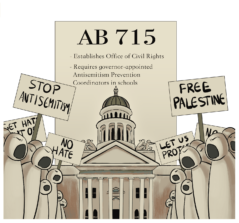
On Jan. 29, the White House released Executive Order 14188, calling for the government to “vigorously” fight antisemitism with all of its legal power, and to review all college court cases relating to antisemitism after Oct. 7, 2023, when Hamas attacked Israel. It also encouraged colleges to investigate foreign students, who the federal government can deport, and required a review of K-12 Title VI protests related to antisemitism.
Following the Oct. 7 attack, there was a 700% increase in antisemitic occurrences on college campuses from the 2022-23 to the 2023-24 academic years, according to Hillel, a Jewish student organization.
However, some feel that the college court cases relating to the Gaza protests are not truly antisemitic.
“The definition of antisemitism has gotten so distorted recently, with Oct. 7 and the starvation of Gaza,” said junior Emerson Makuta. “People perceive criticizing Israel as antisemitism when that’s not the case. [The executive order is] focusing on college campuses where a lot of pro-Palestinian protests have been happening. And that is not antisemitism. That is protest and freedom of speech, which is our constitutional right.”
Additionally, the Trump administration has slashed funding to many of the schools it believes has not complied with the executive order, including Harvard University and Columbia University.
Harvard has sued the Trump administration for cutting $2.2 billion in funding, stating that the cuts to research are unrelated to antisemitism, and thus violate the First Amendment right to freedom of speech and disobey congressional procedures to cut perceived discriminatory funding.
ABORTION
On Jan. 24, Trump released Executive Order 14182, ending the use of federal taxes to fund abortion or its promotion by overturning two of former President Joe Biden’s executive orders: Executive Order 14076, which made funding and promoting abortion a federal government effort, and Executive Order 14079, which classified abortion as healthcare, clearing the way for using federal taxes to pay for abortions.
The executive order aims to follow the directive of the Hyde Amendment, which declares that federal funds cannot be used for elective abortion and has been passed by Congress annually for almost 50 years. The order claims that despite the amendment, federal taxes have been used to pay for voluntary abortions.
In Trump’s first term as president, he appointed justices to the Supreme Court that later overturned Roe v. Wade, making terminating a pregnancy no longer a federal right. During his campaign for a second term, he said that he would leave the decision of whether to allow abortion or not up to the states.
“I can agree with protecting women under instances of rape or incest [by allowing them to get abortions], but I entirely oppose the overturning of Roe v. Wade,” Makuta said. “[Abortion] has become a federal issue due to how harshly women are being treated at a state level, and it’s the federal government’s job to protect citizens when they see states rights infringing on their civil rights of bodily autonomy. The imposing of the Hyde Amendment is extending the oppression of women under health care within individual states.”
In California, Medi-Cal, which provides health services for low-income residents, covers the cost of medical abortions.
BIRTHRIGHT CITIZENSHIP
Another one of Trump’s orders, signed on Jan. 25, prevents people born to undocumented or “unlawfully present” parents from being issued “documents recognizing United States citizenship.”
The Fourteenth Amendment of the Constitution states that “All persons born or naturalized in the United States, and subject to the jurisdiction thereof, are citizens of the United States,” and that “No State shall make or enforce any law which shall abridge the privileges or immunities of citizens of the United States.”
Several lawsuits have been filed arguing that Trump’s order is unconstitutional, since the president does not have the authority to change or ignore the constitution; an amendment would have to be passed by a two-thirds majority in Congress and by the states.
The Supreme court is set to hear arguments about the order on May 15.