Reporting by Gemma Albertson and Reika Lam
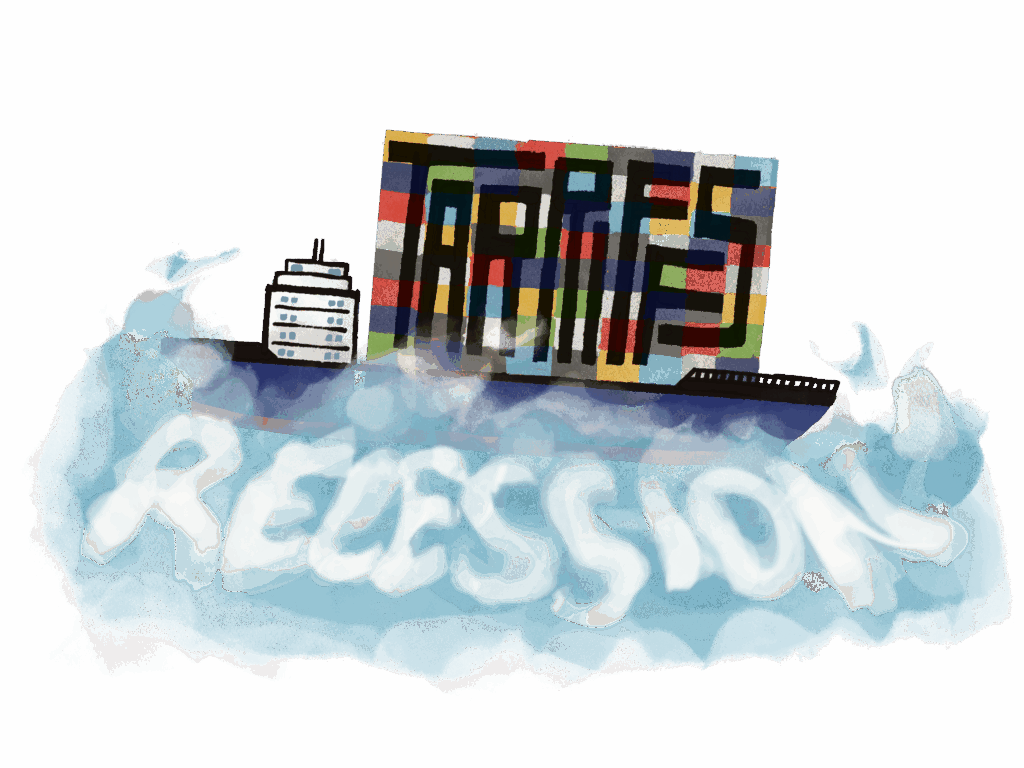
Following the 90-day pause of tariffs on April 9, the probability of a recession hovers around 45% according to Goldman Sachs. While the future of a recession is statistically becoming less likely, there are still high concerns amongst citizens regarding a possible recession. On April 5, just before the 90-day pause, President Donald Trump set a 10% baseline tariff on all imports, with a significantly higher combined tariff rate of 145% on goods from China. These new tariff policies are disrupting trade, the stock market, prices and the overall economic stability of the U.S.
“I don’t like the tariffs, I think they’re not smart for the kind of goals he has,” said junior Matthew Hagedorn. “There’s a reason why we don’t have a lot of the manufacturing he’s looking to bring back in the US, and that’s just simple economics. It’s cheaper to produce stuff overseas, so it allows people in the US to get cheaper goods. So overall, globalization allows for that developed world that we enjoy today.”
Trump brushed off worries regarding these tariffs during an April 30 statement, likening the issue to a matter of children getting “two dolls instead of thirty,” despite millions of Americans expressing fear over the possibility of a sharp increase in prices. These fears are not unfounded; tariffs pose taxes on imports, and under the Trump administration, the U.S. now faces increased costs for countless everyday products. While an increase in tariffs doesn’t necessarily mean a recession is imminent, they can contribute to economic uncertainty.
Past historical instances of recession can serve as warning signs, or even indicators, for the future.
“When there’s certainty, people are going to have jobs,” said Financial Literacy teacher Kevin Nelson. “They have earning, they have spending [and] then they’re confident. When uncertainty comes into the realm … that pushes us the other direction.”
Looking at the recession during the early 1970s, for example, an oil embargo served as a main contributor to economic decline due to the U.S. reliance on imported oil. That reliance remains: recent data from the U.S. Energy Information Administration stated that, as of 2023, the U.S. imported 8.51 million barrels of petroleum per day. Tariffs placed on this oil discourage citizens from purchasing foreign oil and discourage foreign sellers from working with the American market. Petroleum is used constantly in daily life, and if that supply is cut, the lives of Americans may be severely limited.
Recession indicators can also be seen in citizens’ diets. As the cost of eating out becomes unsustainable, citizens start stocking up on comfort food for the home. While some of these comfort foods may include staples for home cooking, the majority of Americans flock to what is cheap, accessible and tasty on a budget; things like macaroni and cheese, canned chili, peanut butter and even SPAM. A study from the National Library of Medicine reported that, among Minnesota parents, 39% reported food insecurity at the end of the Great Recession and were two to four times more likely to have barriers preventing them from accessing produce. So, as a recession begins and Americans across the nation become more and more conscious of their spending, citizens will likely choose the less healthy option, as opposed to the perishable, almost twice as expensive fruits and vegetables.
Trump’s widespread tariffs may also cause a decline in Americans’ health. While the nation has a prominent agricultural force, the U.S. Department of Agriculture reported that, as of 2021, 60% of America’s fresh fruits and 40% of America’s fresh vegetables were imported. The majority of U.S. produce comes from Mexico, which has been spared from tariffs due to the previous free-trade agreement, the U.S.-Mexico-Canada Agreement. Additionally, with Trump already breaking multiple free-trade agreements and even going as far as to promise tariffs on Mexico and Canada, which fall under the USMCA trade deal Trump himself implemented and campaigned upon, confidence is low.
But, more importantly, U.S. stock indexes have experienced extreme volatility following Trump’s inauguration, with the market losing around $11 trillion as of early April. Changes like these in the stock market affect many investment plans and accounts that people hold and rely on.
“For people that are [at the end of their working career], they watched their entire 401(k)s crash the other day,” Nelson said. “If that’s what they’re retiring on, or if that’s what parents are sending kids to college on, then that is a major distraction from their lives, and they didn’t plan on it.”
The impacts of a recession may also affect different groups, as inflation takes a larger toll on those with a lower income.
“We’re in the shadow of Silicon Valley, but that doesn’t mean that everybody across the board is,” Nelson said. “Recessions like inflation aren’t fair. They don’t treat everybody equally. Wealthy folks can navigate both of those storms fairly well; it’s the folks that are on the fringes of those areas that are going to [be] hit the hardest.”
According to the U.S. Bureau of Labor Statistics, households in the lowest income quintile spend over 80% of their income on essentials like food, housing, transportation and healthcare, in contrast to higher-income households, which allocate a smaller percentage of their earnings to basic necessities and have diversified investment portfolios and assets which tend to recover in value once the economy stabilizes.
When looking at the Great Recession, one finds that over half of all families in America lost 25% of their wealth, while one in four lost 75%. These larger losses were primarily concentrated to lower income, less educated or minority households. Furthermore, these losses extended in 2011, two years after the Great Recession tentatively ended, thus further slowing families’ returns to normalcy. While programs at the time attempted to offer some sense of aid, such as food stamps and Temporary Assistance for Needy Families, low government budgets prevented these from having the impacts needed to keep families afloat.
There’s also the high cost of college, with the price doubling in the 21st century. The average collective cost is $38,270 including tuition, books, other supplies and living expenses. Although, given that Trump has changed the Department of Education, there has been a reduction of student opportunities, services and educational benefits considering higher education. This has caused college revenues to be affected, forcing colleges that are losing revenue to either raise their tuition cost or cut their own expenses.
“This year, people are going to start to have less of an interest in college,” said senior Calvin Hong. “People aren’t [able] to spend money on college, so, what do they turn to? They turn to federal scholarships and grants and stuff, but [Trump’s] also cutting those.”
Research from the Federal Reserve also shows that during recession, job losses are more concentrated among workers in lower-wage service industries such as retail, food services and hospitality.
“A recession is not great when you’re trying to get a job,” said junior Matt Hagedorn. “Some careers are more defensive than others, so if you really want to play the game, you can even try to tailor what your major, [or] degree is going to be for those recession and defensive jobs. But I don’t think that’s very realistic.”
While prices may be currently skyrocketing, it may not be too late to prevent a recession. Trump himself seems to recognize the harm his current tariffs are causing, with his administration taking steps towards rolling back on their intensity. Trump has reported that trade deals with the United Kingdom are just the beginning, while Treasury Secretary Scott Bessent attests to great progress being made in reducing the initial 145% taxes on China. These changes did not come soon enough, however, as companies are still concerned about what tariffs may mean for consumer demand, according to CNBC.
In the case that a recession is imminent, there are a number of actions that people can take in order to prepare.
“The best thing that high schoolers can do, or people in general, is just to stay up to date with economic indicators,” Hagedorn said. “Vote for politicians who are going to push the right policies that you want to see [as] that’s the best impact we can have.”
With his approval ratings having gone down from 52% on Jan. 27 to 44% as of May 11, along with the rise of concern among the public about recession, a recent poll has suggested that one in four voters were either regretful for voting Trump, or disappointed in his performance as president so far.
“The president has stated that this is a new economic platform, and to trust him,” Nelson said. “If he’s successful, he will gain a lot of political capital and be able to have a lot of established success. And if not, there’s a lot of explaining to do.”
Luckily, the stock market has been able to make somewhat of a recovery as of May 2. With the market closing on that Friday, signaling the end of a trading period, the index saw their longest winning streak in the last 20 years.