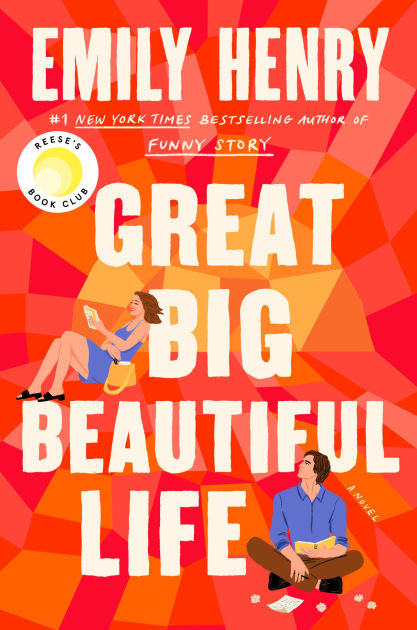
Courtesy of Penguin Random House
Imagine spending over two endless months searching for a famously secretive widow, Margaret Ives, to interview her, find her, manage to set up a time to meet up and maybe even landing the job … only to realize there’s competition against an acclaimed and award-winning author for the exact same position.
This is the exact situation Alice Scott, the protagonist of Emily Henry’s newest release “Great
Big Beautiful Life,” finds herself in. Emily Henry, a giant in the romantic comedy genre, is no stranger to hit books, such as the romcoms “People We Meet on Vacation” and “Beach Read.” Both have sold over 2 million copies since their releases in 2021 and 2020, respectively, following unique characters and love stories.
Her newest release follows Scott, a social butterfly and journalist hoping to write a biography of the elusive Ives. She’s hopeful to get the job, but is deterred when she realizes she has competition: Henry Anderson, a Pulitzer Prize-winning writer who stuns Scott in more ways than one.
The storyline is well presented and has a decent balance of romance, side plot and pacing. The journalistic
and storytelling aspects feel natural and realistic, and the introduction of the famed widow doesn’t feel forced or awkward to read about.
“The pacing of this book was pretty good,” said sophomore Aubrey Leao. “There were one or two times
where I felt [events] just happened, but for the most part, Emily’s writing makes sense, and she doesn’t leave out anything important or focus too much on details. That’s something I really liked about her writing in this book particularly.”
From the beginning of the book, readers understand how important Scott’s job is to her. One of the first scenes is the journalist introducing herself to Ives after months of searching for her. By beginning with an investigative side of the story, Henry fleshes out Scott as her own person, rather than just a flimsy, personality-less main character who only serves a romantic purpose.
Moreover, Henry’s decision to include a secondary storyline that focuses on Ives sets “Great Big Beautiful
Life” apart from traditional romantic comedy books by highlighting not just the relationship between the
two love interests, but also broader interpersonal connections and the difficulties of differentiating between truths and lies.
As more is explained about Ives’ family and lies told by paparazzi and magazines are dispelled, the audience understands Henry’s ideas on how fame, egos and betrayal affect family relations.
Lies are maintained for years and grudges are never resolved, and even though the Ives seem perfect,
Scott’s interviews show how emotionally broken and complex each family member is. Henry dives into how an individual’s upbringing affects their parenting style and discusses the never-ending cycle of generational trauma.
Henry’s creativity is undeniable, but due to the contrast of both topics, at times, it does feel like two different story ideas were simply combined into one. The transition between interviews with Margaret and developing the romance between the main characters can feel abrupt or random at times, again affecting the realism and overall flow of the book.
“[The Ives side plot] wasn’t something I wanted to keep reading, [but] it’s different [from] how other stories are written,” Leao said. “That’s what makes it nice, but at the same time, that also makes me disinterested, because it’s not what I’m used to.”
Additionally, the beginning of the romance aspect felt a bit rushed and the initial character development seemed too fast. The male romantic interest, Anderson, was introduced as a stoic and serious person, yet dropped this stern attitude after about two days, interrupting the realism of the book.
Evidently, Henry’s newest release strays from the typical structure of a romance novel. This choice is rather double-edged — it draws in more fans, but also takes away from the central romance. However, overall, this new experimentation allows Henry to explore larger themes and different styles of writing, which is admirable. Though the execution can be shaky at some points, the overall plot keeps readers intrigued and curious, earning it a four stars out of five stars for its creativity and unique premise.