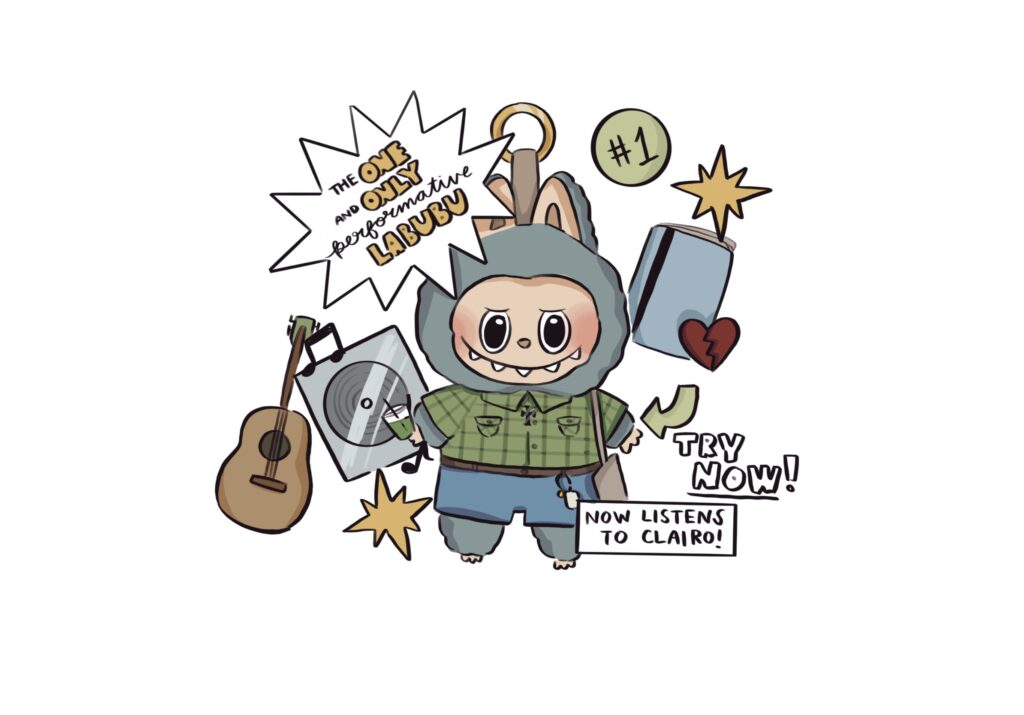
He’s seen leaving the cafe with his oat milk matcha in one hand and “Becoming” by Michelle Obama in the other, his wired headphones blasting Clairo and his white tote bag decorated with Labubus and filled with tampons. Though these little trinkets may be seen as caricatures, they are actually one of the many props that dozens of guys use to win their local Performative Male contest.
The concept of “performative male” has recently gone viral, gaining as many as 28 million views for videos tagged #performativemale on TikTok. There are even contests around the world, in cities like Seattle, New York City, San Francisco and Jakarta where contestants compete and are judged to see who follows the stereotype the best, with San Francisco’s contest having more than 900 RSVPs.
This rise in popularity was largely impacted by overconsumption and trend-hopping among Gen Zs. Adorned with Labubus or the need for matcha 24/7, these “performative males” are a product of the internet.
“[The trend of ‘performative male’] didn’t start serious, it was definitely a bit more [satirical], and it got mixed into consumerism,” said senior Hayden Ha. “A lot of Asian cultures have been drinking matcha for centuries. But now that it’s become this big thing, … a lot of people are treating it as a trend.”
As a result, this culture around curating a more likeable image to appeal to women is mocked across the internet.
“[The mockery is because of] the whole idea of guys who wanted to pull [people] and then [those guys] ended up going way too far,” said junior Anjalika Khare. “People are going to make fun of the extremes in any case, that’s why satire exists … I got a video today [about a] performative male competition … You had a guy holding five Laufey vinyls, a guy reading feminist literature and a guy passing around pads … If you’re doing it in [a] way for no actual benefit, it’s kind of annoying. But also, I also get the satire [and] how it’s funny. People will laugh at it. I laugh at it.”
In addition to the mockery, women on TikTok have taken to making videos about their experiences of dating a “performative man.” They’re described to use women’s interests as a tool of attraction, granting them the title “male manipulator.”
“There’s a fundamental wrong in trying to get into somebody’s interests in such a superficial way; just to try to pursue them, even if they don’t really like you that way,” Khare said. “If you put it in a literal [and] non satirical sense, it’s literally just a guy who manipulates you.”
Even when dressed up as respect, the performative male behavior stems from the desire to receive validation from women.
“When you see men actually caring about feminist literature, or just feminism in general, even if it’s out of a trend or a joke … it’s like, ‘oh, that person is not only a feminist, but they support other aspects that come with being a female,’” said junior Aveah Pok. “To me, that just makes someone more attractive.”
Previously, alpha males were a common trope online, but following changes in ideas about masculinity, the performative male stereotype is now the primary target of satire.
“[There’s] been a trend lately that women prefer softer and more emotionally open men,” said junior Perlina Tse. “Sometimes people get scared of [gym bros, because] they’re trying to act tough, but now, I hear a lot of women talking about liking a man that understands them more and [having] someone more sentimental.”
Although the different “performative males” across time have always striven to receive affection from women, the expectation and standard is often misunderstood.
“I love matcha … [and] I love talking to people about it,” Tse said. “I was asking [this guy], ‘do you like matcha?’ and he’s like, ‘yes.’ … [The] only thing we were talking about is what I like, and he just copied [me], which is not what I want … We want someone that’s … different, but at the same time, people think that being performative is different.”
While the satirical roots of being “performative” are an attempt to call out those who only enjoy things like Labubus and artists like Clairo because they’re popular, many meaningful causes such as men supporting feminism have been diluted as a result. The criticism they receive about these stereotypes is disguised through humor to be light-hearted, but it’s a form of aggression to enforce the traditional norms of toxic masculinity.
“If men feel shameful about supporting feminism and feminist literature, [it] just draws people back to the traditional way of thinking, where men have to be men and be strong,” Pok said. “That takes away from modern society [to] be open to all different types of people.”
Furthermore, it affects the larger concept of gender equality.
“[Performative males] read feminist books, so that women think they’re more approachable,” Ha said. “It’s like a booby trap. [It] undermines the actual message that feminism is actually important.”
Ultimately, the rise of the “performative male” follows a tradition of men being being satarized for their gender expressions. As time goes on, the name “performative” and its stereotype might change, but the prevalence of the topics brought by these concepts will always prevail.