Eva Ludwig
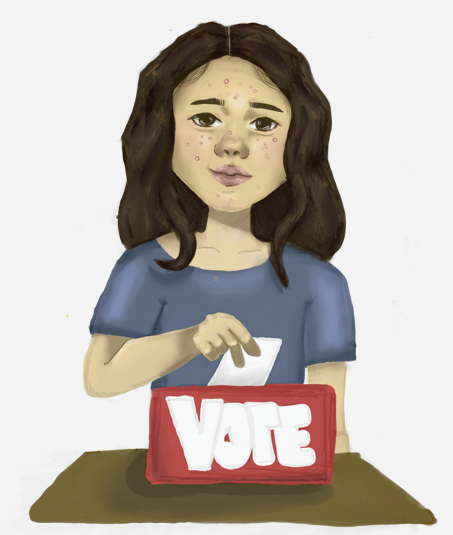
Every 16- and 17-year-old should have the right to vote in local and school board elections in San Mateo. They should get a say in the things that directly affect them.
In July, the United Kingdom introduced legislation that would allow 16- and 17-year-olds to vote in the country’s next general election. Scotland and Wales already allow younger people to vote in local elections, and this legislation would follow numerous countries, including Austria, Brazil, Cuba, Ecuador, Greece and Indonesia, which all have lower voting ages. Many United States’ states — including California — allow 17-year-olds to vote in primary elections if they will be 18 by the general election. Further, many cities in the United States allow 16-year-olds to vote in local or school board elections, including Oakland and Berkeley. In 2024, a ballot measure passed in Albany, California lowered the voting age to 16 for municipal and school board elections.
Studies have indicated that lowering voting ages greatly increases voter turnout. For example, The National Institutes of health found that in Austria, lowering the voting age increased the “first-time voting boost” when the people who have just been given the right to vote come out in large numbers. A similar study from The University of Edinburgh found that voter turnout was higher among 16- and 17-year-olds in Scotland when they were given the right to vote.
Many 16- and 17-year-olds are already working, taking care of their family members, running businesses, doing internships and taking on all sorts of adult-level responsibilities. In “2011, people under 18 paid over $730 million in income tax alone,” according to the National Youth Rights Association. Yet, they were given no representation in the way that money was spent; despite taxation without representation being such an important principle in the U.S., we ignore that key idea when it comes to youth voting.
Younger people are also often treated as adults in other ways. There are thousands of people under the age of 18 who are tried in court as adults in the U.S. every year. Thousands end up in adult prisons and jail, according to the Office of Juvenile Justice and Delinquency Prevention.
We expect young people to know right from wrong. We expect them to be able to navigate and handle the adult legal and prison systems. And yet, we refuse to give them a say in the system that has persecuted them.
School board members should have the primary goal of creating an educational system that is best for students, similar to how government officials should have the primary goal of benefiting the place they oversee to best help citizens. However, while citizens are able to select a candidate they feel is best for them, students are not given the same choice. A democratic political system is designed to allow voters to hold those in office accountable for continuing to help them. Yet, school boards are not being held up to the same standard by those they represent — creating a situation where officials are not receiving crucial, direct feedback from students. If an adult with no children in school can vote in their local school board’s elections, why can’t a student of that district — who is being affected the most by the outcome — have that same right? Why can they not hold their officials accountable?
Still, many believe that young people are just not as competent. They have a lesser understanding of the issues they would be voting on, and are not able to grasp the real impact their decision might have.
But the same goes for adults. Tests for competence in voting — like literacy tests in the Jim Crow era — have always been used to discriminate against certain groups, and they have been stopped for that reason. Why should such discrimination be allowed to continue against the younger population? Any attempt to justify incompetency as a reason for preventing youth voting opens a whole world of injustice that it has taken almost a century for the U.S. to get past.
Many young people are also incredibly politically informed, and care about political issues more than some adults. According to Pew Research Center, 30% of U.S. adults ages 18-29 participated in some form of climate activism in 2023, compared to just 16% of adults ages 50-64. Youth climate protests are increasingly common and are a demonstration of the active interest of youth to be engaged in making political decisions to better our world.
“A lot of bills will affect us,” junior Annie Donnellan said. “Especially when we’re voting for leaders who have [a say] in bills affecting climate change. That will affect us and our future more than it will [anyone] else. We’re going to be on this planet longer, so we should have a say [in] what’s happening.”
Still, many also argue that giving younger people the right to vote would only give more votes to their families. They are likely to feel the pressure of their parents and communities to vote a certain way, placing an unnecessary burden on youth.
But again, the same thing goes for adults. An adult may feel some level of pressure from their spouse, families or communities to vote a certain way. That pressure may result in them making a decision they would not have otherwise made. Voting pressure is a systematic issue that must be reformed, but lowering the voting age does not affect it in any way.
Instead, lowering the voting age for local elections will give younger people a real say and encourage them to continue being politically informed, making longer-term voters who make use of their right.