Mi Nguyen
On Aug. 28, Jim O’Neill, a Silicon Valley investor and top deputy undersecretary of Robert Fitzgerald Kennedy Jr., Secretary of the Department of Health and Human Services, was appointed as the Center for Disease Control and Prevention’s new director.
The original nominee to be director of the CDC, Dave Weldon, a doctor from Florida, was withdrawn in Nov. due to not being expected to receive enough votes in the Senate to approve his position. Weldon was unpopular because of his belief in conspiracy theories about vaccines, beliefs that O’Neill shares.
Following Weldon’s withdrawal, the CDC operated without an official leader for months, until acting director Susan Monarez, a microbiologist and immunologist who has previously been the director of the Advanced Research Projects Agency for Health, was approved.
Less than a month after beginning her position, Monarez was fired, sparking a legal battle between Monarez and the White House. Lawyers for Monarez stated she refused “to rubber-stamp unscientific, reckless directives” during her time as director, leading the White House to respond, saying they fired her because she was “not aligned with the president’s agenda.”
O’Neill has history with Silicon Valley investments, the most prominent being his position as CEO at the Thiel foundation, where he cofounded the Thiel Fellowship, offering $200,000 to entrepreneurs willing to stay out of school. The Thiel Foundation was founded by major Republican donor Peter Thiel.
During the George W. Bush administration, O’Neill wrote speeches for the Department of Health and Human Services, contributing to changes in food regulation services and emergency responses. However, he does not have any medical background, which some find concerning. CDC directors typically have a medical degree.
“[He’s] somebody who has more of a political background, [who] is more invested [in] private sector perspectives and had positions in life that seemed more leaning towards profiting from health, as opposed to consistently being an advocate for public health,” said Malak Elshafei, a medical student at the University of Michigan who discussed her personal opinions without them being affiliated with the institution. “[This] makes me [wonder] what [his] ultimate goals for the CDC [are] and how [he is] going to to the demands of the Trump administration or Kennedy.”
O’Neill has promoted many conspiracy theories, like his statement that COVID-19’s name was selected to hide the origin of the disease, on X. During the pandemic, he endorsed unbacked solutions to COVID-19, like vitamin D as a means of preventing the virus.
The recent months have consisted of sweeping changes in CDC, including Kennedy’s decision to replace the 17-member Advisory Panel on Immunization Practices and mass layoffs.
“[He’s replacing professionals] with [his] little entourage of people,” said senior Gerardo
Padilla. “It’s gonna cause a mass disruption because … there’s a new committee [who will] be doing his bidding … You’ve brought in a whole new committee of people that are now going to be representing ideas [about] vaccines that haven’t been backed by any sort of medical research [or] evidence. When you do that, the whole point of preventative care is going to be erased, and it’s going to lead to more of these outbreaks and diseases [and] make accessing these services even harder for people.”
The Trump administration has cut funding for several public health institutions, causing many to worry about the future of medical research.
“I have a background in global health, and they shuttered funding for the United States Agency of International Development, [which] worked closely with the CDC … to try and research infectious diseases that are going to pop up and become potentially the next [COVID-19],” Elshafei said. “Now [that] USAID has closed and [the] CDC has changed radically in leadership, I’m concerned they’re not investing enough resources and exploring potential pandemics that are going to pop up.”
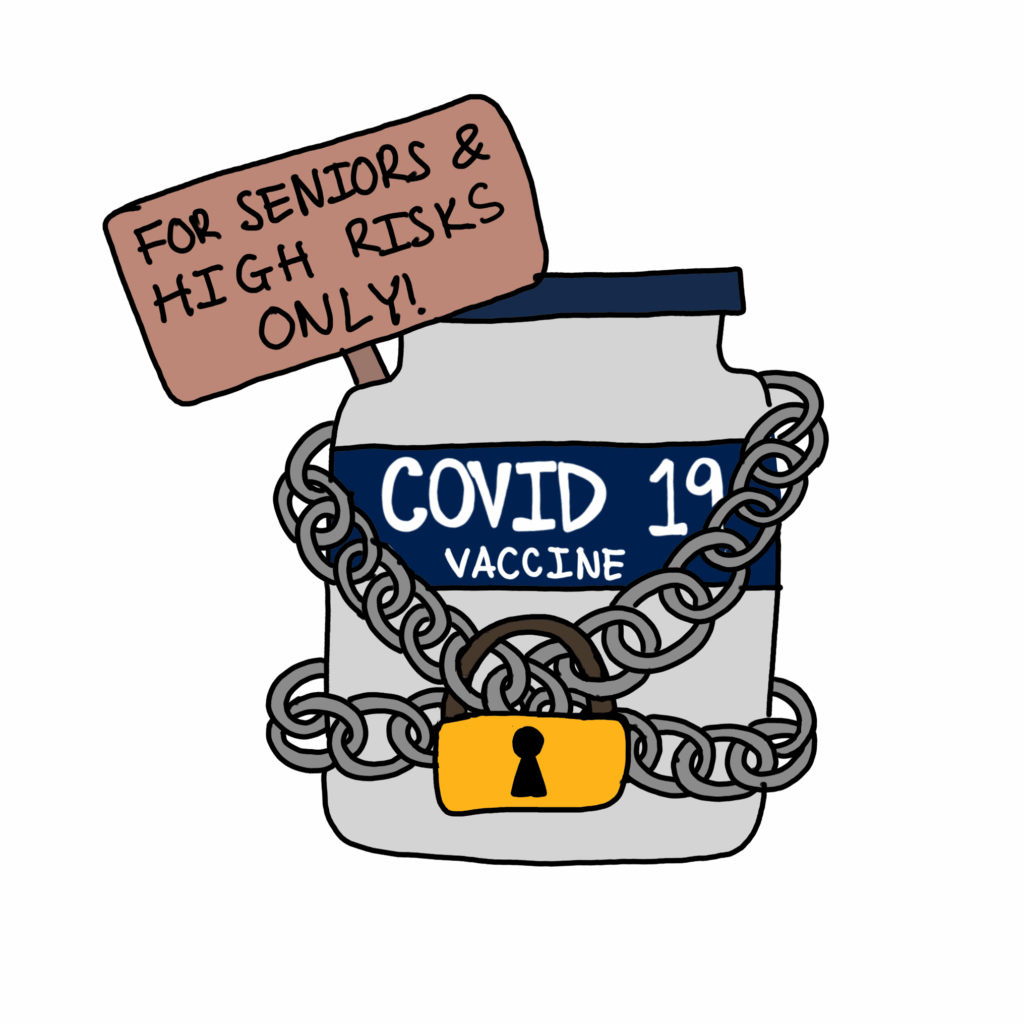
Another major change is that the majority of COVID-19 vaccines are now lied to those considered to be at “high risk” and over 65. Although the CDC listed “high risk” conditions, including pregnancy, on their website, Kennedy stated that pregnant women will not be recommended for the vaccine. On Oct. 6, the CDC removed recommendations that all Americans should receive the COVID-19 vaccine from their website.
“It is going to affect the disabled community negatively because a bunch of disabilities might not be on the list [that classifies someone as] high-risk,” said junior Lia Alves. “Some people might be in greater danger [than others], but [COVID-19 vaccines] should still be accessible to everybody.”
California implemented its own recommendations in addition to the CDC’s, including calling for all children from 6 to 23 months, at risk from age 2 to 18 or who have never been vaccinated against COVID-19, all pregnant women and all children and adults who choose protection to receive the vaccine.
The guidance could have implications for the states.
“[The CDC’s guidance] scares me a lot,” said senior Dahlia Anapolsky. “For example, [in] Massachusetts, people still aren’t able to go to places like Walgreens or CVS, where they would normally be able to make an appointment, go for free [and] get their vaccination, it’s not possible. [O’Neill’s] overlooking a lot of scientific truths that scientists and researchers and people that are in that field have found for decades.”
As O’Neill settles into his new position, changes in the CDC continue.