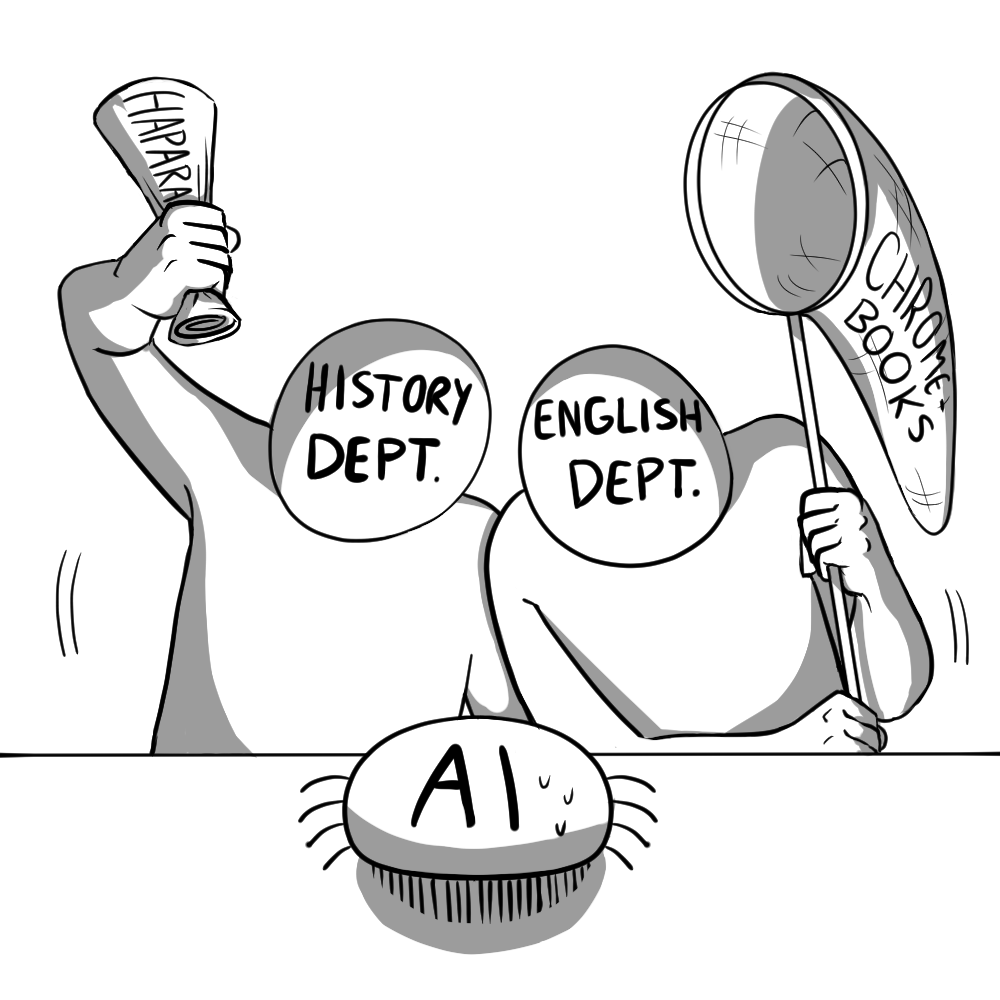
In the first few weeks of school, Aragon students learned about the new artificial intelligence policy changes in the English and History departments. Most teachers of these subjects decided to mandate school-issued Chromebooks in their classrooms to reduce students’ use of AI. This allows them to deploy Hāpara Highlights on each student’s computer. Hāpara allows teachers to view students’ browsers in real time to ensure students are on task and not on AI websites, for school assignments.
Some students have conflicting opinions on this tool and about the new policies.
“I understand the mandated Chromebooks for timed writes or tests,” said junior Sofia Johari. “But for basic assignments in class, [it’s not] necessary because those are the same [ones] we do at home.”
Even for assignments set aside as homework, students have noticed a difference in what teachers say to them regarding academic dishonesty.
“Sometimes, when you don’t finish [classwork], you have to finish at home,” said sophomore Rafaella Eloi. “[Teachers are] okay with it, but they always ask [students not to] use AI.”
In many classes, smaller assignments are being employed to prepare students for major exams.
“If you’re cheating on the assignments [that aren’t] worth that much of your grade, all you’re doing is really cheating yourself out of the experience of learning,” Johari said.
Teachers see these policies as a necessary step in preventing AI misusage, which is becoming an increasingly prevalent issue.
“A majority of my English colleagues reported at least one incidence of plagiarism or AI use [in the past year],” said Victoria Daniel, Advanced Placement English Language and Composition teacher.
Aragon students have also noticed increased AI usage by their classmates.
“Last year, I would sometimes see other students [misusing] AI,” said junior Lam Le. “AI has many purposes with helping students study and doing small tasks, but there are also some misuses that might endanger their learning and capabilities.“
This trend in AI usage by students is not limited to Aragon. Across the world, there has been a dramatic increase in students who are using AI to cheat. According to an article by AIPRM, 53% of students in higher education used AI to generate material for graded work in 2024. This type of behavior contributes to the growing environment of academic dishonesty.
“Using generative AI to create work, to submit work, to enhance their work [and] to get answers to things [is] getting in the way of [students] doing the thinking that we want them to do to be able to get to a final product,” said AP Psychology teacher Giancarlo Corti.
When students rely on AI to complete assignments, teachers are unable to reliably assess an individual student’s understanding. According to a published research article on Science Direct, “in two experimental studies, … novice and experienced teachers could not identify texts generated by ChatGPT among student-written texts.” Without reliably being able to identify AI usage and therefore test for understanding, students may lose valuable learning opportunities.
“[AI gives] you answers [even when] you can use your own mind and [it] can take away your thinking,” said sophomore Brianna Abernathy.
As the year continues, teachers may continue to adjust and change these policies to adapt to the quickly-changing educational landscape AI is creating.