Imagine a city in the United States, uniting with another city halfway across the globe. That is the idea behind sister cities — a relationship that encourages cultural exchange and diplomatic involvement.
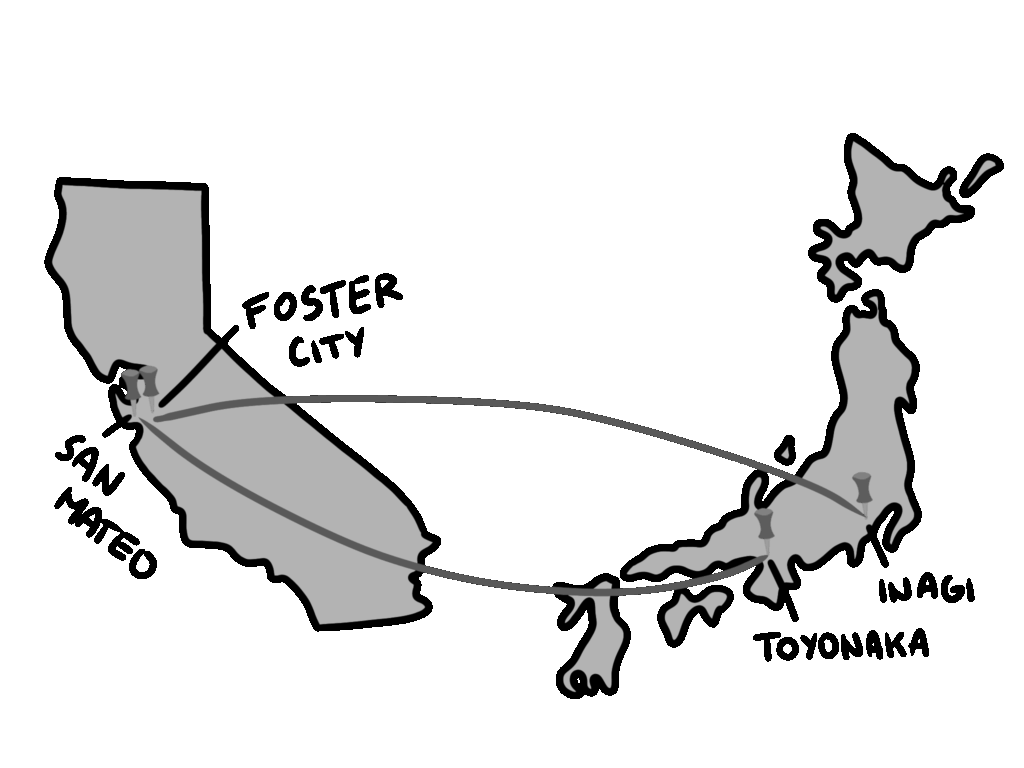
The sister cities program began after World War II, when President Dwight D. Eisenhower had the idea of having people in the U.S. interact with those from different countries, in an effort to increase mutual understanding and prevent future conflicts. Such programs include Foster City’s partnership with Inagi, Japan, which formally began during the pandemic.
”You want to align with cities that have principles the same as yours,” said David Saito, president of Foster City Sister City Association. “Between Foster City and Inagi City, there was a very big focus not only on youth activities and sports, but [also] on things like sustainability and building sustainable communities.”
Thus, most of Foster City’s exchange programs with Inagi City focus on youth interaction. Such events include a youth soccer and baseball exchange that occurred in the summers of 2023 and 2024, a pen pal program and a homestay program in August.
San Mateo also embraced the idea of sister cities early on, forming a relationship with Toyonaka, Japan in 1963. An exchange between Borel Middle School and Dai-Kyu Junior High School in Toyonaka began in 2012 with video chats and transitioned to a pen pal program. Helen Grotans, the orchestra director at Borel Middle School, has led this program for over seven years. She receives up to 100 handwritten letters each year, matches students by grade and interest, and then sends the replies back.
”One of the best things is the gift-giving culture,” Grotans said. “Every time we get a package, there’s some cool gifts inside [like] Japanese candy or stationary or stickers … and then we try to send back some special things from California.”
Yet in real life interactions, the most apparent challenge is the language barrier. In an attempt to overcome this hurdle, music was incorporated into the program. In 2015, students from Borel travelled to Toyonaka and performed music together, and the schools continue to share their orchestra performances online today.
“We weren’t very good at Japanese … but when we played music together, we could communicate,” Grotans said.
The Foster City Sister City Association is also starting talks with the Bay Area Youth Choir and Orchestra about having a music exchange program.
Furthermore, it is vital to have a close-working relationship with the local city governments, as the governments provide both financial and logistical support when hosting events. Differing time zones, school calendars and Japan’s system of rotating teachers each year present challenges for the program. And although technology has made international communication easier than ever, Grotans believes that communicating online was still more difficult due to the differing time zones.
“We used to do a Zoom … [but] we would have to wait until 4 p.m. after school [so] that it would be 8 a.m. on Friday in Japan, and so students would have to stay late,” Grotans said. “In letter writing you have more time to think [of] your questions and your responses … it’s just a more relaxed, old fashioned form of communication.”
Additionally, Saito believes that real understanding comes from face-to-face interactions.
“Nothing really replaces the ability to do an in-person exchange,” Saito said. “I think it opened [the kids’] eyes to just what these programs can help do … even if it’s just a bunch of kids playing soccer.”
Whether it’s a new partnership like that of Foster City and Inagi’s, or a long-standing one like between San Mateo and Toyonaka, sister cities are a reminder that diplomacy can also happen with ordinary students and citizens. Sometimes, writing a letter or having a soccer match is the best way to connect with people halfway across the world.