
Child care provider Angelica Lopez was one of two adults supervising a room of elementary school students at Brewer Island Elementary School in Foster City in an afterschool program during 2017 when she got called outside to help a kindergartener who was bleeding because he had tripped and cut his forehead.
“I had to leave my kids [inside], have [another] staff member [who was outside] put everyone into a room and then I ran out to give first aid,” Lopez said. “It was really challenging to do everything and watch 60 kids and an injured child that needed emergency help.”
In the years leading up to this incident, the child care program that Lopez worked for was forced to reduce student enrollment because it could not hire enough workers.
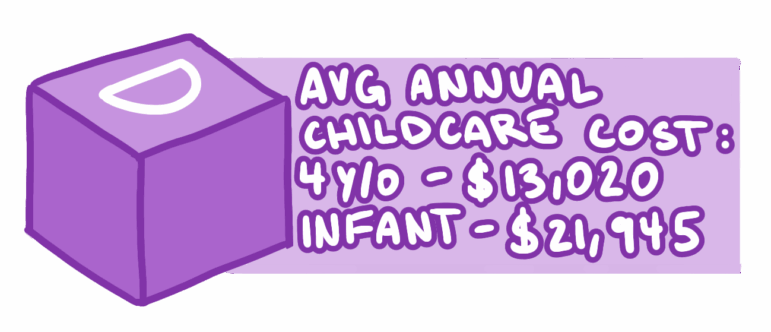
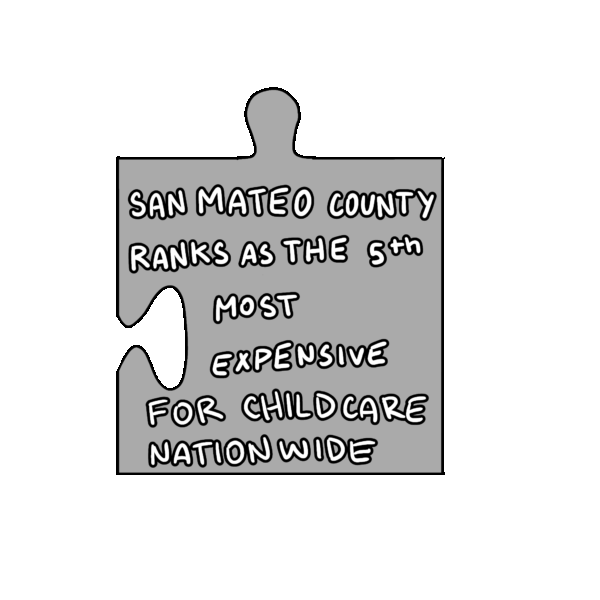
Staffing shortages like what Lopez’s workplace dealt with are just one aspect of the child care crisis — this issue impacts parents as well. In California specifically, the average annual cost for child care of a four-year-old is $13,020, and almost $9,000 more for infants, according to the Economic Policy Institute. San Mateo County is the fifth most expensive county for child care in the nation, according to data compiled by the Wall Street Journal. And child care prices, like many other expenses, are rising. A Pew Research report found that between January 2020 and September 2024, the cost of daycare and preschool went up 22% nationally.
These factors have led Jackie Speier and Lisa Gauthier, San Mateo County Supervisors, to hold town halls during this fall to hear about community members’ experiences with child care and solutions they want to see.
“[Child care] is infrastructure just like our roads and our bridges,” Speier said. “We have an obligation to do more than we’re doing.”
Many parents highlight the necessity of improving the child care landscape with their experiences.
Chemistry teacher Max von Euw has an 8-year-old son who goes to an on-site child care program at his school in the mornings and afternoons. Von Euw said that the company recently raised tuition by 34% and removed a discount he got in previous years. While he knew prices were going to increase, he did not expect such drastic changes.
“It feels like you get blindsided,” von Euw said. “You kind of have this jaw-drop moment… [and] you’re in a scramble.”
Machi Marinenkov, a student at the College of San Mateo, has an 8-year-old daughter, Robbin, to whom she used to be a single mother. For several years, starting when Robbin was 3, Marinenkov said she worked nearly 120 hours a week to afford her financial responsibilities, including child care. She was able to get government assistance for single parents that reduced her contribution to tuition to a few hundred dollars each month, but it was still sometimes hard for her to bear the cost on top of other bills like the costs associated with moving houses.
“I had a lot of things to pay for. I would borrow from my friends sometimes or I would go to the Mom’s Facebook group,” Marinenkov said. “I’ve done everything. I’ve edited photos for invitations. Anything that I could do for money at the time, I was doing. I also had a side business where I was doing some wax seals for wedding invitations.”
Some families avoid the high costs of child care by forgoing it altogether. 26% of parents across the country chose to quit their jobs and become stay-at-home parents, per a 2023 report by ReadyNation.
The amount of young mothers who do not work is disproportionate to the amount of fathers. In 2019, 66.4% of mothers with kids under six years were in the workforce compared to 95% of fathers, according to the Bureau of Labor Statistics. Will Colglazier, Advanced Placement United States History teacher, explained how this can have consequences on women’s careers.
“Whether [women] take time off from work or go part time, they’re losing income there,” Colglazier said. “When they return, they’re behind their male peers who started at the same level. Largely, females are losing out on promotions, sometimes raises, because of their absence due to the need to raise kids due to childcare costs.”
Overall, the effects of high child care prices cost the economy $122 billion, according to ReadyNation.
“[Unnaffordable child care] is an early warning sign for all of us that we’re going to lose our workforce, [which] we rely on, if we don’t fix it,” Speier said. “If you can’t keep the employees in your business because they can’t afford to live here, that’s a big problem.”
So far, Speier and Gauthier have a handful of solutions that they are planning to push to become legislation.
One of them is a county-run online portal that lists all of an area’s child care providers and will allow parents to apply to multiple centers at once, rather than having to fill out different applications for each individual provider. This is intended to streamline the process of finding options for families and increase visibility of care centers, Speier said in a presentation to the Board of Supervisors.
“It’s a traumatizing experience for parents to have to try and locate child care and then be put on waiting lists and the like,” Speier said.
Another potential solution is a program called Tri-Share, where the employer, employee and county each pay for one-third of the tuition. Michigan was the first state to implement Tri-Share in 2021 and cut families’ child care costs by 10% on average. However, in Michigan’s version of the program, the household income had to be within the range of 200-325% of the federal poverty level in order to be eligible, which put the maximum around $130,000 for a family of four in 2025 dollars. The median household income in San Mateo County in 2023 was $156,000, according to Data USA.
In order for the county to fund these programs, the supervisors want to get a half cent sales tax and vehicle rental tax on the ballot in Nov. 2026. For the former, half of a cent would be added as a tax for every dollar spent in the county. According to Speier, this could generate $130 million a year. For the latter, a 1.5% tax would be charged on car rentals from San Francisco International Airport, and Speier said this could add $7.5 million to the county’s child care budget.
Lopez, who has had two kids in child care over the years, earned too much to qualify for low income subsidies but was unable to comfortably afford the cost.
“What we earn is just for our bills,” Lopez said. “So if we’d have a little bit of help, [we could] save some money, have property, because [currently] all our money goes to paying childcare and rent and making ends meet.”
If the proposed taxes are approved by voters next Nov., they would mark a significant step towards mitigating the child care crisis in the county.