Poised on an everyday basketball court, the expansive green hills and vibrant pink and blue trees behind the basket beckon the viewer into a beautiful world of nature and wonder. This image, depicted on a 42-foot wall in the San Francisco Museum of Modern Art, was painted by David Huffman, an Oakland based artist who, in his youth, found sanctuary in basketball. His piece is one of three in the museum’s “Bay Area Walls” collection, each done by local artists to honor the unique culture of the San Francisco area.
The piece, with simplistic and calming visuals, brings emphasis to the magic that can be found in everyday events and beautifully represents the impact the sport has on Huffman.
“This piece is [about] exploring basketball as an element of African American identity and culture,” Huffman said in an interview with SFMOMA. “Growing up in Berkeley, most of us African American kids were playing basketball in parks until lights out… I started thinking about the court as a portal to another place. It’s not about playing the game; it’s a leaping-off point with the backboard as your step into nature.”
Its art style resembles an adolescent’s, bringing further attention to the imaginative nature of the piece. This blend of normal life experiences with fiction honors the piece’s name, “Portals,” providing the viewer with the perspective of a passionate child who finds joy and wonder in basketball.
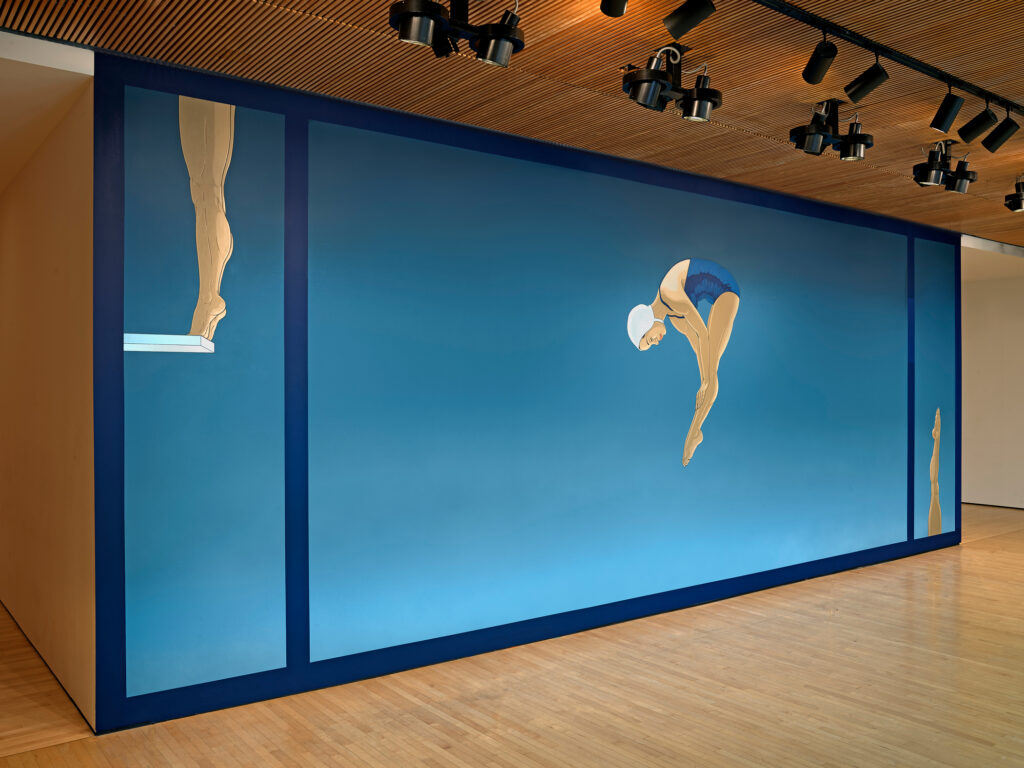
The next piece was done by Jenifer K. Wofford, a contemporary artist based in San Francisco. In her piece, “VMD,” she honors the first Asian American Olympic gold medalist, Victoria “Vicki” Manalo Draves: a Filipina American diver raised in San Francisco who trained to become a professional athlete despite navigating segregated pools.
This story resonates with viewers, bringing awareness to achievements that have been forgotten. Its simplicity and expansive layout encapsulates a sense of peace before a storm, dynamically illustrating the moments before history was made.
“[Drave was] the first Asian [American] woman to have won the gold and then a silver in another competition, which … highlight[s] [this] contribution from the Asian community,” said visitor Meredith Baker. “I didn’t know this happened in 1948, so it’s a good reminder of [our] community [from] more than 50 years ago.”
Additionally, the inclusion of this piece helps bolster the representation of female artists in mainstream museums and collections.
“I’m seeing this woman, this artist, who’s displayed the most prominently in this museum [and] it’s the thing that struck me the most,” Baker said. “[I grew] up taking some art classes in college, [and it was a common belief that] women weren’t in the arts until the 80s, and it’s obviously not true. There’s been a great representation of women artists here that I otherwise would never have known.”
The final installment of this collection exemplifies the cultural effect and importance basketball has in our hometown. “Bay Area Hoops,” created by cartoonist Gene Luen Yang, portrays three famous Bay Area basketballers: Stephen Curry, Jeremy Lin and Fran Belibi. Yang uses his classic comic book art style, connecting these athletes with three concepts unique to basketball: the three pointer, the pick and roll and the slam dunk.
Even those who don’t have a direct connection to basketball can find meaning and admire this piece for its nostalgic feel.
“I don’t know much about basketball and the history of [it] in the Bay Area … [so the style] definitely makes it more like you want to read it,” said visitor Ruben Weitzman. “It’s pretty novel to have a comic as an art piece, I’ve never seen it before.”
The collection is a lovely representation of Bay Area culture, specifically in the athletic sense. It would’ve been nice to see other aspects shown as well — like cultural food, monuments and specific places — but as the exhibit changes what pieces and artists they feature, it’s likely different artworks will be created, which may achieve this goal.
Given the exhibit’s attention to cultural details, relatability and simplistic yet creative pieces, this exhibit is deserving of five stars out of five stars. If one is near the SF MOMA, there’s no harm in stopping by to explore our local culture on a deeper level.