Waymo expanded its autonomous taxi services in July to include Burlingame, Millbrae and San Bruno. The Google-owned company has been testing their vehicles in San Mateo since 2024.
The service uses artificial intelligence to operate without a human driver.
“[Waymos are] a great advancement in technology,” said sophomore Aditya Rathore. “AI is going to improve, as we’ve seen in the last few years, and it’s better than humans in many things. And I believe the same [AI] improvements can also come to Waymo in the long term.”
Some believe that Waymos provide other benefits over conventional taxis.
“I have dogs, and Waymo doesn’t care if I bring my dogs in, whereas sometimes a Lyft or Uber driver doesn’t want you to bring dogs in their car,” said math teacher Craig Sipple. “I [also] like that Waymo doesn’t talk.”
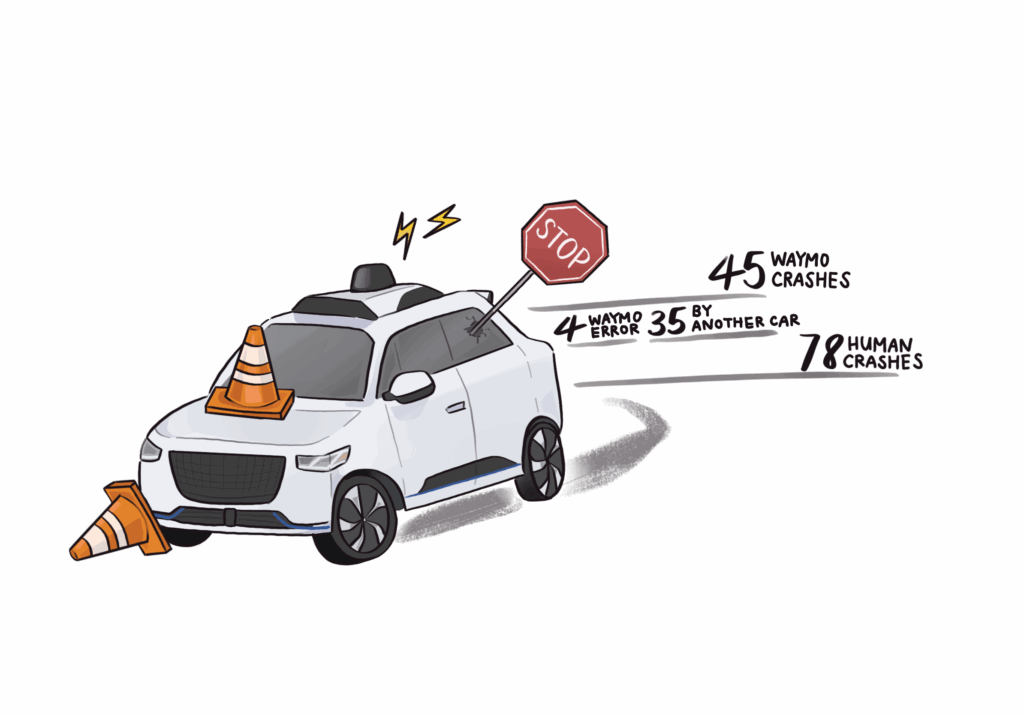
However, there have been concerns over the safety of Waymos. But according to Timonthy B. Lee on Ars Technica, over the course of six months and 96 million miles driven, Waymo was involved in 45 crashes that were reported to the National Highway Traffic Safety Administration. Of these, only four were due to the Waymo driver’s error and 35 involved the Waymo being hit by another car. Over the same distance, an average human driven fleet would be involved in 78 accidents.
There have also been concerns that Waymo’s safety statistics are not fully transparent. By law, Waymo is only required to report their severe accidents, so incidents and crashes that do not cause any injury or damage are unknown by the general public. This rule may artificially inflate Waymo’s safety rate.
Nevertheless, some believe that Waymo’s use of Light Detection and Ranging technology improves its safety significantly over competitors.
“Waymo has sensors that map out its environment through LiDAR, and Tesla’s relying solely on the camera,” Sipple said. “Tesla’s relying on a computer watching a video feed to make decisions about how to drive, whereas Waymo has … more sensors and technology on it. That’s why Waymo’s been self-driving before Tesla and getting cleared for expansion first.”
Still, Waymo’s lack of on-the-spot thinking has drawn the ire of some citizens. When reversing, for extra safety precaution, they give off high pitched beeps, even in the dead of night. A repeated issue has occurred where Waymos have stopped in the middle of the road for seemingly no reason, slowing down traffic significantly.
“If you’re comparing [it] to a crash, [slowdowns] may not seem as bad, but in the long term, it’s frustrating to deal with,” Rathore said. “You expect to get into a taxi that’s working, [so] you’re disappointed by the delay.”
When Waymos were initially introduced to San Mateo County in 2024, David Canepa, a San Mateo County supervisor, said that Waymo tried to force the county to rush the decision to approve their expansion with a one-day deadline, while also presenting little data.
“When Waymo only gives our police and fire chiefs a single day to comprehend how to deal with robot cars navigating [our] streets, there’s a problem,” Canepa said to the Redwood City Pulse. “Little notification, little transparency and little outreach has been Waymo’s strategy from the start. This is a sneaky company trying to monopolize a market that’s not for sale.”
Proponents of the Waymo expansion into San Mateo County have cited the “Vision Zero” policy in Redwood City, designed to reduce traffic accident related deaths and major injuries to zero.
Despite this, according to the San Mateo Daily Journal, traffic related accidents in Redwood City more than doubled in 2024, ranking the city third worst among all cities in California.
“The future is self-driving cars,” Sipple said. “I would compare it to the number of people that die in car accidents every year because of human error. Will there be some computer error? Sure, but I think in the end, it’ll be less than human error.”
In Jan. 2026, Waymo plans to expand its fleet to New York City and Nashville.