Eva Ludwig
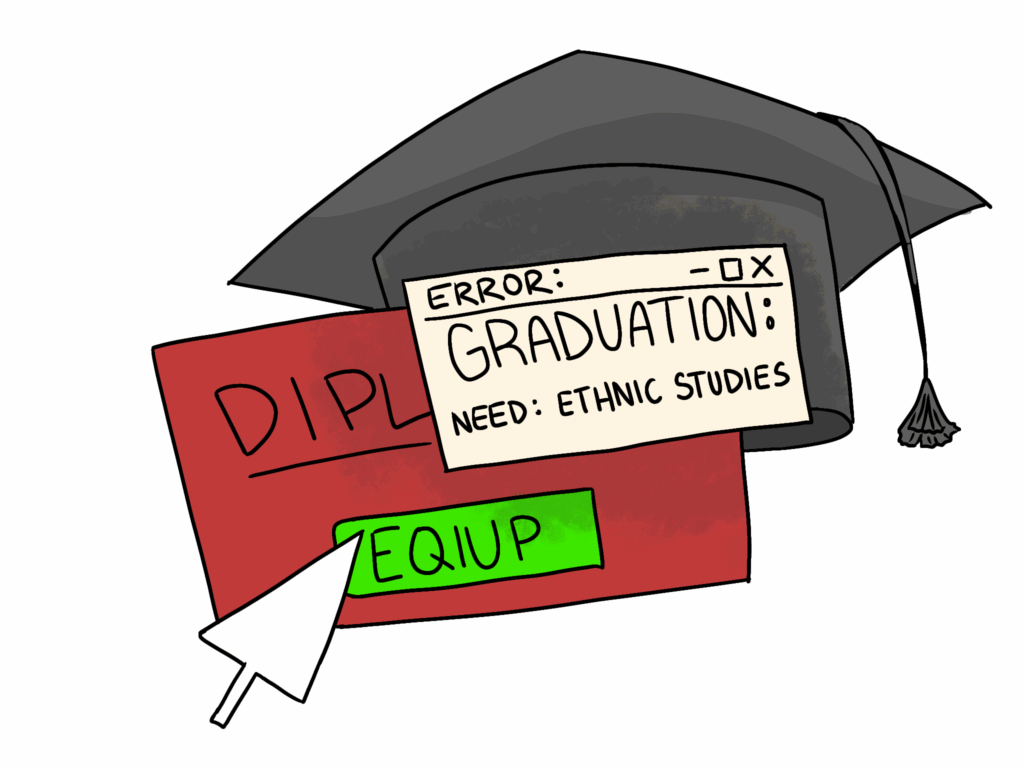
In Oct. 2021, Gov. Gavin Newsom signed Assembly Bill 101, which made Ethnic Studies a statewide graduation requirement. The class was created to educate students on Native American, Latino, African American and Asian American and Pacific Islander history, as well as offer historical lessons based on student demographics. The mandate was set to begin with the class of 2030, but due to funding cuts and controversy surrounding the class, many districts are not teaching Ethnic Studies.
The Ethnic Studies course at Aragon began as an elective in the 2018-2019 school year, and was mandated for freshmen and transfer students in the 2020-2021 school year, before the state’s requirement.
“Ethnic Studies should be mandated because it’s really valuable to teach students civic engagement and another side of history that they might not get in their history classes, [such as] in Modern World History or U.S. History,” said senior Aila Liu. “Ethnic Studies teaches a racial aspect of history that usually isn’t spotlighted in their regular classes … it gives [students] a different perspective on history in general, really opens their mind to minorities’ experiences … [and] teaches them how to be empathetic for other people that might be different from them … It [teaches] critical thinking and logic skills during class when you’re thinking about things that other races have been through.”
However, some students hold opposing opinions.
“[Halting the mandate is] a really good idea,” said sophomore William Reeves. “[Ethnic Studies] should be a class that you only take if you really want to take it. I’m glad that they’re holding the mandate so that everybody still has the freedom to choose what they want to do … I might not necessarily want to learn about what [others] want to learn about, and the class should be directed towards people who want to learn about [Ethnic Studies].”
Ethnic Studies has been surrounded by controversy since the very beginning of the course. Last year, after concerns from parents had prevented the Palo Alto Unified School docDistrict from making Ethnic Studies a graduation requirement, the course passed in a 3-2 vote. At the same time, accusations of antisemitism within the curriculum sparked a Sequoia Union High School District-wide review of the course. At Menlo-Atherton High School, a local advocacy group circulated an email falsely informing students that they could opt out of the course prior to the beginning of the school year.
The curriculum of Ethnic Studies classes has evoked varying opinions, similar to the news of the mandate.
“I didn’t really believe that the class gave me a lot of information whatsoever,” Reeves said. “It taught me about things that I already knew about and didn’t provide any insight. The main message that I was getting from the class that I should hate the country that I live in, and that I should hate a lot of people [here].”
On the other hand, some students had a much more positive outlook on the class.
“I personally [really] enjoyed it,” said senior Ava Sims. “Everyone is learning about the history of so many different other cultures … and things that happened from the point of view of so many different people [in Ethnic Studies]. It is really important for an overall education, because if you only focus on one thing too much, then you’re not getting a well rounded perspective … [From] kindergarten through eighth grade, anytime you talk about history, it’s always … about the same things. [When I took Ethnic Studies], that was the first time that I wasn’t just learning about the Civil War, the American Revolution or slavery.”
Opponents of Ethnic Studies argue that Ethnic Studies classes promote liberal ideologies, contradicting school policies which prohibit indoctrination.
However, some students disagree with this argument, stating that the classes remain unswayed by teachers’ opinions.
“As long as [the class] stays objective, [that’s what matters],” Sims said. “If a teacher is teaching a controversial topic, but is constantly inputting their own opinion to manipulate how students are viewing that topic, that’s wrong … I’m in Advanced Placement [Government and Politics] right now, and there’s a ton of things I’m learning about that I don’t always agree with, but it’s nice to know the other side and how they’re viewing things [and] my teacher never inputs his opinion [on] how he views certain topics.”
However, others believe the class did not improve the social environment at Aragon.
“When I was taking [Ethnic Studies], I noticed that a lot of students don’t take it very seriously,” Liu said. “And I think that’s just the culture … surrounding ideas of race and ethnicity in the U.S. That [might] be combated by a different curriculum.”
With planned Ethnic Studies funding omitted from the 2025 state budget, it is unknown if the requirement will be enforced in the future.