Lillian Huang
With billions of people on the internet everyday — whether it be on video games or social media apps — there is a vast landscape of online interaction, leading many students at Aragon to develop online friendships.
For senior Heli Artola, her online friendship developed through social media.
“We met through Tiktok,” Artola said. “She just found one of my videos and commented on it, and we just started [direct messaging] from there … I know a good amount of information [about] her, [like how] she doesn’t live in the United States … and her family story. I’ve known her for five years now … It’s bittersweet, because I know I’ll never meet this person, but I know that they’ll be there for me, whenever they can.”
Moreover, as time goes on, many online friendships become more personal.
“We started by talking about very simple things, like games and just complaining about day to day life, like homework or whatnot,” said senior Leilani Tsao. “But then as we grew older and we grew closer together, we actually formed a very strong support system.”
Furthermore, online friendships can start at a very young age, which junior Aaron Lee now, in hindsight, views as a possible danger.
“I used to have online friends,” Lee said. “It started when I got access to the internet [when] I was three. As I went through my adolescent years, the internet kind of shaped my ideals. And I got lucky, because people I met on the internet were pretty good people, so they helped me to grow into a good person, the best I could be despite having less parenting … But the same way that online friendships can help you be a better person, they can also influence you to be a worse person.”
To junior Macklin Berg, online friendships are also risks.
“This person could be straight up lying about their age, or straight up lying about everything,” Berg said. “And then if they pressure you into leaking your address or something.”
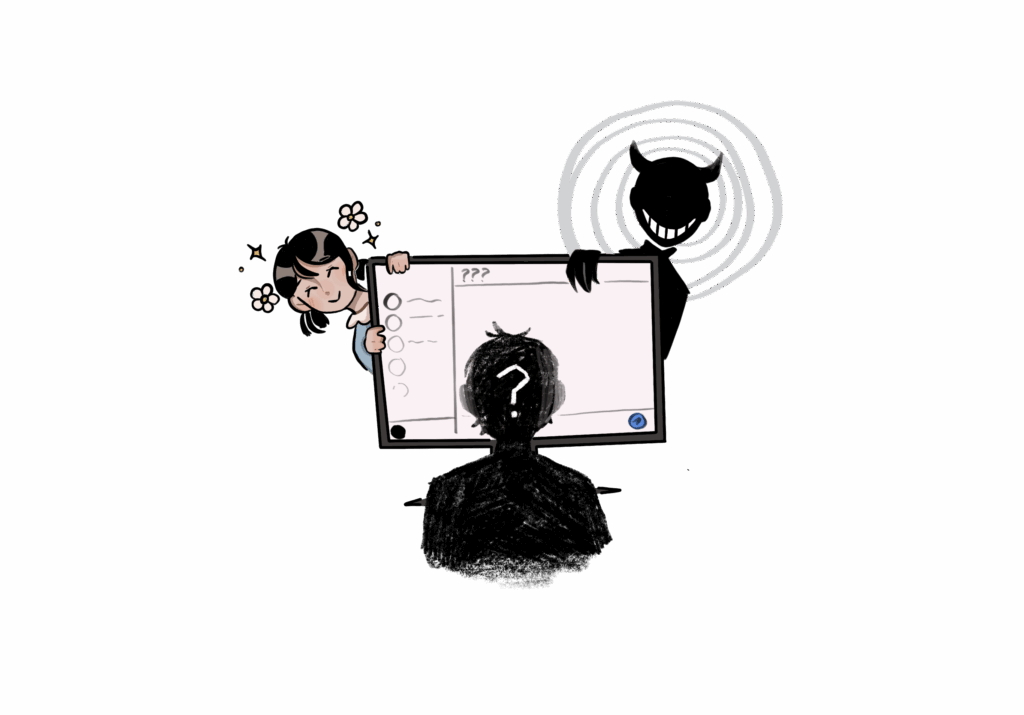
Similarly, the dangers of online predation can be a vicious, unpublicized cycle.
“The problem with predators online is that they’re not caught and no one is taking responsibility to catch them and arrest them,” Lee said. “The dangers with people being online at a young age is that one: they don’t know how to avoid them. Two: they don’t know it is happening. And three: as they grow up, they begin to think that behavior is normal, and ultimately they become predators themselves. And that’s a big problem.”
To combat the dangerous cycle, some people recommend taking a number of precautionary measures to protect oneself.
“Online catfishing is a very big problem, especially today, because everybody’s on the internet,” Artola said. “The way of preventing it is just being cautious and asking multiple questions regarding the person. Before I started really becoming friends with my online friend, I had to ask a bunch of questions that at first seemed weird to ask, but at the end of the day, I knew they weren’t because it was for my safety.”
Some other approaches involve checking for human qualities based on conversations together.
“The more you talk to someone, the more [parts] of your life slips out to them and the more of yourself you reveal,” Tsao said. “[At some point to me, I felt that] there’s no way this isn’t a real person. Either this person is very carefully crafting some personality, or they’re just a real person and they’re looking to have fun … [In my experience,] I knew it was the latter because] we talked to each other a lot and sometimes they’d just bring up things that were so very human to complain about and then they’d make very human mistakes. This is definitely a 13-year-old talking to me.”
Luckily, her beliefs were proven correct when they finally spoke together.
“We did end up meeting up,” Tsao said. “It was at one of my ballet performances. It was very scary actually. There was always lingering doubt of ‘what if she was actually a 50 year old guy the whole time?’ But then, we’d exchange pictures [to identify each other] once we determined that we’re gonna meet up … Once we got past the initial, first stage awkwardness of ‘oh my gosh, I’m not talking to my screen,’ it was actually really relaxing, and we were able to just settle into how we normally act online.”
While there is some truth in the common stereotypes about online creeps, these stereotypes can often be overrepresented.
“[The stereotypes] are fair,” Tsao said. “[But] if you get to the point of having a very close relationship with someone, you usually should be able to judge by yourself if they are the person you think you’re talking to, so the stereotype is kind of a bit overstated.”
Despite people often placing blame for these online predators, criticism often falls on the apps. With recent lawsuits against companies like Roblox and Discord for failing to prevent unsafe activities, some students question whether the apps are truly at fault.
“The ones that have safety measures installed in them, I don’t think they’re that dangerous,” Berg said. “It becomes dangerous when the person tries to make the move. The app doesn’t make it dangerous, the person does.”
Although online platforms allow for immense opportunities to connect and socialize in a new medium, it can also require careful consideration before joining spaces, platform safety features, user maturity and parent-imposed restrictions.