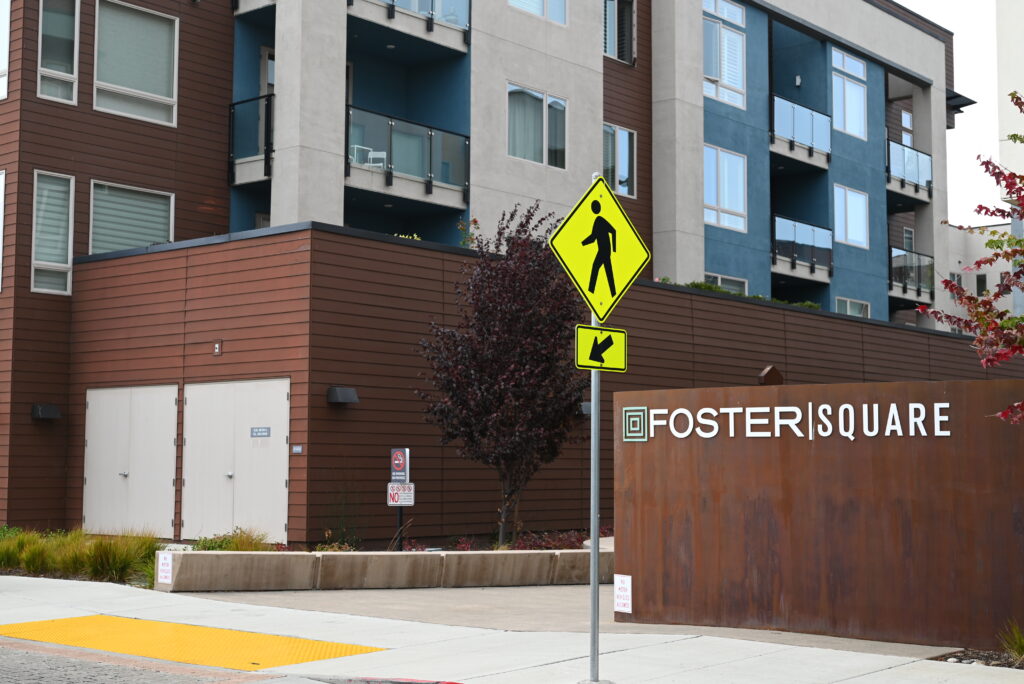
Foster City Square
Foster City’s parks are being bombed. Canadian geese, with their knowing eyes and smug waddles, have turned the city’s pristine parks into minefields of green and white, leaving a trail of droppings where no human can escape.
“When I do go to the parks, I can’t really ever have a picnic because there’s goose poop everywhere, and it’s annoying,” said junior Sonakshi Rajput, a Foster City resident and member of the city’s Youth Advisory Council.
The city is enacting a non-lethal plan to reclaim its green spaces from the hundreds of geese gracing its lagoons, who leave behind as much as 300 pounds of waste every single day. The stakes are more than aesthetic: in 2022, Heal the Bay identified two Foster City beaches among the top 10 most polluted in California, largely thanks to the geese’s prolific digestive systems.
The non-lethal plan came only after fierce public resistance. In May 2022, the city obtained a federal permit to kill up to 100 geese. By Sept., about 40 protesters had gathered in front of city hall and later marched to a councilmember’s home. More than 14,000 supporters from animal protection agency In Defense of Animals, over 140 times the number of actual geese, sent opposition emails to the council. Public speakers urged the council to reconsider, citing the “humanitarian need to save the animals.”
The council backed down and directed staff to investigate non-lethal methods instead, resulting in the permit to kill geese expiring before a single bird had been culled. The non-lethal strategy approved by City Council last December involves a high-tech arsenal of drones, lasers and balloons designed to scare the geese away, as well as deploying highly trained dogs to chase birds from the parks and waterways. Beyond the gadgets and canines, city leaders are also focusing on a more foundational approach, including habitat modification — removing grass, which is the geese’s main source of food — and public education, a campaign to stop residents from feeding them.
The city’s methodical and costly approach to its goose problem may seem like overkill for a community barely four square miles wide. But to understand why the fowl get full project management treatment from Foster City, one must understand the city’s very DNA.
LEVEE
Foster City’s “conservative” philosophy, defined not by a political party but a cautious, preventative and long-term approach to planning, is deeply embedded in every decision. The geese, in a way, are just a living, feathered manifestation of the challenges facing a city that was built from scratch and exists by a careful act of will. This mindset is most evident in the city’s most critical project: the battle against rising sea levels.
Foster City’s levee, an embankment around the city’s perimeter, stands as more than just a wall; it’s a shield. Without it, Foster City would simply not exist. Built on reclaimed marshland, the city’s core residential and commercial areas sit below sea level. For decades, a system of earthen levees was all that stood between the community and the relentless waters of the San Francisco Bay. But a 2014 Federal Emergency Management Agency finding deeming the levee insufficient for flood protection was the wake-up call, threatening to designate the city a flood zone and forcing thousands of homeowners into mandatory, expensive flood insurance.
The city’s response to this threat was, in true Foster City fashion, preventative. After years of studies and public outreach, voters overwhelmingly approved a $90 million bond measure to upgrade the levee, a complex, multi-phase engineering effort featuring new floodwalls, seismic retrofitting, and a hope that the Bay will stay politely in its lane. Today, the project is complete, and the results are tangible.
For Rajput, who lives close to the levee, the construction was a mixed blessing.
“My parents and I used to go on a walk there all the time,” Rajput said. “After the construction, we’ve been going less just because [the levee blocked the view] … [That being said,] if sea level rising is a real thing, then it’s important. [The city] addressed it adequately, even though it was an expensive project.”
Councilwoman Phoebe Shin-Venkat, who wasn’t on the council when the funding was approved but supported it as a community member, sees the levee as more than just flood protection.
“It’s doing its job protecting [the city], but now we [want to tackle the question of]: how can we make this into a true amenity that more people know about?” Shin-Venkat said. “Is there a way that we can make the levee more connected to the local business and community, so that we can generate more revenue from the levee as well?”
If the geese were a minor nuisance and the levee an existential threat, housing is the slow-burning crisis testing the city’s very identity.
HOUSING
The city’s self-contained, cautious planning is now facing a new force even it can’t out-schedule: the state of California. The state, in its quest to fix the housing crisis, has ordered Foster City to plan for thousands of new housing units, a bureaucratic earthquake in a city whose identity is built on low-density, suburban planning and the careful separation of residential from commercial space.
Shin-Venkat, the first renter ever to serve on the city council, pushes back against the framing that the city is simply following state orders.
“I never am someone who wants to be on the back foot,” Shin-Venkat said. “I never pitch building housing or doing our part as, ‘Oh yeah, the state told us to do it, therefore we have to do it.’ Cities that couch things that way put Foster City in a victim status. And we are not victims.”
Instead, Shin-Venkat sees housing as addressing a fundamental community need.
“I’ve seen actual survey results coming from Foster City community members that said the top issues are housing and cost of living,” Shin-Venkat said. “We have a huge opportunity to not only do the right thing, but focus on doing the best thing for the community because we want to make sure people can stay here.”
The instinct, however, is to preserve. The city has engaged in a slow, deliberate process of updating its Housing Element — Foster City’s plan for housing-related concerns — including extensive public outreach and numerous studies. But the process has been defined by a deep-seated desire to retain the city’s “character,” a word Shin-Venkat believes often obscures the real issue.
“I love when people say ‘preserving character,’ because I wonder who is dictating what a character is,” Shin-Venkat said. “The character of a community is made up by the characters: us, each one of us that live, work and play here. We define the city. We define the community. It’s changing like an organism, minute by minute … When I hear we have to be careful around the ‘character of Foster City,’ it’s usually a deflection to not build more housing.”
The city has developed “Objective Design and Development Standards” to ensure any new construction “complements existing neighborhoods” rather than disrupting them. This is the city’s attempt to meet a new challenge without abandoning its core identity.
But the cautious approach comes with trade-offs. This focus on preservation can frustrate residents who desire a more vibrant, urban environment — the very amenities that require population density to sustain.
“It’s nice to have parks [and] a suburban, comfortable feel,” said senior Dahlia Anapolsky. “But there’s a lack of diversity in restaurants, there’s limited nightlife and limited vibrant urban [activity].”
Shin-Venkat acknowledges this tension directly.
“People want amenities,” Shin-Venkat said. “People want more restaurant selection. They want more retail. [To get there,] we need to make sure we have enough people, businesses and people in those businesses, to support [what] we want.”
The issue also lies in keeping families together.
“My son, over the years, has had friends move away: some out of Foster City, out of the state, out of the country,” Shin-Venkat said. “The [cost of living] in Foster City [is crazy]. Even within the peninsula, Foster City has the highest pricing for rentals and for homes. It’s not just about making money; it’s also more importantly about keeping the fabric of the community together.”
Like many others, Rajput has noticed the construction happening across the city.
“Especially during COVID and still now, there’s just a lot of construction projects that have been taking place, like where the McDonald’s is,” Rajput said. “There’s been constant construction in Foster City to expand housing … They’re using up a lot of the city with either housing [or] the bare minimum stores. Me and my friends always talk about this: you have to always go outside of Foster City to really hang out anywhere.”
The housing boom has yet to be translated into the amenities young people want.
“We could have had a better mall,” Rajput said. “The strip malls are just places to get food. In downtown San Mateo and Burlingame, they have streets with restaurants and smaller shops.”
Even Foster City’s celebrated lagoon, a centerpiece of the master plan, falls short for Rajput.
“Some of the parks like Gold Park have beaches, but I wouldn’t want to go in it because the water isn’t the best,” Rajput said. “And again, there’s goose poop everywhere.”
The housing dilemma, unlike the levee project, is a problem with no easy solution, highlighting the tension between the city’s foundational desire to conserve its way of life and the demands of a changing world.
BLUEPRINT
The same master-planned origins that created the city’s vulnerabilities also shaped its unique aesthetic; Foster City’s “conservative” philosophy isn’t just about risk aversion – it’s also about the proactive, deliberate creation of a specific and beautiful community full of lagoons and parks and geese.
The presence of Eichler homes, with their iconic mid-century modern design is no happy accident. These homes were intentionally invited into the master plan by developer T. Jack Foster, who wanted to marry a progressive, open-air lifestyle with his vision for a new city. The post-and-beam construction, and floor-to-ceiling glass walls of the Eichlers were a curated choice — a bold aesthetic statement that perfectly matched the optimism of the 1960s and the forward-thinking nature of the planned community.
“They’re beautiful,” Anapolsky said. “I’m really a fan of that style of architecture. It’s nice to have a strong piece of architectural history in our community. It’s something we should be proud of.”
But that pride in preservation creates its own tensions. The city’s strong design standards and Homeowner Association requirements can make even minor renovations difficult for homeowners.
“There has to be a fine distinction between preserving historical homes and not allowing people to change their property the way they’d like it to adapt with society the way it is now,” Anapolsky said. “While I’m all for keeping architecture I’m a fan of, if it’s not to your personal taste, you should be able to edit on the inside. It’s your property.”
This same tension between preservation and adaptation plays out across the city’s governance. Foster City was built according to a blueprint, with neighborhoods planned simultaneously rather than evolving organically over decades like neighboring cities.
“[San Mateo’s] Shoreview neighborhood has narrower streets because it hasn’t been updated and renovated whereas the Baywood neighborhood has much wider streets to accommodate for bigger cars,” Anapolsky said. “Even though they’re both part of San Mateo, the communities developed at different times. All the neighborhoods in Foster City look the same because they were all established at the same time.”
The city’s deliberate approach can also create new blind spots.
“I wonder if [Foster City] looks at one problem without thinking about a broader range of things,” Rajput said. “The [creators] of the city thought about the beauty of the city, but they didn’t think about how that would create the natural habitat for the geese. They [might] be doing the same thing by not considering the effects of getting rid of the geese population.”
Furthermore, the master plan has succeeded in creating efficiency, as some believe, but failed to anticipate what young people would actually need.
“There’s a very obvious center of the city and there are schools [within] walking distance from any residential area,” Rajput said. “It was designed for meeting basic needs. It was master planned for a different purpose than what I would consider a good city.”
Though the city’s initial planners could not have solicited input from today’s youngest residents, both Rajput and Anapolsky serve on youth advisory bodies that give youth a voice in city planning.
Rajput describes the Youth-Advisory Council meetings as highly discussion-based despite their formal structure and influential, if incremental.
“[With] 15 members on the council across four different high schools, there are lots of opportunities to share input and what [we] want to see change in Foster City,” Rajput said. “Last year, Parks and Recreation was taking input from the Youth Advisory Council, and one member requested to have a track on Shorebird Park. They’re actually taking that into consideration and thinking of implementing that.”
Anapolsky, who serves on the county-level Parks and Recreation Commission, sees similar dynamics at play.
“About 20 years ago, Foster City requested three skate parks,” Anapolsky said. “Initially, [all] three were approved but so far, only two have been built. [We have to] make sure there’s room in the budget, vote on it, and then it’ll start to go underway. The process takes [from] six months to multiple years.”
This slow, careful process that is meticulous, well-intentioned and sometimes frustrating captures the city’s character. Nowhere is that more visible than in its most unexpected creation: the geese. The city’s carefully designed environment — so good for people with its manicured lawns, plentiful parks, and sprawling man-made lagoons — is also a perfect habitat for geese.
Shin-Venkat takes a pragmatic view of the waterfowl situation.
“It’s interesting that people are so fascinated with the Foster City geese,” Shin-Venkat said. “They’re animals. They’re naturalized. They’re not going anywhere. If we love it here, and they love it here. For them, our 24 parks are paradise.”
The city is now solving this problem with the same methodical, long-term and expensive approach it used to build the city itself. They are, in essence, trying to re-engineer their own accidental ecosystem — a fitting and absurdly final act for a city that lives and dies by the blueprint.