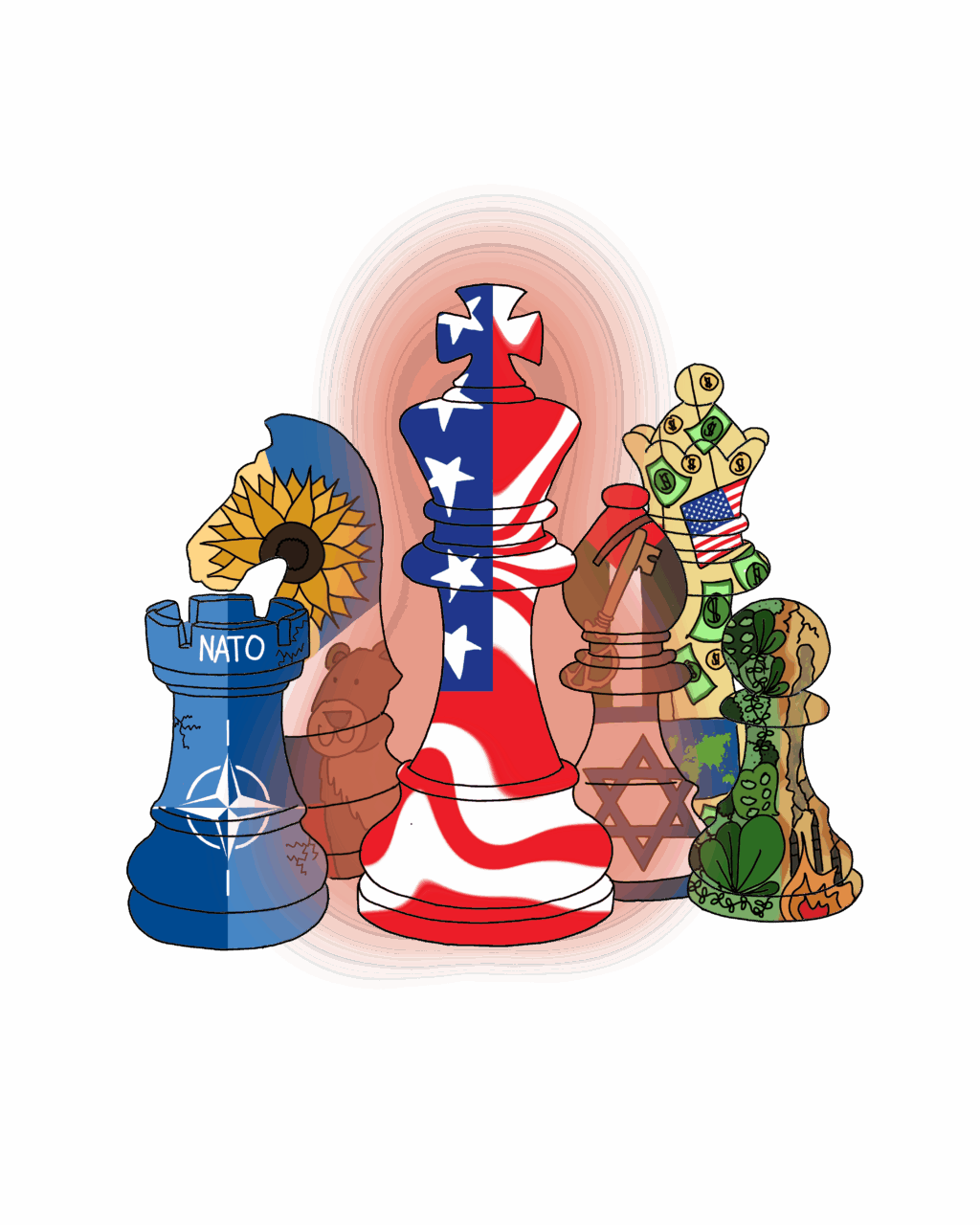
On Oct. 30, Trump wrapped up his visit to Asia, in which he discussed various policy issues with foreign leaders, including those related to his imposed tariffs. This followed Trump’s speech to the United Nations General Assembly in Sept., where he discussed his views on the North Atlantic Treaty Organization, tariffs, foreign conflicts and climate change. During this speech, he spoke out against globalism, an ideology promoting the interconnection of political systems and economies across the world. Instead, he advocated for sovereignty and patriotism, praising the United States.
“America is blessed with the strongest economy, the strongest borders, the strongest military, the strongest friendships and the strongest spirit of any nation on the face of the earth,” Trump said.
Trump is a strong proponent of nationalism, supported by his “America First” policy of putting American prosperity above global interests. Some students agree with Trump’s beliefs on this subject.
“If we put Americans first, no matter which [political] side [people are on], it’ll be a lot better for the country,” said senior Andrew Akkawi.
Previous U.S. presidents have approached foreign affairs differently. George W. Bush focused on promoting democracy and countering terrorism after the 9/11 attack. Barack Obama fostered alliances and diplomatic solutions instead of the military. Similarly, Joe Biden used traditional diplomacy and alliances for international policy.
Trump has prioritized unilateralism and bilateral relations in both his first and current term.
TARIFFS
Currently, Trump has placed tariffs on over 90 countries. The highest rates have been placed on Brazil and India, both with 50% tariffs. These tariffs are taxes that American companies must pay to the U.S. if they import goods from a tariffed country. This often results in companies raising prices to balance the cost of the tariffs.
“I think [Trump has] mischaracterized [tariffs] intentionally to the American public,” said Modern World History teacher Scott BonDurant. “If you ask most people what they are, I think there are some misunderstandings … That’s problematic because people get the wrong idea.”
According to a poll conducted by Ipsos, only 45% of the American people actually know how tariffs work, with 17% believing that tariffs are paid by the exporting country to the U.S.
Trump believes that tariffs are a necessary economic tool that should be used when countries are not following rules about trade.
“We’re … using tariffs to defend our sovereignty and security throughout the world, including against nations that have taken advantage of former U.S. administrations for decades,” Trump said.
Aayushi Kothari, senior and vice president of Model UN club, disagrees with Trump’s usage of tariffs.
“If you’re going to use tariffs to bring industry back to the U.S., you need to supplement that with actual domestic policy to bring industry to the U.S.,” Kothari said. “That’s the opposite of what we’re seeing. We’re seeing colleges and universities being cut … This doesn’t feel like trade protectionism to bring industry back to the U.S. because our domestic policy doesn’t support that and our trade deals aren’t doing that.”
NATO
NATO’s June 2025 summit in Hague, Netherlands was mostly focused on the defense spending of each nation, an outlier from the previous summits, which were heavily focused on support for Ukraine amid the Russia-Ukraine conflict. At the meeting, the NATO allies agreed to increase their total defense spending from 2% to 5% of their nation’s gross domestic product.
Before this new budget was decided, Trump had previously remarked that if nations didn’t commit to spending money on defense, he would encourage Russia to do what it wanted to them. During the summit, leaders reaffirmed their support for the collective defense of all NATO allies, including Trump. However, just last week, the Pentagon announced the U.S. would be decreasing the amount of American troops in Eastern Europe. Although several U.S. and Eastern European officials said this action was not taken because of the U.S. lessening commitment to NATO but because of Europe’s increasing capacity for defense spending, senior lawmakers in Congress have criticized this change.
Others’ criticisms have been aimed at NATO encouraging increased militarism.
“We spend way too much money on the military, [but] I also do feel like we have an obligation as one of the larger, more powerful countries in the world, to protect the interests of other nations as well,” BonDurant said. “So those two beliefs are sort of at odds with each other … [but] I would like to de-emphasize the necessity for NATO. I don’t love that there’s this international police force out there, because it certainly serves Western interest and Western capital interests. I don’t necessarily know that it always lives up to its original mission.”
CLIMATE CHANGE
Trump has frequently voiced his belief that climate change is a hoax, and that renewable energy is not helpful for nations. He has incentivized the fossil fuel industry to continue growing, aligning with his “Drill, Baby, Drill” ideology. Additionally, he believes that renewable energy is disadvantageous.
Trump has also withdrawn from the Paris Agreement, an international climate treaty pledging to reduce carbon levels and limit global warming. Currently, the U.S. is one of the largest contributors of carbon dioxide emissions.
Some students are similarly skeptical of the credibility of climate change.
“This is also going to [sound] kind of radical, because they’ve been telling us there is an effect on the climate when we’re producing so much of this unnatural CO2, but the amount we’re producing is so minimal compared to what’s actually naturally happening in the Earth,” Akkawi said. “Obviously, we should take care of our planet, but it’s gotten to the extreme where it’s like we’re doing so much stuff that’s not really even affecting [climate change] … I don’t really see it as the biggest issue.”
However, many call Trump’s ideas on climate change into question.
“It’s very frustrating to see our president call climate change a hoax and withdraw the nation from any movements trying to address climate change,” said senior Kabir Sulur. “As many activists and scientists say, this is not good for the health of the world and our environment [because] humans consume so much.”
ISRAEL-PALESTINE
There have been tensions in the Gaza area for more than a century. After the 1967 Six-Day War, borders in the Middle East changed and Gaza was occupied by Israel from Egypt. Today, Palestinians mostly live in Gaza, and another area known as the West Bank. The most recent conflict began on Oct. 7, 2023, when Hamas launched a terror attack on Israel. Like the Biden administration, the Trump administration has provided military aid to Israel, which some see as defense against terrorism and others see as supporting ethnic cleansing.
Trump recently brokered a ceasefire between Israel and Hamas with his 20 point Gaza peace plan. As of now, Trump does not have a clear stance on what a solution to this conflict would look like, but has emphasized co-existence. He has repeatedly stated that Palestine should not be recognized as a state, because he believes it would reward Hamas and encourage continued conflict, but he also has shared his vision for a two state solution with the Peace to Prosperity plan.
“[The conflict is] an ugly situation, because people are gonna unfortunately, I think, keep dying,” Sulur said. “This conflict isn’t over, but I think the U.S. has played a big part in continuing the destruction over the past two years, even though they’ve [now] come to a ceasefire. Although this has been a decades-long conflict between Israel and Palestine, I think the U.S. should have tried more to make peaceful solutions and stop people from dying instead of funding militaries.”
RUSSIA-UKRAINE
Conflict between Russia and Ukraine first began in 2014, when Russia annexed Crimea, which is internationally recognized as a part of Ukraine. This conflict massively escalated in 2022, when Russia invaded Ukraine.
According to the Council of Foreign Relations, “Putin claimed that the goals of the operation were to demilitarize and denazify Ukraine and end the alleged genocide of Russians in Ukrainian territory.” However, other sources say that the true goal of Russia is to ensure that Ukraine doesn’t join NATO.
At the time that the conflict began, Biden put economic sanctions on Russian officials, banks and its oil and gas industry. After Trump first came into office, he promised to end the war in 100 days, believing that both Putin and Zelenskyy would listen to him. The deadline he set has passed, but the conflict hasn’t ceased. As a result, some Aragon students are conflicted about whether the U.S. will actually achieve a fair peace deal that will end conflict.
“It is wrong of Russia to try to invade [Ukraine] and try to take over because they’re not just fighting Ukraine, they’re trying to actively take over Ukraine,” Kothari said. “Regardless of whether Ukraine is going to join NATO or not, Ukraine is an autonomous nation … The U.S., with values of freedom, liberty, independence and [because it is one of] the first democracies, [is] responsible for defending nations that are being invaded.”
The purpose of this article is to give a brief overview about the topics discussed. Please feel free to conduct your own research.