Matilda Bacani
“Everyone deserves a chance to fly.“
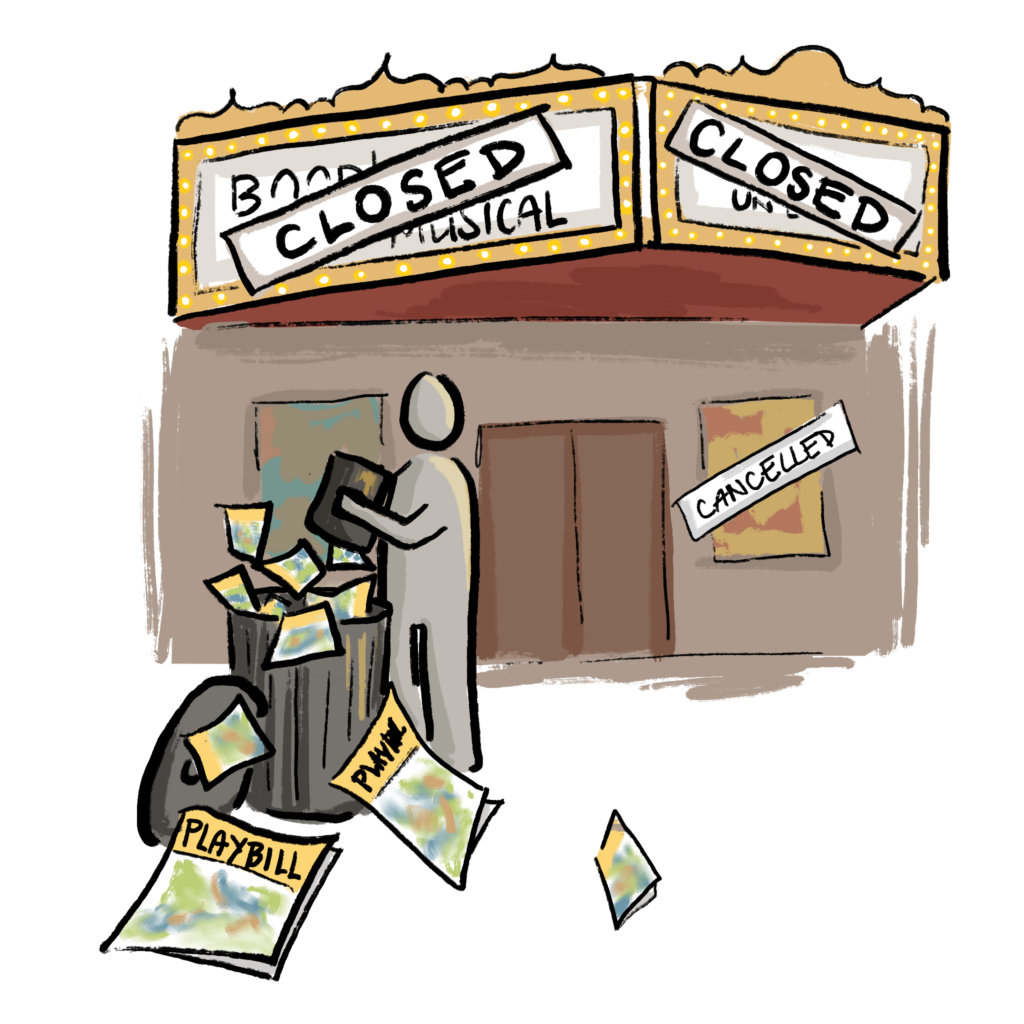
Spoken by the 2003 musical “Wicked” main character Elphaba, these words have held true to theater fanatics for years. Yet, in the post-pandemic world, the same magic isn’t keeping new Broadway shows off the ground. Musicals like “Boop!” and “Smash!” have shut down within months of their openings, leaving fans and performers concerned about the future of live theater.
Since COVID-19 disrupted the industry, Broadway has faced a tornado of challenges. According to the Broadway League, the last full season’s gross revenue was down 17% from the last full pre-COVID season.
Additionally, tourism, once a large source of revenue for New York City theaters, has yet to fully recover. According to a CNN report, New York City’s visitor numbers are below pre-pandemic levels, reducing the audience of potential ticket-buyers. At the same time, production costs have reached highs. Sets, costumes and labor are all more expensive due to inflation pushing prices higher.
Furthermore, the way people consume entertainment has shifted. Streaming platforms like Netflix, Disney+ and YouTube push high-quality content at a fraction of the price at which Broadway sells their tickets. And while short form content is on the rise, a stage show is not pushed by an algorithm and requires time, travel and a financial commitment that people are not ready to invest in.
“With all the new … media, people’s attention spans are not very high,” said junior Alexander Gutzman. “People don’t feel [like] they … [can] sit through an entire musical or play without their phone. The fact that you can see movies at home means there’s less people going to both movie theaters and actual live shows.”
This environment has made Broadway productions more risk-averse. Producers are hesitant to launch shows that don’t promise virality or buzz.
“If they’re not willing to invest, then … these shows aren’t going to be as [popular],” Castillo said.
These ripple effects extend beyond the stage, as high school students and Gen Z performers face a shrinking pool of opportunities. With fewer productions staying open, the goal of having a sustainable career in Broadway is seemingly unattainable.
“Suddenly there’s … less job opportunities than there [were] … before, and there already wasn’t a lot to begin with,” Gutzman said. “It can really damage some people’s careers. If there were many more opportunities, I would definitely be much more inclined to do something [on Broadway].”
This proves to be discouraging for many, including junior Elisa Castillo, who plans to major in vocal performance.
“It does demotivate me,” Castillo said. “Knowing that there’s not really … a [high] income … [and you need a] side job to maintain yourself … is sad because I do see a loss of interest.”
Yet, local theaters are stepping up, providing spaces to practice and perform even when Broadway doors are hard to open. Aragon’s drama department is such a place, having a full theater for nearly all days of “Footloose,” the school’s most recent work.
“I hope that with our generation, we are a lot more aware, a lot more accepting, and I hope that will be [reflected] … in the musical theater,” Castillo said.
Ultimately, Broadway’s struggles display a larger cultural shift. Audiences want convenience and affordability, while producers must ensure financial sustainability. The industry has been forced to evolve, but for now, the landscape of Broadway is precarious, and new performers must grapple with the consequences firsthand.