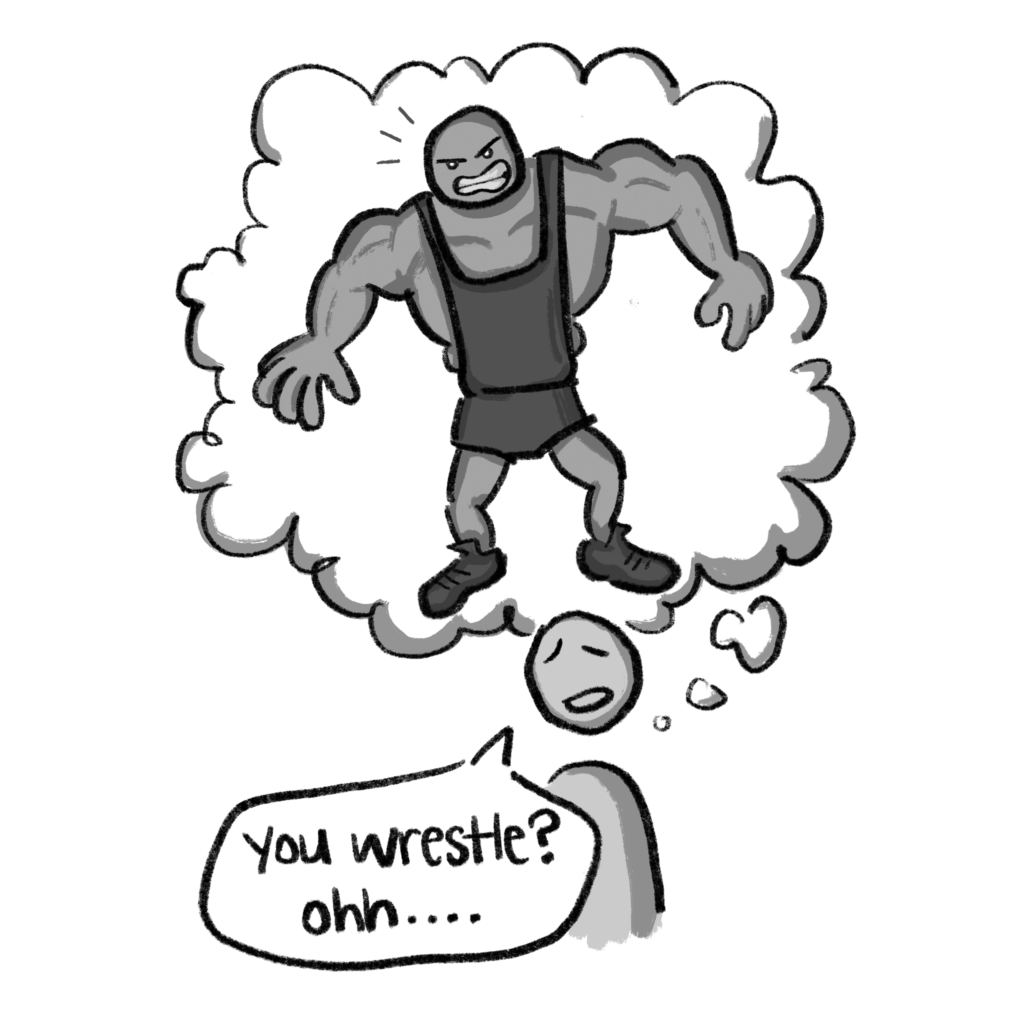
According to the National Wrestling Hall of Fame, wrestling is estimated to be 15,000–20,000 years old, making it one of the oldest sports in the history of the world. Today, wrestling is the sixth most popular boys sport by participation, and nearly the tenth most popular girls sport, according to USA Wrestling. But despite its popularity, wrestling is often subjected to stereotypes and misconceptions.
“When most people think of wrestling, they think of [World Wrestling Entertainment] and stuff like that,” said sophomore and wrestler Mark Rumberg. “Like jumping on people in a ring or throwing chairs. But it’s a lot different for high school and college wrestling. WWE is more of a fake story … It’s scripted.”
Perhaps the most common misconception surrounding wrestling is that it is too violent or dangerous due to the sport’s physical nature.
“We don’t really want people who are trying to be violent and hurt people on the team,” Rumberg said. “You want to be able to overpower the other person, but you’re not trying to hurt them.”
Wrestling rules and regulations are also made with player safety in mind. Certain unsafe maneuvers such as choking an opponent or twisting their limbs are considered illegal.
“There’s constant rule changes in high school wrestling, with the main goal [being] to keep the sport safe,” said athletic director Steve Sell. “I do 100% disagree with any idea that the sport is unnecessarily dangerous.”
A study by the National Library of Medicine found that for every 1,000 participants in wrestling aged 12-17 years old, only 29.57, or around 2.9%, suffered significant injuries.
“You probably won’t get hurt [wrestling],” Rumberg said. “Sometimes I’ve gotten small [injuries] that hurt for a bit, maybe for a day, but you won’t get any major injuries [wrestling].”
Other people are confused by the high amounts of physical contact involved in the sport.
“People say that it’s very touchy, [and] that people who like to do wrestling [are] very weird,” said senior and wrestler Lucas Torres. “I feel like that’s how other people think about it, while as a wrestler, you don’t really think about it.”
Another common misconception among students is that wrestling is a sport played only by men, as they make up the majority of high school wrestlers. In the 2025-26 season, 300,214 boys will participate in boys high school wrestling while girls wrestling will have approximately 74,000 participants, with girls making up around 19% of all wrestlers according to USA Wrestling. While these numbers may seem comparatively small, girls wrestling is on the rise, with 2025 marking a 15% increase in participation, according to USA Wrestling.
“Girls wrestling has finally become a more popular sport,” said sophomore and wrestler Halona Nacua. “Last year, we only had a team of four girls but this year, we’re having 10 to 12 girls join the team from what I’ve heard.”
The National Collegiate Athletic Association has recognized women’s wrestling as its 91st championship sport for the 2025-2026 season with the inaugural championship being held from March 6-7, 2026.
“It is fantastic, a long time coming,” Sell said. “These women … deserve a platform to compete and to represent themselves and their universities.”
Something else many do not understand about wrestling is how difficult the sport truly is.
“We used to have a poster up in the locker room that said, once you’ve wrestled, everything else in life is easy,” Sell said. “That was from Dan Gable, who’s one of the more famous wrestlers in [U.S.] history.”
Wrestlers agree that their sport is challenging.
“It’s a very … fast-paced sport. It really pushes you past your limits,” Torres said. “So if … you want to find out how far your limits can go, this is the sport for it.”
Wrestling strives to defeat these misconceptions, as the sport becomes safer and more inclusive.