Vanessa Chan
A student’s college application represents more than a few essays; it’s four years of hard work and stress to be sent off and judged by admissions officers. Every essay, every extracurricular activity, grade and test score is about to determine the fate of one’s future with a single click to submit.
These students put in hours of effort to stand out in their college applications through their academics, athletics and especially, extracurriculars. Driven by ambition and the desire to be accepted to a top university, some students take the initiative to create nonprofit organizations.
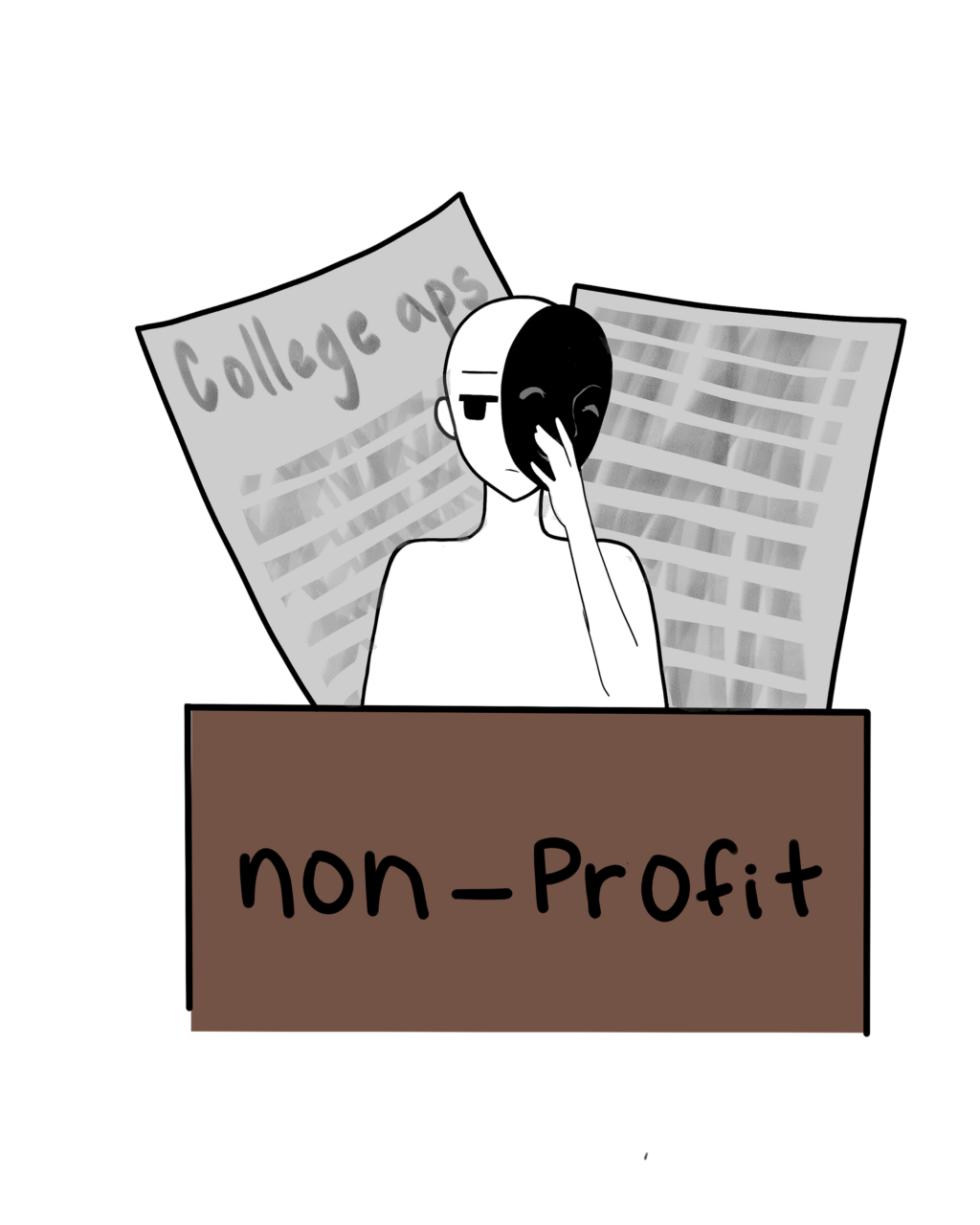
The legitimacy and dedication of these operations are debated due to the shallow motivation and lack of genuine enthusiasm behind their decisions.
“You shouldn’t start something just for college app[lications] because if you don’t have a lot of passion, it leads to not actually putting a lot of work in, because you’re not motivated to do it, especially with nonprofits,” said junior Kara Hwang. “[Also], a lot of people apply for grants [for their projects. [Performative nonprofits] take away grant money from more deserving, more passionate people.”
When people don’t make the efforts to actually work towards the goals of their organizations, it becomes redundant and self-defeating.
“If you want to start a nonprofit, it should be because you’re interested in helping people, rather than getting into a college with it,” said sophomore Ryan Newman. “If you spend time and do the work to create a nonprofit, obviously it’ll look good on a resume, but it just defeats the purpose.”
This has created a culture in which students are rewarded for “leadership roles,” i.e. founding an organization, even when they haven’t put any substantial effort into it. This also puts pressure on students who don’t have their own passion projects, perpetuating a state of inferiority and unwanted stress.
“It’s very easy to compare yourself with other people,” said sophomore Reika Lam. “If you see your peers or people your own age, doing the same [activities] as you but to a [more extreme] scale, it’s easy to think [less] of yourself and put more pressure on yourself.”
Moreover, the long term effects and obligations of leading an organization are often ignored after beginning college, making it pointless, as most organizations are meant to last for decades.
“The problem is that a lot of people don’t continue [their organization] throughout college,” said sophomore Kana Ueno. “They all usually stop doing it when they get into college … if you’re gonna commit to it throughout your lifetime, if you’re passionate [about] it, then [you] should do it.”
Furthermore, forming an organization for a shallow reason and without actual passion affects one’s overall fulfillment and satisfaction.
“If you do something that … you’re not going to want to do, it’ll make your high school life less fun,“ Hwang said. “It’ll make you miserable, work[ing] at things you’re not happy about … If you’re just doing things to write it down, actually [working on your nonprofit] won’t be enjoyable for you. So there’s no point in doing it if it’s … only for college.”
However, if students put genuine effort into their organization and try to make it flourish, they will be more likely to see positive results.
“If a person truly cares about the goals of [their organization], it’ll be shown in the [impact of] the nonprofit,” Newman said. “Having [an organization] that works [can be] huge for college and for being proud of yourself and those are really important things for people [to feel].”
The line between performative and passionate nonprofits lies in the dedication and commitment a person has for their organization: if one is willing to follow through with the decision to start a nonprofit, then equal benefits can be reaped. But little enthusiasm leads to less reward.
Extracurriculars are meant to show universities the applicant’s genuine self and passions. Starting a nonprofit for no reason does nothing to further this goal. Performative organizations hinder a person’s ability to showcase their true personality and are only really necessary when they’re motivated by real enthusiasm.