Eden Kwan
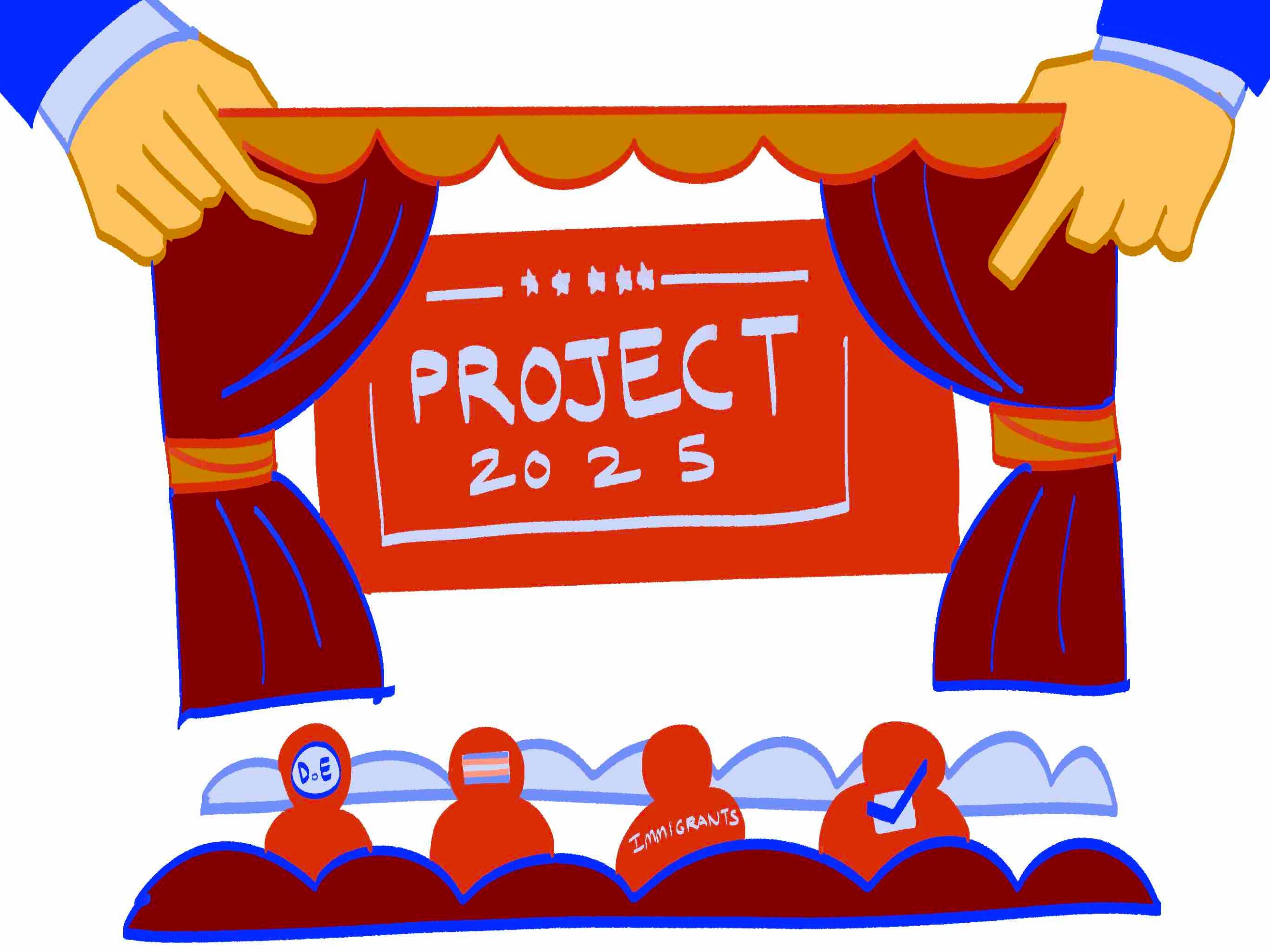
Ask ten people what Project 2025 is, and get ten different answers. Just as most Americans skip the terms and conditions on their phones, many haven’t read the 900-page plan that could reshape the federal government, which raises the question: what exactly is Project 2025?
KNOWLEDGE
“It’s a project for political reform that leans towards the right,” said sophomore Robert Mo. “I haven’t heard about specific policies, but I know some people are very against it.”
Like Mo, many people are only familiar with the basics of Project 2025, and are still unclear of the ramifications of this sweeping conservative policy plan. Nevertheless, many are aware that it is highly controversial.
Some have been following the proposal more closely.
“I started hearing about it as it came about in 2024, during the [presidential] campaign,” said Jon Felder, U.S. Government and Modern World History teacher.
“There were a lot of people out there saying, ‘if Trump wins the election, we’re going to see more of this in 2025.’ It was created by the Heritage Foundation when President Biden was still president, with the hopes of a conservative [president] getting elected [next].”
EDUCATION
Project 2025 lays out an ambitious plan that would restructure how the federal government is run, affecting nearly every department. One of its most dramatic proposals is to eliminate the U.S. Department of Education, shifting responsibility for public education and funding for low-income school districts to state and local governments. Although unequal access to education is already a problem, critics warn this could further widen the gap, leaving students’ experiences even more dependent on their district.
Moreover, the plan aims to eliminate federal funding for Title I, which provides funding for schools to close opportunity gaps between low and high-income students. If enacted, consequences would include a worsening teacher shortage. According to the Center of American Progress, a progressive policy think tank, 6% of teaching positions in California would be lost.
“Low-income schools usually [have] kids that need education,” said sophomore Donya Paz. “[In] a lot of low-income schools, [students aren’t] going to be able to go to other places to get an education. This is all they have. If you take away funding for that you’re setting kids up for failure. [For] people who need it, this is their chance to provide a life for themselves, their parents and their futures. Taking away funding for this is hurting not only them, their families, their community, but also … everyone.”
Project 2025 also plans to eliminate the Head Start program, which supports low-income families and children through early learning and development services. According to the National Education Association (NEA), Head Start was able to serve nearly 720,000 children in 2024. If the Head Start program were to be eliminated, 800,000 toddlers would lose educational services.
The project seeks to increase education choice through “micro education savings accounts,” praising Arizona’s Education Savings Account program as an example of states increasing school choice, suggesting Project 2025 to use Arizona’s program as a model.
The program provides $7,000 of taxpayer money per child for expenses, such as private school tuition. However, according to the NEA, the ESA program lacked accountability in private schools’ finances and operations and predominantly served wealthier, private school families. Only 5% of ESA recipients in Arizona came from ZIP codes with a median income under $49,000, highlighting its lack of impact on lower-income students who need funds the most.
“The funding should not be going towards rich kids’ education,” Paz said. “[Money] going towards tuition for people that can afford the tuition is contradicting what the money is for. You should use the money for things that would help people, instead of just giving them more money even though they already have it.”
Based on the Constitution’s separation of powers, Congress has specifically outlawed the concept of impoundment, which means presidents cannot refuse to spend money that Congress has directed them to through an enacted law. The Trump administration and Project 2025 are challenging this principle. Their actions towards freezing Title I prompts the question, to what extent are Project 2025
and Trump going to in order to obtain power, and how will the states bear the impact?
So far, Trump has signed an executive order to issue guidance to states on using federal funds to increase students’ ability to decide the schools that they would like to attend.
Project 2025 also has major implications for higher education payment. It proposes the removal of Biden’s income-based student loan repayment.The NEA reports this will lead to 43 million Americans paying up more per month on student loan debt. The project also called for the elimination of the Parent Loan for Undergraduate Students loan program, which has been partially achieved. The Grad PLUS program, which provided student loans to graduate students, maintains current borrowers but stops from accepting any new borrowers under Trump’s One Big Beautiful Bill Act.
RACE & GENDER
Project 2025 impacts not only the funding for education but also the curriculum taught. It calls for the removal of critical race theory and “gender ideology” from public school curricula, comparing transgender content to “pornography.” Trump signed an executive order in January to cut federal funding to schools which teach what he claimed to be “indoctrination” like “gender ideology.” However, this executive order was blocked by a federal judge due to the order failing to define what a Diversity, Equity and Inclusion program is, as well as being an overstep of the government’s power.
On a similar note, the project also proposes to amend Title IX to define sex as “biological sex recognized at birth,” instead of gender identity. The project plans to reverse revisions to Title IX under former President Joe Biden, which added the prohibition of discrimination based on sexuality and gender identity
to the law.
“Getting rid of protections … [for] LGBTQ youth is very harmful,” said sophomore Julian Rhodes. “Discrimination has led to [higher] suicide rates of [LGBTQ] kids … As an LGBTQ youth, I’m lucky to be in a community where I’m not afraid to go to school and face discrimination. But I know, for other kids who don’t have the same safe community as me, getting rid of laws that protect against discrimination toward them can affect them a lot. [It] is very unhealthy for people to face discrimination.”
IMMIGRATION
Beyond education, Project 2025 additionally plans to crack down on immigration, expanding the government’s ability to detain migrants, narrowing the number of ways people can legally immigrate and streamlining the process of deportations by requiring fewer hearings and protections, opening the door to more mistaken deportations and overall discrimination.
As of now, the OBBB Act allocated $170 billion towards immigration, including $30 billion towards Immigration and Customs Enforcement and $45 billion towards construction of immigration centers. Trump has issued an executive order commanding the government to detain and prosecute undocumented immigrants.
“[ICE} isn’t a great [method] of deportation,” Rhodes said. “Because people are being stripped of basic rights to court and hearing, and what I’ve seen from the detention centers is that people aren’t being treated right. The families of those who are deported aren’t getting any information from where the people [who] have been deported are being taken … I cannot believe that our government and the president [are] allowing this to happen. It’s very inhumane and disgusting how
they are treating these people.”
SOCIAL MEDIA
Social media has become a center for discussion about Project 2025. After a debate between former Vice President Kamala Harris and Trump, a thread on X, formerly known as Twitter, breaking down Project 2025’s key points drew the attention of 20 million people.
Apart from being a center for discussion, social media has become an information source. Because the plan is long and complicated, people rely on summaries from influencers, whether those summaries are accurate or not. Content creators from both the left and right post their interpretations of the plan, allowing them to shape the overall narrative. However, influencers transform tedious and complicated concepts into quick and engaging media, which draw more Americans into conversations about government. People who would usually shy away from politics can now pick up information by scrolling through their social media feeds.
Though many of Project 2025’s proposals have yet to be implemented, some students fear that the project will hurt the country if it were fully enacted.
“The people that need help the most are the people that Project 2025 would hurt, and it just makes the rich people richer and the poor people poorer,” Paz said. “It’s just going to hurt the country, because it’s going to make people feel more excluded … It’s not really progressing America.”
With Project 2025 being implemented, there are major implications across countless fields. These policies have the power to reshape the nation.