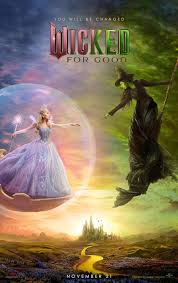
There are spoilers ahead for “Wicked: For Good.”
In 2019, “Cats” flopped at the box office, receiving exceptionally low reviews. Two years later, the “Dear Evan Hansen” film was similarly a flop, falling far short of its beloved Broadway counterpart. A few years later, “Mean Girls” received low ratings as a movie musical as well. However, breaking through the trend of musical movie flops, Wicked crushed at the box office, receiving record attention in the movie musical industry with raving reviews.
Exactly one year after “Wicked” grossed about $750 million dollars globally, its sequel has finally hit theaters, completing Elphaba’s journey through Oz from Shiz University to the Yellow Brick Road.
My predominant emotion coming out of “Wicked: For Good” is that it is a strong sequel, though not without shortcomings.
From a story standpoint, “Wicked: For Good” thoroughly captured the beauty of the musical’s twist on a classic story. Elphaba, rather than an evil witch, continues her hero’s journey of challenging the Wizard of Oz’s authority, immediately picking up where the first film left off.
“They tied up most of the plot holes from the first movie well,” said junior Madissen van Lingen. “We went straight into the animals building the Yellow Brick Road, which was a really strong opening for Elphaba’s character. I really liked that.”
As the story continues, Fiyero leaves his wedding with Glinda to take Elphaba’s side, Nessarose is killed by Dorothy’s flying house, and Elphaba turns Boq into the heartless Tin Man and Fiyero to the brainless Scarecrow to save their lives. Finally, the film reveals its greatest deviation from “The Wizard of Oz:” Elphaba fakes her death to escape to another land with her true love, Fiyero.
While directly connected in story, “Wicked: For Good” takes on a very different role thematically, focusing on the emotional arcs of the characters. The music of the film perfectly exemplifies the drastically different tone of the second film. While “Wicked” was filled with poppy and thrilling music, like “What is this Feeling”, “Dancing Through Life,” “Popular” and — of course — “Defying Gravity”, “Wicked: For Good” takes on a more solemn and sentimental tone, with “I Couldn’t Be Happier,” “The Girl in the Bubble,” “As Long as You’re Mine” and “For Good” itself. While both parts have top notch music from Stephen Schwartz, the slower, more emotional music of “Wicked For Good” seemed to pull the story down, it also provided for character depth.
“[My favorite] song in the film was definitely ‘For Good,’” van Lingen said. “It’s such a sad and beautiful song. And I really love the scene after that where [Glinda] and [Elphaba] were crying at the door. I heard that was improvised [by the actors], and I thought that was insane. It was so beautiful.”
While of course the music and story were powerful, Ariana Grande and Cynthia Erivo’s acting as Glinda and Elphaba, respectively, are what give the story strength and emotional honesty, with both actresses seeming to be truly connected on and off screen. Most importantly for the “Wicked” series, their voices in the movie’s title song pair together just as well as their acting.
“‘For Good’ is one of my all-time favorite songs ever,” said Psychology and Modern World History teacher Jessica Frankle. “Ariana Grande and Cynthia Erivo’s voices are magic together … Every time they sing together, I almost like it better than when they sing on their own.”
While part one was very exposition-heavy and focused on Elphaba’s journey from a shunned student to a powerful witch, part two explores the characters’ overarching narratives. Using the extra space provided from its expanded section, Glinda’s journey is able to more properly develop, depicting a shift from Oz’s figurehead of goodness to a true leader.
“All these characters have so much more depth and Glinda’s character development in the movie was so much greater than in the musical,” Frankel said. “The scene that they added of her welcoming the animals back to Oz was a really nice touch to show that her character has developed. At first she’s just popular, and then the last time we see Galinda is her just showing ‘I’m not good yet, but I’m trying my best’ and using what Elphie has taught her.”
Despite strong leading performances, all time greats Jeff Goldblum and Michelle Yeoh struggled in their supporting roles, both on the singing and acting end. While I felt that Jeff Goldblum’s performance of “Wonderful” was certainly enjoyable, Schwartz’s music and John M. Chu’s colorful cinematography itself did much of the heavy lifting. Oscar-winning actor Michelle Yeoh’s Madame Morrible fell flat.
“Unfortunately, as much as I love Michelle Yeoh, I was not blown away by her performance,” van Lingen said. “Michelle Yeoh, she yelled the same line over and over again, ‘she’s trying to kill us!’ But she said it in a really monotone way and it didn’t feel like what I know she can do.”
My greatest personal criticism of the film was its length and pacing, as the filmmakers didn’t stretch the story nearly as effectively as the prior. Though its emotional moments helped complete the character arcs from the first, they only brought more of my attention to its pacing. On top of that, the sections that were created for the film didn’t always feel properly placed.
“The pacing was really weird,” van Lingen said. “They stretched out a really short act into two and a half hours, which could have worked, but they did it wrong. They stretched out the wrong moments and sped up the wrong moments.”
While the exposition and action of the first film kept me at the edge of my seat, the slow pacing and drawn out segments of the second left me waiting for the story to get to its finale. Though its ending was certainly an impactful one, it didn’t pack as strong of a punch when I was less drawn in from the jump. In the end, the film was a fun watch, but lost some steam from its pacing.
As much as “Wicked: For Good” could’ve been stronger with some more action and better pacing, it was still an incredible watch from its music to its story to its acting performances, deserving a strong four out of five stars. I hope “Wicked” reminds filmmakers that fantastic stories from the stage should and can effectively be taken to the screen, when its creators choose the right musicals with a strong cast and space for the film to flourish. With proper integration, there is strong potential for cinema and theater — like Elphaba and Glinda — to work in tandem.