On Feb. 6, the Coding for the Culture competition was held at Stanford University.
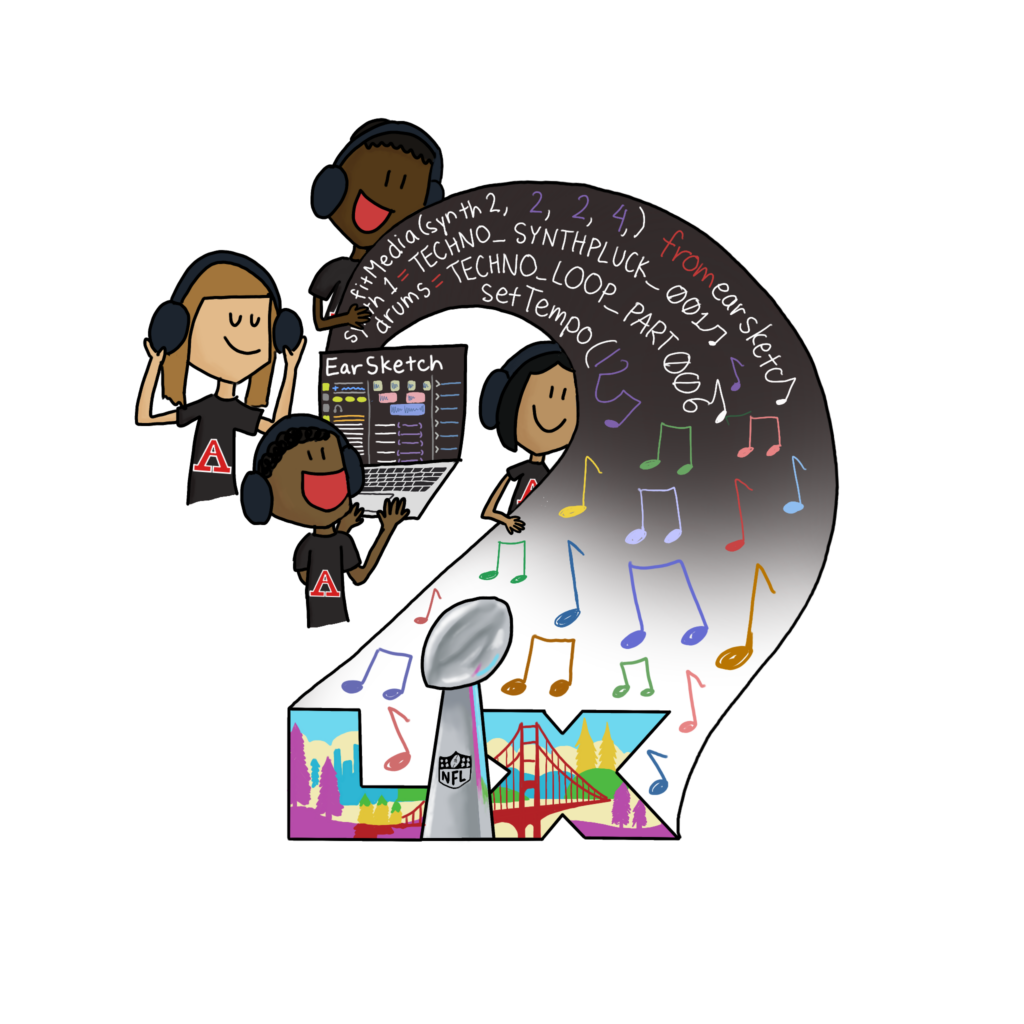
Coding for the Culture is an annual competition that takes place during the week of the Super Bowl. Students from a local high school present music they have coded using the code editor EarSketch to a panel of judges, and the winning piece is typically played in the locker rooms at the Super Bowl.
This year, 30 students from Aragon participated: 10 students taking Engineering Technology, 10 in Computer Science and 10 in Digital Photography.
Over the course of three FlexTime sessions, Coding for the Culture employees held Zoom calls to teach students how to use EarSketch, which were held in engineering technology teacher Arron Apperson’s classroom.
“I hope that kids understand that computer science and these types of technologies [may] often seem out of reach because of [their] complexity, [but] they’re not,” said digital photography teacher Nick Carrillo. “Computer science is fun. I don’t think a lot of students make the connection of coding and fun and putting it together. And this really is an opportunity for kids to make that connection.”
The students’ music was Super Bowl themed, and the categories of music that the students created included anthems for the competing teams, a halftime show remix, a game day hype track, commercial jingles and victory celebration.
The competition was hosted by JReid InDeed, a philanthropic organization. Justin Reid, a professional football player in the NFL, founded the organization to support underprivileged youth. The aim of Coding for the Culture is to bring computer science education to students while allowing them to express themselves through music.
“The students love it,” said Alanna Murray, Executive Director of the JReid InDeed Foundation. “Sometimes some of [the students] are intimidated [by] coding, technology, HTML, JavaScript and all these different coding languages, not realizing [that] once you actually get into it, it’s a little bit simpler than you expected. It’s opening their minds towards something new.”
Each year, Coding for the Culture collaborates with a high school in the community where the Super Bowl is held.
“Because [Reid] was a student at Stanford, he reached out to his previous professor,” said College and Career Advisor Queenie Hua. “Then [the professor], because [of] his community partnership with Aragon, invited Aragon to do this event with him … [because] we hosted his students before for their final exam projects [where they] go to [a] high school and do a presentation on AI in the classroom for the students and work with them on a project.”
In order to take part in the competition, students learned how to use EarSketch to create 30 to 45 second pieces of music. Students could code using Python or block coding, and could work alone or in groups of two to three.
“It’s fun because you have to figure [EarSketch] out,” said junior Alexander Gutzman. “But it’s not so hard to the extent where it’s annoying you because you can’t figure out how to make certain sounds happen … I was working on a [synthesizer] for constant movement in the song. I didn’t know exactly which [synthesizer to use], but then you can put [‘synthesizer’] into the search bar of the different possibilities, and you can try them out and then figure out which one sounds really good.“
Students could use preset sounds, including clips from famous songs, apply effects or create their own sounds to produce a song.
“I’m using this as an opportunity to familiarize myself with coding and incorporate my love of music into that because I’ve always been interested in music composition,” said sophomore Leah Magliulo. “I play with MuseScore; sometimes I’ll write music but I haven’t ever really tried making beats and remixes based off already existing soundtracks.”
Some students believed that Coding for the Culture was more enjoyable compared to other competitions.
“If you compare this to those traditional hackathons, [here] you actually have fun making it,” said junior Allison Hsu. “[And] you can actually listen to the music that you make. Meanwhile, [for] hackathons, are you [really] gonna use all that [code]? This is [an] actual functional thing.”
The winners of Coding for the Culture were junior Isaac Cheung, Magliulo and senior Luke Novak in first place; junior Alina Liashenko in second place; and juniors Emi Lo and Claire Dong in third place.
“It was a fun, once in a lifetime experience,” Magliulo said. “My team … thought outside of the box the most and I think that’s what made us stand out. We incorporated our own sounds, we uploaded our own music and had lyrics.”
Coding for the Culture is expected to take place in Los Angeles in 2027.