Eden Kwan
Wake up. Eat. School. Train. Sing. Dance. Sleep. Repeat.
This is the life of thousands of hopeful K-pop trainees, working tirelessly to balance their academic lives and the rigorous preparation they must undergo to achieve greatness.
These trainees sacrifice their childhoods, their social life and sometimes education to debut, typically doing so as minors. They’re thrust into the public eye at an underdeveloped age and they only seem to debut younger and younger as time goes on.
Take the leader of popular girl group TWICE, Jihyo Park, who began her journey to become an idol at 9-years-old, or renowned soloist BoA, who began training at SM Entertainment at age 11 and debuted at 13.
Debuting minors forces a child into a very public occupation and may be pushing the boundaries of what the idol is comfortable with, especially when their popularity begins to soar and they become victims to paparazzi and swarms of crazed fans.
“I was at [an airport] in Korea and P1Harmony came in and it was so chaotic,” said junior Naomi Dang. “Everyone was screaming and crowding, rushing towards them … I’m sure it was really scary for the idols as well.”
Though the members of P1Harmony are all currently adults, this sort of fan conduct is not limited to adult groups — underage idols still risk being crowded and overwhelmed by this terrifying behavior.
Additionally, K-pop companies are seemingly unafraid to have younger idols be part of mature concepts, allowing them to take part in songs or albums with suggestive themes.
For example, Ni-Ki from ENHYPEN debuted at only 14-years-old. When the group released their hit song “Fever,” which featured considerably racy lyrics and a rather sensual music video, many listeners took to sexualizing the teenager and treating him like he was an adult.
These incidents are too common in the K-pop industry and are an unacceptable way to portray an underage celebrity. It makes one wonder why companies would have minors sing about such topics when they could simply wait for them to reach maturity.
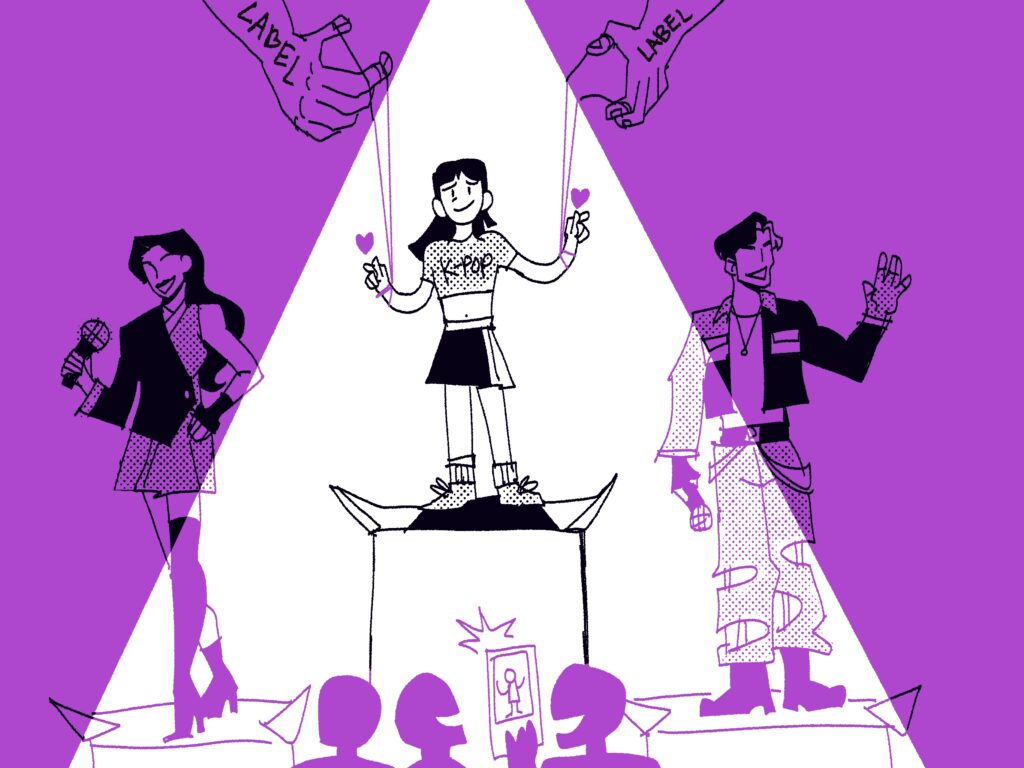
A likely explanation for debuting minors is an attempt by agencies to increase an idol’s industry lifespan. Because K-pop idol contracts typically last for seven years, by debuting younger idols, companies can maximize the amount of time they are on stage and gain more profit, leading to idols debuting at 16, 15 or even 14-years-old.
However, even though some K-pop companies are motivated by business incentives to debut minors, some idols themselves are eager to debut as soon as they can. Many are fueled by their desire to find success through a lifelong idol career, despite the many challenges they undergo in the process.
“If it’s something that [the idol] really, really wants, then good for them: they’re chasing their dream,” said sophomore Audrey Joe. “But they also have to make a lot of sacrifices, like giving up [their] education [and] moving away from [their] family. [They also] have to put a lot of trust in strangers.”
Though it’s admirable for a teenager to be so determined to achieve their goals, this decision doesn’t come without its downfalls. The mental health toll that debuting takes on an individual can be enormous, with constant feelings of inadequacy weighing down on oneself, which is heightened by the fact that they are young.
“[Underage idols may have] eating disorders because they have to be in good shape and have to have good looks or good skin all the time,” said sophomore Dylan Soo Hoo. “It can be really hard on them because trainers are really strict … They can have anxiety because some trainers have an eye on one person and they’ll [critique] that person really hard … Sometimes [trainers] say they’re not good enough to become a K-pop idol.”
Both the process of debuting and the career of being a K-pop idol can have incredibly damaging effects on a person’s mental health, as well as their overall life experience. The normalization of putting minors into an intensive and draining position has to be diminished, as it’s evident that companies prioritize efficiency over the well-being of their employees.
Even if a minor is willing to take on the exhausting challenge of idol training to support their dreams, companies should not be thrusting underdeveloped adolescents into the public eye. Minors are not informed enough, nor psychologically mature enough to make this decision. It is the company’s responsibility to act in the best interest for their employees, even if this means opposing the pursuit of profit.