Lillian Huang
On Dec. 28, 2025, anti-government protests sparked across Iran due to the economic instability and lack of support felt by citizens from the government. Protests, as well as the Iranian government’s response, caused mass casualties and a death toll of tens of thousands, although reports vary on the exact number.
Inflation, the leading cause of disruption, has skyrocketed. The price of food rose by an average of 72%, and purchasing power has dived by more than 90%.
“Bread was [around] 30 cents, and now [it’s] $3 to $5,” said sophomore Kiana Aref Adib. “My uncle [and his family aren’t] that well-off right now, so it’s a really big struggle for them. It’s insane how high the price [rose] for basic groceries.”
The rial, Iran’s currency, reached a ratio of 1.36 million rial per U.S dollar in late December, a record-low.
“In my family [we talk about] gold prices: one day, you should be buying gold, because it’s at such a cheap price [in] U.S. dollars,” said sophomore Arianna Aref Adib. “But another day, [it changes and you] shouldn’t be getting it because it’s so expensive. I would love for the currency of Iran to have be at a set [value] rather than [fluctuating].”
Iran weakened after facing economic sanctions placed by the U.S. preceding Iran’s revolution, the United Nations enacting sanctions over Iran’s nuclear programme in 2006 and Israel’s attack on Iran in June 2025, which caused a 12-day war.
The protests preceded a nationwide blackout, preventing news organizations from receiving and reporting live updates, as well as phone calls, outside connection and internet access to citizens. The death toll was estimated between 5,000 to 36,500, 24,669 were arrested and 2,109 sustained serious injuries. Shopkeepers have shut down due to the chaos in the streets. Vandalization and tensions between the government and the Iranian population have continued to heighten.
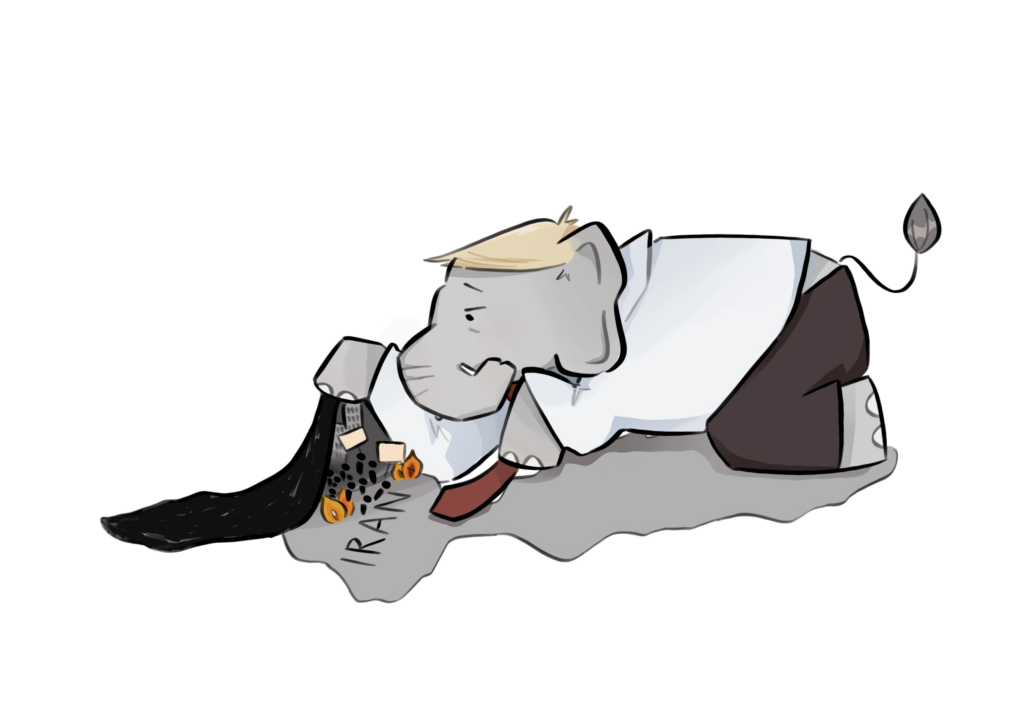
President Donald Trump made very serious threats in response to protests, stating that he will take action against the Iranian government if they continue to kill protesters. Such threats are unsubstantiated, causing distrust amongst Iranians.
“As an Iranian, I would really want Trump to do something [to help Iran],” Arianna Aref Adib said. “But as an American, I don’t want to get involved in a war … As [an Iranian-American], it makes me really question [myself] identity wise, and I’m stuck in the middle.”
Some say that Trump’s threats are hypocritical, especially considering his current deployment of Immigration and Customs Enforcement agents, who have also killed citizens.
“[Trump] wants to be involved in things and make it seem like he’s doing things when he’s not,” said sophomore Mckenna Lindberg. “[Trump] wants to draw attention away from what’s currently happening to our country so that he can [say] ‘sure, I’m killing all people in our own country, but I’m helping other people.’ He [has] a very strange [foreign] policy, and he’s trying to find new allies after he’s damaged so many of the relationships [with] the countries in the North Atlantic Treaty Organization and a lot of European countries.”
The messy political climate between America and Iran, especially due to American allyship with Israel, has contributed to the hostility.
“There’s always merit to trying to improve relationships [in] international affairs; it’s always good to have relationships that are friendly on both ends,” Lindberg said. “[America can] at least try to figure out how we can help [Iran] fix [their] economy and how we can help get this country back on their feet. I don’t know how much of that is going to happen, just because international affairs is not the highest priority right now within the U.S. government.”
On the contrary, Trump stated that he plans on making peaceful arrangements as well as a treaty with Iranian officials.
“A lot of people are now starting to see that it isn’t right that he’s in office, and that there are things that he’s doing that [the population] don’t necessarily agree with, even within Republicans and really right winged people,” Lindberg said. “[Their opinion is] not changing completely, they aren’t doing a full turnaround, but because people are starting to doubt him, he’s losing popularity, and by painting himself as a white knight and a hero, he will be able to gain that popularity back, even if [his efforts aren’t] real.”