Written by Seona Srivastava and Ellie Blakely
The U.S. launched a military strike in Caracas, Venezuela and captured Venezuelan president and authoritarian leader Nicolás Maduro on Jan. 3. President Donald Trump then stated that the U.S. intends to “run” Venezuela for the foreseeable future, sparking debate about the future of both the Venezuelan government and U.S. foreign intervention.
The operation, which Trump referred to as a “large scale strike,” occurred around 2 a.m. local time. It involved 150 U.S. aircraft and 200 special defense forces, which attacked Venezuelan air defense to make way for U.S. military helicopters that were transporting troops to Caracas. Fatality counts vary, but Venezuelan officials say that over 100 people, including Venezuelan civilians, were killed in the operation, and U.S. officials report that seven U.S. soldiers were injured.
Once captured, Maduro and his wife, Cilia Flores, were transported to New York, where Maduro faces charges of narco-terrorism, conspiracy to import cocaine and other counts related to the possession of firearms. Prosecutors allege that Maduro worked with several large and well-known groups involved in illegal drug trade, including the rebel group Revolutionary Armed Forces of Colombia, Venezuela gang and crime organization Tren de Aragua and the prominent Sinaloa and Zetas cartels.
However, in his first court appearance on Jan. 5, Maduro pleaded not guilty and said he had been “kidnapped,” by the U.S. Additionally, experts say that while Maduro benefited from the drug trade, Venezuela is not a major conduit for cocaine distribution to the U.S. Trump also pardoned a former President of Honduras who was exporting cocaine to the U.S.
A TIMELINE OF ESCALATION
When Maduro came to power in 2013, he hoped to continue a socialist government using oil revenues for reform programs. Instead, economic collapse followed — funds were mismanaged, and Maduro was accused of drug trafficking and providing weapons to and coordinating with FARC.
During Trump’s 2020 State of the Union address, he described Maduro as an “illegitimate ruler, a tyrant who brutalizes his people.” The 2024 Venezuelan election, marked by widespread accusations of rigging and fraud, declared Maduro the winner. By January 2025, the Biden administration had recognized Edmundo González Urrutia, who was living in exile, as the winner and Venezuela’s rightful leader.
In July 2025, Trump secretly signed a directive to the Pentagon authorizing military force against Latin American drug cartels his administration identified as terrorist organizations. By August, the Pentagon had sent warships, fighter jets and troops into the Caribbean.
On Sept. 2, Trump ordered a strike on a Venezuelan boat, claiming it carried terrorists from another Latin American drug cartel. More strikes followed, which some international law experts characterized as illegal.
“We have no confirmation these are actually drug boats,” said senior Erin Finn. “There is a very high chance they’re just fishermen out trying to support their families … I hate when stability leaves regions because that’s families, people [and] communities being impacted.”
On Sept. 4, Venezuelan fighter jets flew over American warships in the Caribbean. By Oct. 2, Trump had ordered an end to all diplomatic outreach to Venezuela. November and December brought more airstrikes and escalation, until Jan. 2, when Trump announced via social media that U.S. forces had captured Maduro and posted a photo depicting a handcuffed and blindfolded Nicolás Maduro in custody.
COMPETING JUSTIFICATIONS
Maduro’s alleged crimes were one of the Trump administration’s main justifications for his capture, but opinions differ sharply on whether drug trafficking necessitates U.S. intervention.
“It’s a domestic problem the United States has no business interfering in,” said senior Javier del Rio. “[If people] traffic drugs through the United States, that’s not Venezuela’s problem. It’s the fault of the buyer who is bringing them into the United States. Just because they originated in Venezuela doesn’t mean the intention [is] or that there was a coordinated assault on American democracy because these cartels exist within the country of Venezuela.”
Some believe that Maduro’s reported connection to drug traffickers helps to justify the operation, reasoning that his capture will prevent drugs from being trafficked into the United States.
“The prosperity of the U.S. is what matters [most],” said junior Vidhu Thirunagari. “Drugs are definitely a big problem. So even if Venezuela wasn’t the main culprit [of drug trafficking], we gotta start somewhere. [It was] definitely a step in the right direction.”
OIL JUSTIFICATION
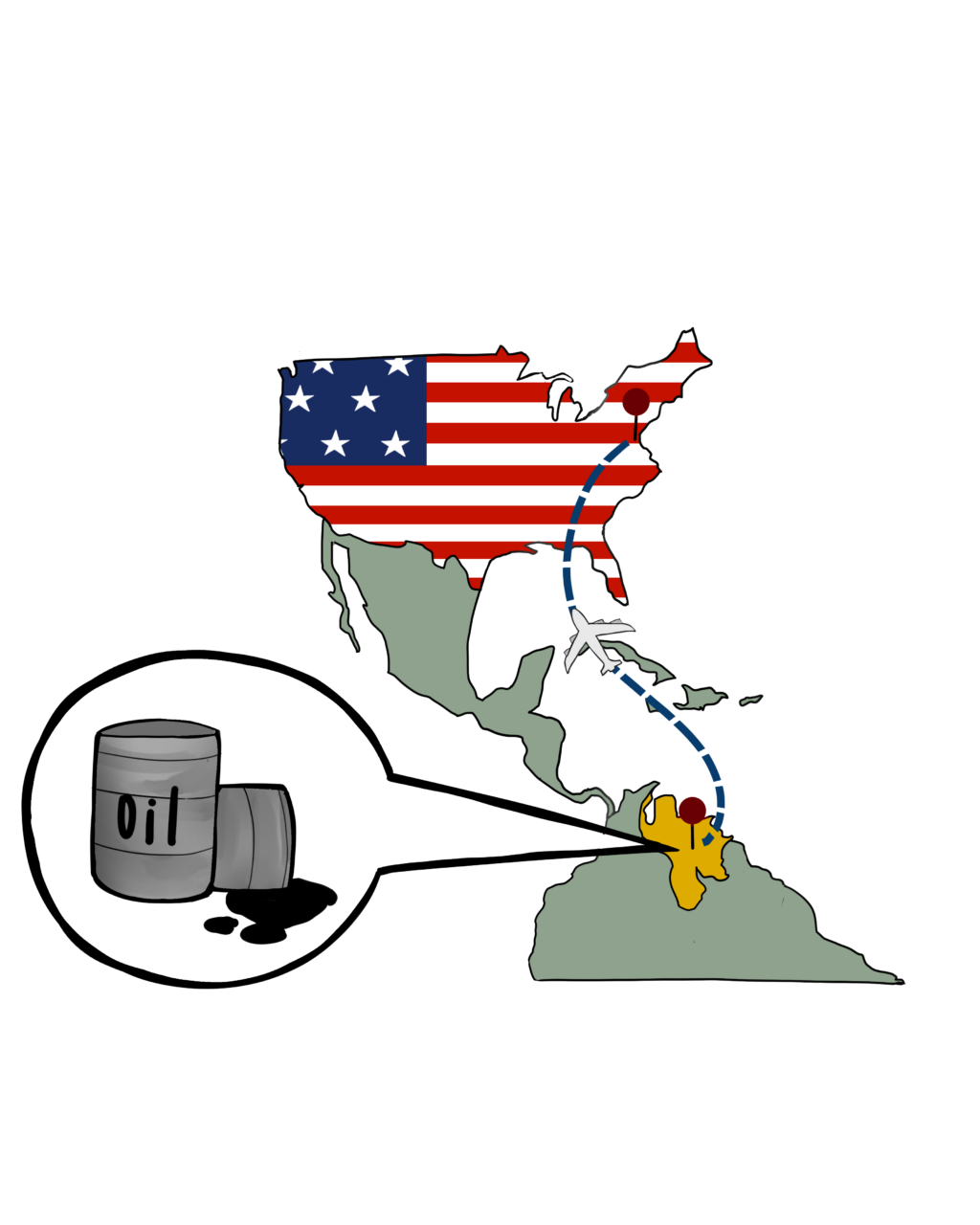
Beyond the drug trafficking narrative, Venezuela holds the world’s largest oil reserves, a fact Trump has referenced repeatedly when justifying the operation. According to United States Secretary of War Pete Hegseth, “President Trump is … deadly serious about getting back the oil that was stolen from [the U.S.]us and … reestablishing American deterrence and dominance in the Western Hemisphere.”
The claim that Venezuelan oil was “stolen” traces back to the country’s nationalization of its oil industry.
In 1976, Venezuela created Petróleos de Venezuela, S.A to manage the state-controlled sector of oil. While initially meant as protection from foreign companies and an opportunity for oil revenue to be diverted towards social programs, aggressive nationalizations under Hugo Cháavez — especially with major expropriations in 2007 — led to a severe decline in oil productivity.
“My dad and his family lived there for 35 years,” said senior Javier Del Rio. “The reason they left was because Hugo Chavez and the Chavismo government made it unsafe … After taking steps to become more authoritarian, abolishing term limits and rigging elections, the [nationalized] oil led to the [top] 1% of Venezuelans benefiting from the oil money. People in the middle and bottom never got that kind of wealth, power or security. After 27 years of people not having control over the future, [of] not having enough to eat for the week, [of not being able to] speak up for yourself [at] risk of being kidnapped, arrested or shot, the initial sense [after Maduro’s capture] was [freedom].”
When Chávez nationalized the industry, he fundamentally altered contracts with major U.S. oil companies like ExxonMobil and ConocoPhillips, seizing their assets and operations without adequate compensation for their property losses, leading to billions of dollars in investments lost. This history forms the justification that frames the current intervention as reclaiming American property rather than simply seizing another nation’s resources.
On Jan. 6, Trump announced Venezuela would begin giving some of its oil supplies to the U.S., promising a “tremendous amount of wealth out of the ground to the people of Venezuela, [Venezuelan immigrants] and to the United States of America in the form of reimbursement for the damages caused us by [Venezuela].” The crude oil variety found in Venezuela requires extensive refinement, but it’s compatible with U.S. refineries.
Beyond the immediate economic benefits, Venezuela holds strategic value for emerging technology. Venezuela sits within the Guyana Shield and Orinoco Mining Arc, a region rich in rare earth elements essential for artificial intelligence infrastructure, specifically materials critical for semiconductor fabrication and precision manufacturing tools that underpin AI systems.
As AI systems move from experimental to operational deployment, physical infrastructure becomes the main constraint rather than software design, positioning Venezuela as a potential source of both the minerals and the energy needed to power the massive data centers required for advanced AI development.
“We’re entering a point where the grid we have for energy isn’t enough to sustain AI because [it] needs so much power,” said senior Matthew Chong. “Trump’s policy [are] loosening all the restrictions for AI [to be] able to keep ahead of China and their AI advancement. Whoever reaches [artificial generative intelligence] will control the future of the world … It’s such [a matter] of national security that they will do anything to [prevent] the oil industry [from dying]. If we don’t help the oil industry, then we shoot ourselves in the foot.”
Industry forecasts support this view: AI and hyperscale data centers could require an additional 30 to 50 gigawatts of power capacity in the U.S. by 2030, equivalent to dozens of large power plants.
PUBLIC AND LEGAL CONCERNS
The public’s reaction to the raid has been mixed. Some believe Maduro’s capture and the U.S. decision to “run” Venezuela will lead to a better future for the country.
“[U.S. control of Venezuela] is not inherently bad,” Thirunagari said. “It could turn out for the better … The U.S. is a great place. Obviously people don’t like having other people rule over them, but in the long run, it might be better in regards to government and infrastructure and school systems.”
Additionally, some appreciate the brevity and precision of the operation.
“Traditionally, the U.S. [participates in] very drawn out wars, but this was more of a strategic and surgical strike,” said senior Matthew Chong. “Taking a whole president and [bringing] them to the U.S. in a night saves more lives than if [the attack] was drawn out.”
Many have also expressed concerns about the legality of the raid. Abroad, U.N. officials, other nations and legal scholars say the raid violated international law and posed a threat to Venezuela’s independence.
Some justify the military operation by questioning the legitimacy of international law.
“Maduro wasn’t democratically elected,” said sophomore Veer Bhalla. “He rigged the election [and] took out his political opponent. International law sometimes doesn’t have to be followed. It’s more of a guideline … [It’s] very strict [about] the way you can’t do certain things, but sometimes those things have to be done.”
Violations of international law are often rationalized through citing self-defense, necessity or a humanitarian crisis. These notions have established dangerous precedents, such as escalating geopolitical tensions and legitimizing genocide, enslavement and other forms of crimes against humanity. Thus, these explanations are usually highly contested, controversial and viewed as attempts to create impunity rather than true legal exceptions, discarding the humanitarian impacts of violent and destructive international law violations.
“[My family] can’t return to my grandmother’s entire home region in Jalisco because of severe cartel activity,” Finn said. “People [dying] during the Venezuelan operations with bombings is something people gloss over … Other than some strange sense of nationalized glory, what might one get [from] this? Not much.”
Bhalla acknowledged the human cost but maintained his position.
“Obviously civilian deaths should hopefully be prevented at all times,” Bhalla said. “But in operations like this, there’s bound to be some deaths.”
“AMERICA FIRST” CONTRADICTION
Despite his justifications, Trump’s actions in Venezuela directly contradict the “America First” philosophy that defined his 2016 and 2020 campaigns, which were centered on ending foreign interventions and focusing on domestic priorities. His supporters, particularly within the Make America Great Again MAGA movement, had long opposed exactly this kind of military action in other countries. For many, this operation exposes a fundamental hypocrisy in the administration’s stated principles.
“The America First policy is a lie,” Del Rio said. “The whole premise of invading and involving ourselves in a different country’s domestic situation because it would be better for us is inherently hypocritical against ‘America First’ because the idea is that you want to divest from other countries and not have stakes in foreign affairs. To me, ‘America First’ stands more for ‘Trump first’ or ‘government interests first’ or ‘power first.'”
This administration, however, rejects this characterization. According to Hegseth, this operation “is about the safety, security, freedom and prosperity of the American people,” staunchly declaring: “This is America first. This is peace through strength.”
However, many remain unconvinced and unswayed by the administration’s framing.
“I already feel negatively towards the [Trump] administration,” Del Rio said. “Any chance to do something positive and productive in Venezuela has been overrun with a desire for power. [They’ll go to] whatever lengths to get that power. Whether they go to Venezuela or Greenland or Iran or Cuba or Colombia, nothing they do is going to be for the people of that nation.”
VENEZUELA’S POLITICAL FUTURE
In Venezuela, Maduro’s supporters have kept control of the government. Maduro’s former vice president, Delcy Rodríguez, began serving as the acting president of Venezuela following Maduro’s capture, even as the Venezuelan opposition claims Edmundo Gonzalez Urrutia to be the rightful leader.
“[She] is not as extreme as Maduro,” Tiwary said. “He already has a lot of mechanisms and influence in place. If [America had] picked a person popular by the people and not by power and legislation, Venezuela [would have] a high risk of starting a civil war.”
Trump has caused additional controversy by backing Rodríguez over members of the opposition, especially since he heavily condemned and captured Maduro, to whom Rodríguez is an ally. This suggests that the leadership of Venezuela and the status of democracy in the country may not be as important to Trump as the prosecution of Maduro and U.S. access to Venezuelan oil reserves.
Overall, life in Venezuela remains similar to before Maduro’s capture.
“Day-to-day life hasn’t really changed at all, and people are still getting arrested for celebrating the capture of Maduro in certain states,” Del Rio said. “It’s not like the U.S. can take down one [person] and then all of Venezuela’s problems are fixed. Maduro has so many people within the government, even people that aren’t within government — people in different neighborhoods that get money, weapons and drugs from him. If you take down the guy at the top and leave everything else, it just creates a vacuum of power that people are looking to fill.”
The intervention has added another layer of confusion to the already complex Venezuelan politics. It is unclear what Trump’s vague promise to “run” Venezuela entails, raising fundamental questions about what direct American administration of a sovereign nation would look like: its structure, scope and duration remain undefined. This ambiguity blurs the distinction between soft power influence and hard power control.
While unusual, there is some precedent for a military operation enforcing U.S. law on a leader of another country. In 1989, the U.S. invaded Panama to capture military leader Manuel Noriega and brought him to the U.S., where he was convicted of drug trafficking and other charges in a situation similar to that of Maduro. However, there are key differences between the two operations. Noriega’s capture was preceded by other military conflict between the U.S and Panama, and the U.S. did not otherwise intervene in the Panamanian government, unlike in the circumstances surrounding Maduro’s capture.
Even a democratic transition faces insurmountable obstacles due to the Maduro government’s deeply entrenched power.
“There are so many people in the streets in each city, each neighborhood that depended or are affiliated very closely with that government,” Del Rio said. “To bring [a different] leader into power would be dangerous.”
Many have concerns regarding the future of Venezuela given Rodríguez’s legitimacy, González Urrutia in exile, and a once revered Corina Machado facing backlash from the international community. Ultimately, whether the U.S. raid on Venezuela achieves lasting change with regard to the country’s government remains yet to be seen. In the meantime, the Trump administration appears to be increasingly intervening in foreign affairs with the goal of gaining assets for the U.S. and showcasing its power.