Recently, teachers have raised the question of implementing changes to Aragon’s bell schedule to better fit students’ education. Aragon currently follows the district’s model, which was the result of COVID-19 scheduling mandates. But after a visit from the superintendent where concerns about the current schedule was expressed, teachers were informed that they could propose edits to the district.
“The superintendent at some point said, ‘Listen, you guys are really upset about this, give me an alternative,’” said Carlo Corti, psychology teacher and one of the staff members spearheading the voting process. “We decided to find what we’re gonna do is just do some general feedback outreach to the faculty, talk about some different schedules, have a little conversation about the benefits.”
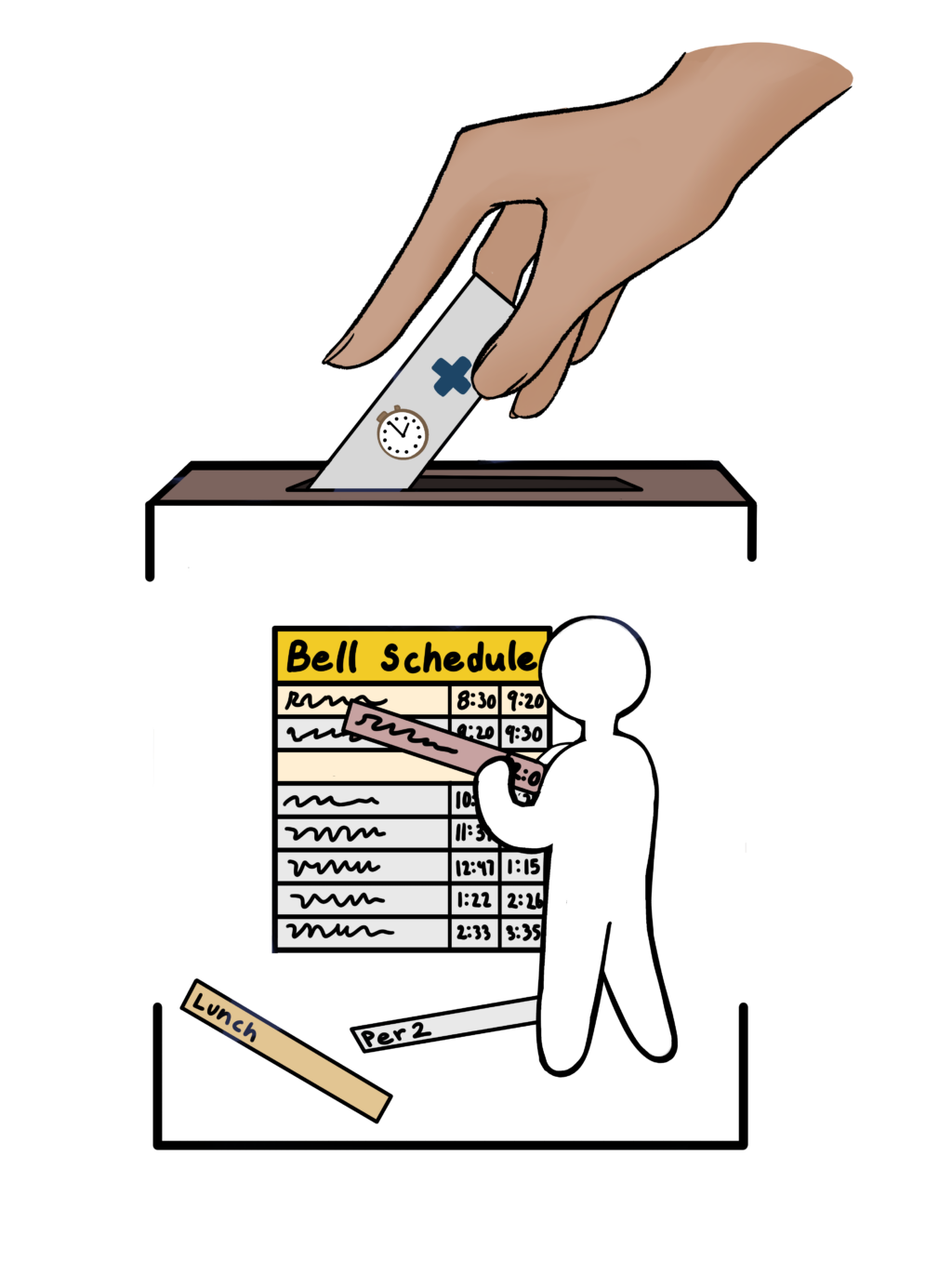
The ballot included options ranging from complete schedule changes, such as having just one block day per week, to minor modifications.
Some of the minor changes proposed in the ballot included moving FlexTime to after fourth period, shortening the seven minute passing periods and doing announcements during Flex instead of fourth period. Other changes like moving lunch between fifth and seventh period on block days and moving brunch to after third period on one through seven days were also proposed. Minimal changes to timing amounts serves to provide for more teacher collaboration time, instead of directly impacting students’ schedules.
“One of the primary things we’ve heard was [that] teachers really value their collaboration time with each other, and if there were a way to increase the amount of time that we had to work together to plan, … grade [and] work on problems of the school, that’d be beneficial,” Corti said. “That’s been the latest iteration of our surveys and schedules. [The idea has been that] if we’d made passing periods six minutes instead of seven, that would [give] a lot of teachers [a few] minutes more at the end of the day to meet, or if you did announcements during Flex times [instead of] during class, that would allow that to happen as well.”
A return to the pre-COVID-19 schedule of three one through seven period days and two block periods was also considered. In fact, the original shift away from this schedule sparked the conversation in the first place, as many found the district mandated change to San Mateo High School’s schedule — instead of the schedule Aragon staff had crafted to best fit the school — to be unfavorable.
“There was lots of work that went into [our previous schedule,” said Advanced Placement Biology and Advanced Biotechnology teacher Katie Ward. “Lots of thought, lots of visiting other schools, lots of looking at other bell schedules, talking to other staff about … advantages or disadvantages, … looking at our own population … [Switching to the mandated schedule] really did, for a lot of people here, [feel] very, very disappointing … [it was unfortunate] to have all of that work just feel like it was being completely ignored.”
While the teachers came to a general consensus that no major changes should occur to our current schedule, with more minimal changes yet to be discussed, this still begs the question of what students think. In a survey conducted of 78 students, the Outlook found that 70% believed the current schedule to best fit their learning. The most popular major change was switching to all block schedules. There were no particularly favored minor changes.
“We often listen to student voices and we will survey students, listen to student anecdotes,” Corti said. “We had a lot of information about what students thought was important. As an example, we know from Panorama data [that] students would love it if [class time ended on zeroes and fives]. It’s just simple, right? It makes sense … but it’s so hard to get the right amount of [required educational] minutes with that five and zero ending.”
Many students have also expressed interest in longer lunches. Unfortunately, the viability of that conversation is low, as 15 minute shifts require more movement in the larger schedule than simply adding on more time to the afternoon.
“[Extending lunch] would mean adding that ten to 15 minutes per day to the school day,” said assistant principal Andrew Hartig. “Where that becomes a little tricky is that the teachers also have a contract with the district that says it’s a seven and a half hour work day … with so many minutes starting before and so many minutes after. So 3:45 really is our hard, [and] stop moving beyond that would take something else.”
All in all, though many feel that changes to the bell schedule should be minimal, the possibility of change still suggests a positive trend toward school autonomy.