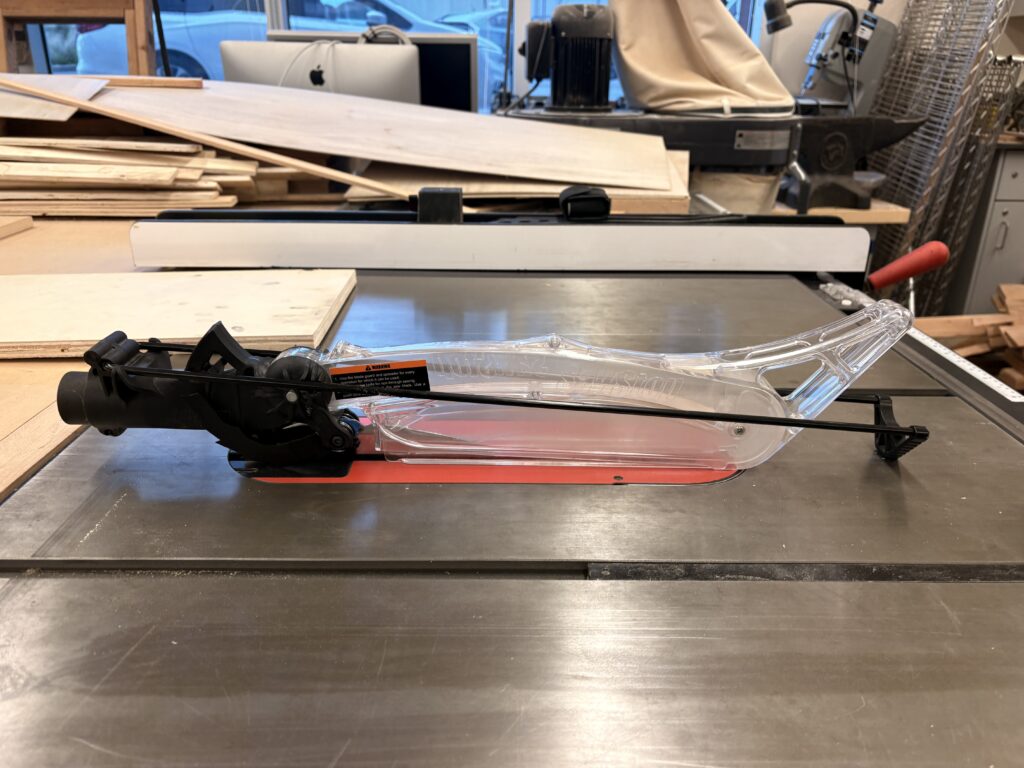
Table saw found in the shop.
Since late February, Aragon Robotics has been temporarily barred access from the shop — a space used for working with power tools. The shop area is associated with Arron Apperson’s classroom, and is used for Engineering Tech and Constructions and Trades.
Up until recently, robotics members from the three technical teams — FIRST Robotics Competition, FIRST Tech Challenge and Marine Advanced Technology Education Remotely Operated Vehicle — were granted use of this room after school.
The current restriction is the result of an incident in which a robotics member removed a safety guard from a table saw and did not reassemble the parts. This guard was one of many safety precautions of the saw, which includes a feature that immediately stops the saw upon contact with electrically conductive materials — like skin or metal.
“A student was unfamiliar with a feature on one of the saws, and [they] did not realize how to take [it] off,” said robotics technical mentor Geary Chew. “And I’m not saying that you’re not supposed to operate the machine without that safety feature … [But it] was designed to prevent materials from inadvertently flying off the machine while it’s being cut.”
A programming mentor had been present during this, but there was no mechanical supervision — someone overseeing the process, who was also familiar with the shop tools.
“This was a non-injury incident, but it could have been [an injury one] … I feel bad about it, too,” Chew said. “That day was Chinese New Year. I took off early … [and] we still had enough [mentor] coverage, but we did not have everybody watching the shop.”
The saw had been used to slice a piece of wood, a task that had been completed without incident. However, the circumstances under which this occurred raised concerns about safety policies in the robotics team, among other issues.
Within a week, a meeting was held with administration to determine how the robotics team should proceed.
“As a group, admin, Apperson and [robotics adviser Craig] Sipple all created a list of action items to make sure there’s more supervision present during the power tool usage … [and] make sure that mentors and students are better trained in power tool usage,” said senior robotics director Aayushi Kothari.
There were preexisting protocols in place for many of these issues: adults needed to be in the immediate vicinity, basic shop training took place at the beginning of the year. But this incident became a call for revisiting those safety and supervision standards and stricter enforcement.
“[We have to] draft a supervision policy for multi-space activities, which we already have, but we’ll write it down, re-evaluate and update the shop safety rules and training for students and adults, … recruit additional adult coverage [and] reinforce the procedure to announce when we are allowed to use power tools and when we aren’t,” Kothari said.
As a result of this process, which also led to the cancelling of a regular robotics meeting, two of the technical teams have found themselves lagging behind.
“We’re pretty much done with the fabrication that needs to happen, so it’s not as detrimental, because most of the assembly can happen outside,” said junior FRC design lead Reet Bhatia. “However, the entire process of the incident taking place, and then the conversations with mentors and admin, did effectively push us back one entire week, which means that the time that we budgeted for programming and for driver practice will need to get cut short.”
MATE ROV encountered similar difficulties, although their competition season comes later, toward the end of April.
“The sheer canceling of the meetings was something that worried us, because we have a timeline going, and a specific date that we wanted to test our robot by, and obviously, by delaying it, we weren’t going to be ready to test it,” said senior MATE ROV mechanical lead Emily Jane Vincent. “As of right now, we have fallen a bit behind, which is concerning, and especially as someone whose team wasn’t at fault for the closure it was like, why are we affected by this?”
To work around the lack of shop access, FRC and MATE ROV have outsourced some minor tasks, like cutting materials, to other schools in the area and mentors.
“We were able to ask DTech’s team to cut some plates recently for us .. and we were able to get other motors and stuff switched out with schools like Nueva,” Bhatia said. “It’s a part of gracious professionalism, [a value of FIRST].”
The season will come to the close at the end of April, and by then, the robotics team hopes to complete its review of the safety and supervision guidelines and implement its updated policies.