Lillian Huang
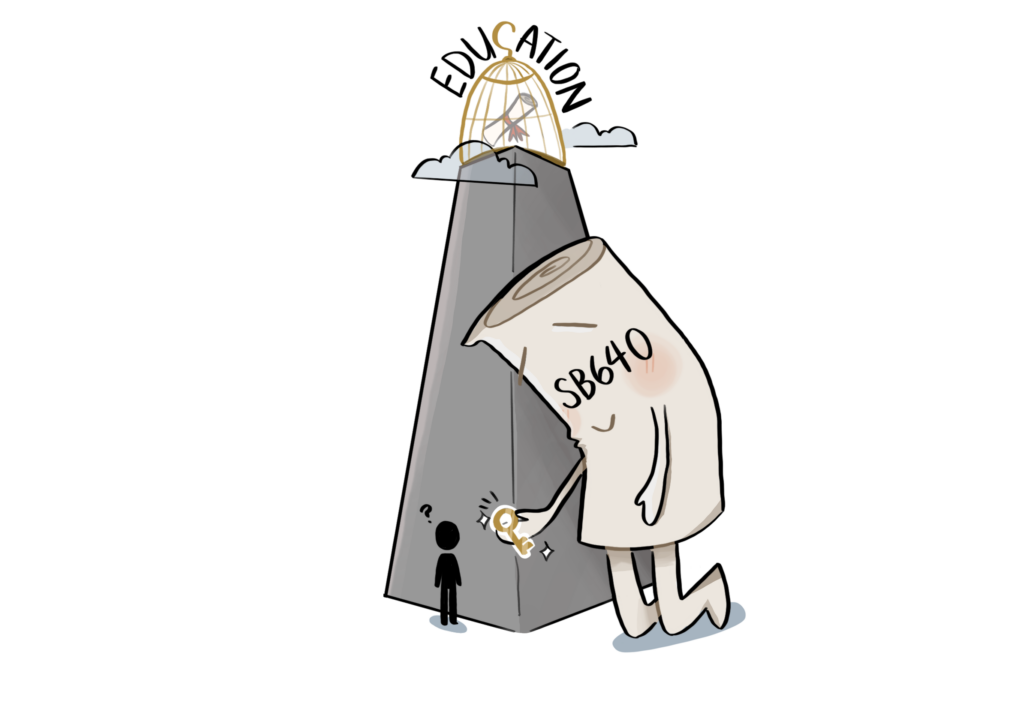
On Oct. 6, Gov. Gavin Newsom signed Senate Bill 640, granting eligible high school students direct admission into some California State Universities. Authored by Democrat State Sen. Christopher Cabaldon, the bill is effective beginning Jan. 1, 2026. Cabaldon stated the bill would encourage and expand accessibility to higher education.
Under the bill, eligible students meeting the CSU admission standard of a 2.5 or higher GPA who have fulfilled A through G high school courses will receive admission offers from CSU campuses on behalf of the CSU Chancellor’s office without a required formal application. Students can choose to decline the offer or complete enrollment steps to secure a spot.
“This bill [provides] an opportunity … to learn about college and to know that they have a choice,” said senior Heli Artola. “[For example,] there’s a lot of people in my family that didn’t apply to colleges because they didn’t know how to or they didn’t feel like they could get in. But with this new bill, it would be eye-opening to them knowing that a college chose them.”
However, some consider the possibility that relatively lowered bars for acceptance may negatively impact student performance.
“[Some] people aren’t going to be motivated to work hard … because they don’t feel they need to,” said junior Audrey Turner. “[People] need to have urgency to do their work, but not to the point where it’s impacting their mental health. It’s a fine line you have to walk.”
It is important to note that the bill does not guarantee placement into students’ preferred campuses, especially if their selected campus or major is oversubscribed. In such cases, placement into the universities depend on additional criteria, like higher GPA, to secure admission.
Additionally, the bill only applies to certain CSUs, such as Fresno State, California Polytechnic State University Humboldt, San Francisco State and others, which have faced severe financial problems due to budget cuts and declining enrollment in the past years. More popular CSUs, like Cal Poly San Luis Obispo and CSU Fullerton, are not subject to the bill and require the pre-existing application requirements.
Some contemplate how the bill may impact the prestige some students may regard colleges in.
“The standards, for some people, of prestige may be impacted, because people might [start] to see it as, ‘oh, now it’s easier to get into, so it’s less special,’” Turner said. “But overall, the people who go are going
[are] the people who are interested in higher education, … in getting a degree … [and] in trying new things.”
Another detail is that the bill only applies to Local Education Agencies, such as a public board of education; private high school students are not subject to the bill’s provisions. Some, like Sophie Farid, a junior at Crystal Springs Uplands High School, consider this to be a reasonable decision because of the resources private schools have access to.
“[We] have support for everything that you could possibly think of,” Farid said. “So from a standpoint of a Crystal student, it doesn’t affect us very much.”
Additionally, some students believe the bill is taking the wrong steps toward raising the standard of education for students across the U.S.
“[By] the time someone graduates high school, it’s too late to shoehorn them into college, especially if the past … 13 years of their educational experience has been of poor quality,” said junior Remy Chow. “You have to make sure that [their] education is good from the beginning … then everyone will be more prepared [and] more likely to go to college, and then you can increase your college enrollment without this … method.”
Many, like college advisor Mary O’Reilly, are eager to see the changes this bill will bring moving forward.
“I’m excited … to see how it rolls out,” O’Reilly said. “Maybe the first year there might be some learning curves that the state and different schools have to work through. But it’s going to open more doors for students [in general].”
Results from this bill are expected after the first season of fall 2027 applicants.