Lillian Huang
On Jan. 8, Gov. Gavin Newsom delivered his final State of the State Address, outlining his goals for a year and the progressive policies he oversaw in the last seven years.
As governor of California, he has signed legislation restricting oil and gas polluting operations near communities, brokered deals between labor and business groups for greater litigation and generally receives praise on embracing fiscal restraint, especially following federal funding cuts under the Trump administration.
Yet, despite the majority voter approval of Newsom, 54% think California is headed in the wrong direction, revealing a mixed consensus on his intent and approach to major policy areas.
HOMELESSNESS AND HOUSING
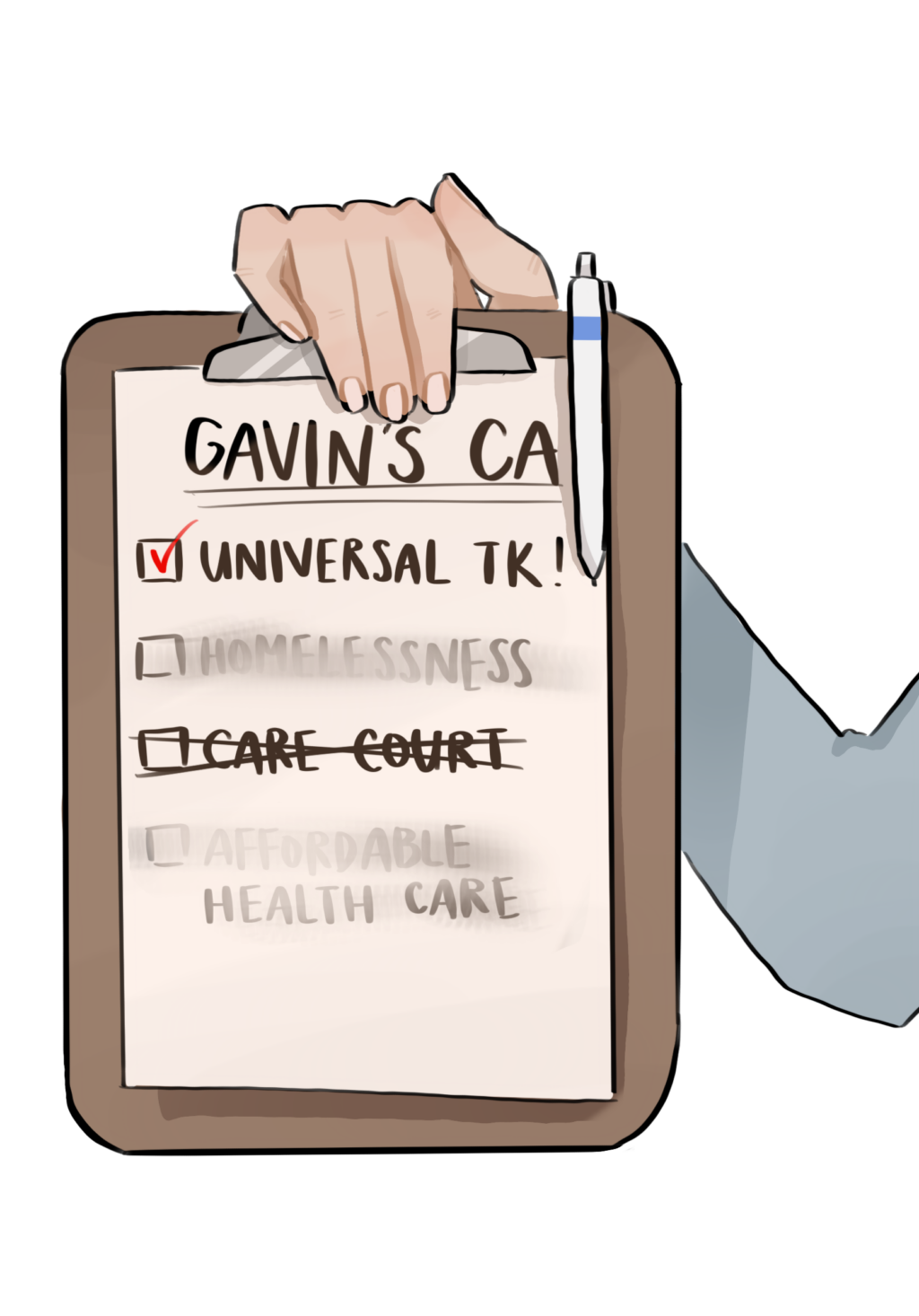
The homelessness crisis is one of Newsom’s signature policy areas. But critics claim he has yet to deliver substantial results.
Though policies like Homekey — which provides state funds to purchase and convert abandoned hotels into housing units for the homeless — and a $20 billion budget solely dedicated to the problem, his initiatives have yet to deliver on his 2018 campaign promise to build 3.5 million houses.
And while California’s unhoused population has dropped by 9% statewide, the state makes up 24% of the nation’s homeless, a figure that continues to rise.
While these numbers can be attributed to the expensive cost of living in the state, critics also complain that programs like Homekey shift the financial burden of caring for the homeless to local and county governments, which does not guarantee protection from federal cuts. They also claim that his policies fail to address the root of the crisis.
“[It’s] scorched earth,” said senior Erin Finn. “He’s trying to clear the streets. That’s not addressing the root problem … poverty, drug use, lack of compassion. [That] leads people to desolate [situations] forced to be on the streets and not [having] anywhere to go … [It’s] more of a question of mental health than policing but he’s definitely leaning into the policing.”
MENTAL HEALTH POLICIES
One of Newsom’s most anticipated policies was the Community Assistance, Recovery and Empowerment Act, which provides behavioral health care plans through civil court petitions for adults with severe mental illnesses.
Projected to help 7,000 to 12,000 Californians, many families were disappointed; about 45% of petitions get dismissed, and successful results across counties range from less than a thousand to none. Yet, while critics claim it has done nothing to solve the inadequate housing and mental health services, others believe the program, with improvements and resources, holds potential.
“It’s not right that they advertised [that] they could … help way more people than they could,” said junior Lia Alves. “But it’s partially our responsibility as people and members of the community to help out others and … support the funding for this so that more people can be helped.”
In 2025, Newsom signed SB 27 to expand CARE Court’s eligibility, though the changes it will bring are still unclear.
EDUCATION
One policy area Newsom has been praised for is his efforts toward making education universally accessible.
“[When] I went to transitional kindergarten, the age range … was any children turning four or five between September and December,” said sophomore Urjita Debnath. “We had 20 kids, maybe less. But it really helped because I only went to one year [of] preschool and … while I was good enough for preschool, I was in a weird phase [academically between preschool and kindergarten].”
Since then, public-funded TK eligibility expanded from 50,000 to over 500,000 4-year-olds, mostly under Newsom. He has also expanded child care and preschool slots for low income families, while removing barriers to higher education and increasing funding for the University of California and California State University system.
NATIONAL PRESENCE
It is no secret that Newsom is considering running for the 2028 presidential election, given his increasing social media presence nationally, especially after President Donald Trump took office last year. Through tweets and public addresses, Newsom depicts himself and California as the “beacons of democracy,” a foil to the Trump administration, and has opposed them through controversial measures like Proposition 50, which redistricted California in the Democrats’ favor as a response to gerrymandering in Texas to help Republicans.
“A complaint I see online is that people think Democrats don’t do enough in response to Republicans,” Finn said. “[Newsom’s] doing pretty good at appearing as a contrast to that.”
However, he has also received criticism for trying to appeal to more right-wing activists, primarily through his podcast “This is Gavin Newsom.”
“He’s like a Democrat Donald Trump in that he’s extremely populist,” Finn said. “[He’ll] say anything he thinks would help him get voted. So he does flip-flop on stances a lot based off the tides of the day … For example, [regarding] transgender rights, … when he’s governor of California, he’s like, ‘I support that.’ Then he did a podcast for national audience and was like, ‘not so much, actually.’”
However, his attempts at appealing to various audiences also garner mixed responses from viewers concerned about his sincerity and values, leading to comparisons with political phenoms like New York City Mayor Zohran Mamdani.
“[While Newsom] did start his big campaign before Zohran Mamdani, Mamdani built himself as [someone who] cares for his people,” Debnath said. “I think that’s what Newsom’s trying to do, but instead … he’s trying to connect with everybody in the country, which isn’t going to work because of how big this country is and the many different people in it.”
With eyes on Newsom on a state and nationwide level, many expectations are set upon him as he focuses on finishing the initiatives he started.