Dahlia Selig
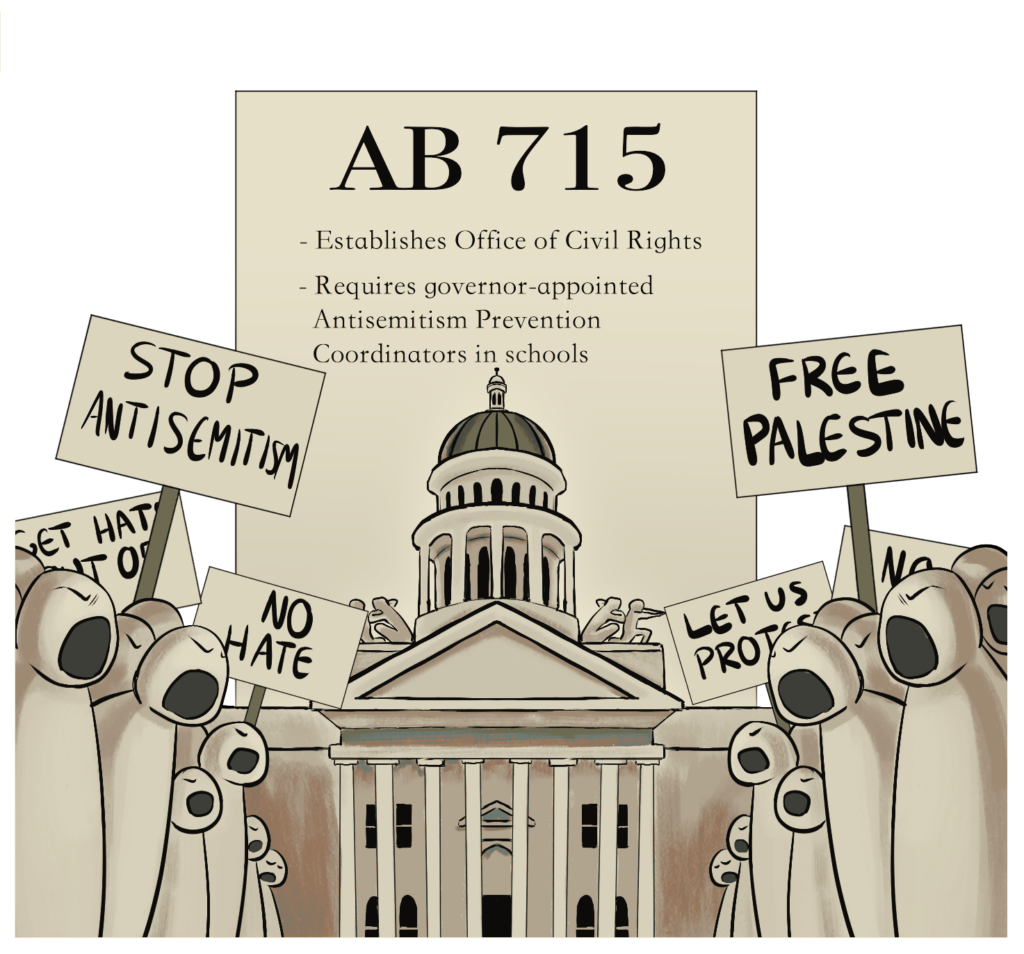
On Oct. 7, Calif. Assembly Bill 715 was signed into law by Gov. Gavin Newsom. The bill went into effect Jan. 1. It established the Office of Civil Rights and required the government appointment of an Antisemitism Prevention Coordinator to prevent antisemitism in schools and advise the California legislature on antisemitism prevention.
First proposed in February 2025, the bill went through multiple amendments, facing debates between lawmakers about what constitutes antisemitism and other issues. The final version broadly addressed bias rather than directly mentioning the Israel-Hamas war.
“The [Senate] voting for the bill was 71 to zero and then 35 to zero [in the Assembly] because no one would dare vote no on it,” said senior Sevara Saidova. “They didn’t want to sound antisemitic.”
Besides causing debate in the California State Legislature, the bill has also caused controversy among the public.
Major supporters of AB 715 were the Jewish Public Affairs Committee of California and the American Jewish Committee, who believe the bill will tackle antisemitism. It promises that “the Antisemitism Prevention Coordinator [will] develop, consult and provide antisemitism education to school personnel to identify and proactively prevent antisemitism and to make recommendations … to the Legislature.”
According to the California Department of Justice, around 15% of California hate crimes were anti-Jewish in 2024, an uptick from 8% in 2014.
Some students agreed the bill could yield positive results.
“It will [hopefully] reduce … derogatory language in schools,” said junior Tahlia Shahani. “It [can be] hard for big public schools to respond to small instances of discrimination.”
Meanwhile, major opponents included the California Teachers Association, American Civil Liberties Union and Muslim organizations. Opponents claim the bill censors pro-Palestinian voices and constitutionally protected speech.
“People are gonna be a lot [more] wary of … [spreading] their own opinion,” said sophomore Emma Sakai. “Teachers shouldn’t be teaching rhetoric that is antisemitic [but] it’s going to make conversations, especially about the conflict in Israel and Palestine, a lot harder … [even though] those are conversations we need to be having.”
Modern World History teacher Scott BonDurant argues for a bottom-up approach instead.
“Schools like ours have disciplinary policies in place already around hate speech,” BonDurant said.
“Aragon is a great example … Last year, when we started seeing increases in dehumanizing language, the whole school … did a full campaign and saw … [a] reduction in that … language. Do we need a full statewide bill that legislates what we can and can’t teach in our classrooms? We didn’t. This sets a dangerous precedent.”
Several Aragon students also shared their expectations of the bill, considering how it might affect Aragon classrooms.
“I don’t think that it would help Jewish students … because if they’re experiencing something right now they can go and report [it],” Saidova said. “I definitely agree with the intent of the bill, but [not] the implementation … because it [stops] discussion in classrooms.”
BonDurant worries about potential free speech violations.
“For any population, any religion, any race, any ethnicity, we teach our students to be thoughtful about our sources and potential bias,” BonDurant said. “If we are … not allowed to present any sources that are critical of the foundation of the State of Israel or its right to exist or even that are pro-Palestinian, we’re not giving our students … the chance to corroborate and make up their own minds. That is the hallmark of good social studies teaching. That’s concerning to me … [that] we’re moving away from free speech.”
In December, a federal judge blocked a request to pause the law by citing how teachers do not have the First Amendment right to insert personal political views into education and claimed it’s language mostly builds on California’s current education law banning discrimination. There is still an ongoing lawsuit with plaintiffs planning to appeal to higher courts.
Although the bill has passed into law, the authors of the bill acknowledge that there is still more to be done with the bill, specifically with the vague phrasing in several sections. Furthermore, this year, California lawmakers will need to clarify how instruction that doesn’t include as much bias will be implemented.