Dahlia Selig
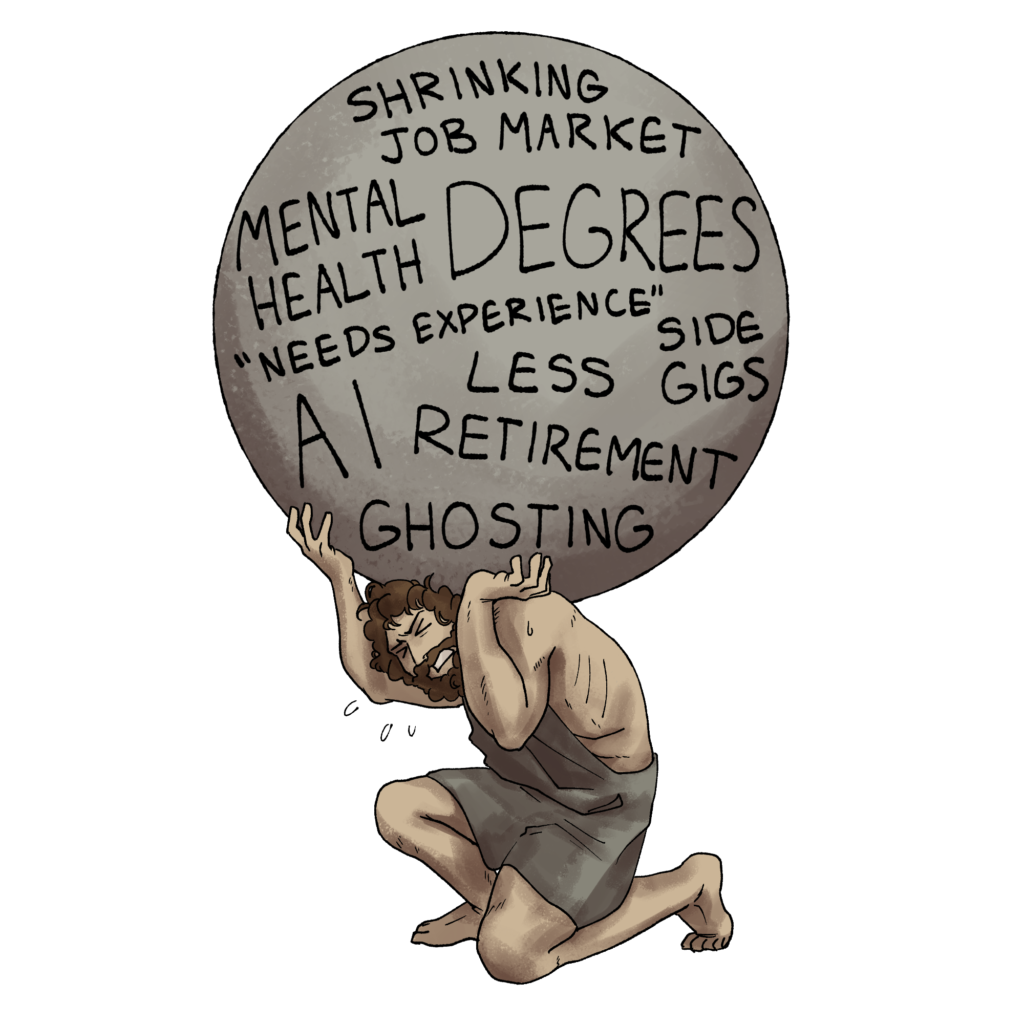
According to the Federal Reserve Bank of New York, in December 2025, the unemployment rate for young Generation Z people aged 22-27 was 7.8%.
“We’re cooked,” said sophomore Linus Zhao. “On Instagram, TikTok, YouTube Shorts or Snapchat, you might have seen some [videos] where [there is] a person and they have a giant spreadsheet … and it shows that they applied to [work at] 1,000 places, but in the end, they only got offers from one or two places. That’s scary.”
Though industries like healthcare added 37,000 jobs last month, total employment excluding health care declined by 367,000 since last year.
CAUSES
Many view entry jobs requiring prior experience as a barrier to employment for young people. LinkedIn found that 35% of entry level jobs required three or more years of experience, with 60.3% in fields like software requiring such experience.
According to World Economic Forum, entry level jobs as a whole have declined by 29% from January 2024 to September 2025, which has resulted in greater competition among Gen Z workers.
“I am noticing that students are facing more competition in general when it comes to jobs and internships, especially for positions that offer meaningful and hands-on experience,” said Career Technical Education Coordinator Queenie Hua. “It’s not necessarily [that] the opportunities don’t exist … It’s just that employers are more selective, and many are looking for candidates who already have some level of experience.”
Employers tend to avoid training employees by hiring those with several years of experience and advanced degrees, so many jobs are hiring college students who completed internships.
“I’ve been trying to apply to some jobs myself,” said sophomore Robert Mo. “It’s difficult to find a good job — I’m not even worried about the pay at this point. They either require me to be older or have a degree of some kind … I’d be qualified to do some of these jobs, but they just don’t want me.”
The percentage of older workers aged 55 and up has increased from 15% to 23% in the last 20 years due to higher life expectancy and the need to save for retirement. However, older people may not be competing for the same jobs as young people.
“The retirement age is going up and up and up,” said senior Aidan Schneider. “My parents are both near 60, and they’re not retiring for another couple years. [Although] older people [are] getting these jobs, older people generally have stayed in the same jobs, and those jobs aren’t really changing … All these new jobs are sparking up, so people could get those jobs, so to blame all the old people for taking up all jobs is pretty bad.”
Difficulties for young people to obtain jobs can also be attributed to the “low fire, low hire” job market, which means companies are hiring fewer workers but also firing fewer workers. In December, the hiring rate was 3.3% and steadily decreasing.
This can be attributed to uncertainty for businesses, which makes them hesitant to hire young workers. President Donald Trump’s tariffs and mass deportations have created uncertainty due to increased costs and reduced labor supply.
“Because the economy is less stable, people are more hesitant to hire new [graduates],” said Leo Zhuang, an employed
member of Gen Z. “[The instability exists because] the president can single handedly raise the Dow Jones [index, which tracks the stocks of 30 high-profile companies] … [If] he makes a comment, [that] we go bomb Iran [or] we kidnap the Venezuelan president, then [the economy changes] overnight.”
One of the potential causes behind the high unemployment rate is artificial intelligence, which companies are beginning to use to replace workers. According to Goldman Sachs, AI could automate 25% of work tasks in the U.S., including 46% of office and administrative jobs, though, so far, Anthropic states that AI’s actual exposure to tasks is a lot lower.
“My current ability level could be easily replaced by AI,” Mo said. “You could probably ask ChatGPT how to fix a computer, and they’d fix it faster than I could. The first step towards getting a better job is getting a job first. [AI] just removed that first step, [making] entry level work impossible.”
Tech companies like Meta, Microsoft, Amazon and Google laid off tens of thousands of workers after the COVID-19 pandemic due to lower profits and overhiring during the COVID-19 pandemic, so older Gen Z tech workers entered a crowded job market.
“[Tech companies] are making money; they’re not doing poorly,” Zhuang said. “They can pay their employ-
ees. The thing that upsets me is that it’s clear they hired too many people … and they are just cutting headcount to improve margins … Why did you hire these folks in the first place?”
IMPACT
The job hunt process not only poses problems on an organizational level but has an emotional cost. Many experience frustration, stress and self-doubt because of their inability to get a reply to an application or an acceptance of the position.
“Not getting responses is discouraging, especially if I’m reaching out to professors in my [biology] department,” said Aragon alumnus Toby Harris. “It’d be nice if they would reach back and at least tell me that their lab didn’t have any spots.”
The job market crisis can also have an effect on Gen Z workers’ confidence. For example, many Gen Z workers feel held back by factors they cannot control, with 40% of Gen Z believing their personal background and 40% believing their education prevents them from reaching their ideal career, according to the World Economic Forum.
SOLUTIONS
In spite of the difficulty many have faced with gaining employment, some have proposed ways to overcome them. Some believe that educational institutions should try to combat lack of employment.
“Within the College and Career Center, between me and Ms. Mary, we help students prepare not only for college, but for their po-tential job opportunities and internship opportunities … [by helping] them with [their] interviewing skills, mock interviews [and] resumes,” Hua said. “[With] all the resources available at Aragon, I hope the students will take advantage of [them].”
In addition to efforts made by schools and applicants, some believe that employers also have an important role to play in improving the job market for young people. Employers might help by offering more entry-level positions that do not require extensive prior experience, as well as providing training opportunities that allow students to build skills on the job.
Some believe persistence and strong communication can make a significant difference in the job search process on the applicant
end as well, especially in a competitive market where some applicants may give up too early.
“[Applying to jobs] is a process,” Hua said. “It takes time, patience, networking and follow-through. If a student has good communication skills and if the em- ployer says, ‘Well, we’re not hiring at this point,’ I would recommend [ask-
ing for] their email, [and sending a message saying], ‘Thank you, I understand you may not be hiring right now, but do you mind if I follow up?’”
Even though AI has replaced many entry level jobs, students can still apply for minimum wage jobs that are less reliant on computers to build their skills.
“Entry level jobs are harder to use AI for, because they’re just a lot simpler tasks, but they’re a lot more physical,” Schneider said.
“I worked at a golf course. [You] can’t replace that with AI. I worked as a soccer referee; you can’t replace that. There’s these [jobs like] McDonald’s workers. You can maybe add machines there, but you need someone to be a technician for that.”
While some jobs still require human workers, members of Gen Z continue to face increasing competition in the workforce.