Lillian Huang
With the introduction of the Automated Ball-Strike Challenge System to the MLB, the world of baseball is waist-deep in transition to a new era, spearheaded by an impending reliance on technology.
The new system brought many significant changes, some radical and even unprecedented; for the first time in MLB history, calls can officially be challenge by players, assisted by an automated system capable of instant decision-making.
The ABS system was developed as a result of fan complaints regarding inaccurate umpire calls; the first prototype of the system, which involved fully automated calls but did not include challenges, was tested for the first time in a live game environment at the 2019 Atlantic League All-Star game.
Over the next few years, various improved models underwent testing in minor leagues, but it wasn’t until 2022 that the current challenge format emerged as an alternative to fully automated decisions, sprouting from public inclination towards the retention of human authenticity that existed not only in baseball but across all scopes of athletics.
“You don’t want to have something that becomes super [boring to watch],” said varsity baseball coach John Rally. “Debating with officials [and] feeling emotion … is part of the fan experience and sports [as a whole] … So the blend of still having umpires [make calls], but with the right to overrule them, is a good, natural transition.”
By June 2025, the MLB officially adopted the challenge format for the upcoming season, opting for a middle ground between human and automated umpiring systems.
The final revised version of the system, which debuted in the MLB this season, uses a 12-camera Hawk-Eye system to produce a 3D graphic of pitches in real time. This, however, will only be used to check the validity of challenges, not to make initial calls.
Challenges are to be made only by the pitcher, batter or catcher involved in the play, right after the call has been made and with absolutely no outside assistance — not from the dugout, other players or fans. Each team gets two opportunities per game, retained if correct, and if a team enters extra innings without remaining challenges, they will get an extra one per inning.
While undeniably groundbreaking in the context of MLB, these changes evolved directly from their predecessor, the Zone Evaluation system, which implemented a similar pitch-tracking strategy for evaluating the performance of umpires and their calls.
Recently, many sports administrations have been working towards the incorporation of automated officiating in their respective sports, and it had seemed that baseball should follow suit, especially when there was proper technology and research to turn this vision into reality.
“When it was 1983 and your instant replay was … the same shot [with] … no zooming in [and] the frame [jumping] from here to there, … then you [could] still have those debates,” Rally said. “But the problem is that when you have the technology to clearly show what the right call is, you can’t really [leave that out], right?”
Since its highly anticipated debut in the MLB, the system has received praise for balancing emotion and precise automation — the addition of challenges maintains the sense of tense uncertainty that keeps fans engaged, while the technology has vastly improved clarity and decisiveness in calls.
“If you watch football there are times where the replays [have] you hanging on the edge of the seat and times when … it doesn’t seem to be that consequential of a play,” Rally said. “You’re never really going to have that with baseball … [The technology] is going to show you that either the ball caught the strike zone or it didn’t … so when you walk away from it, you’re [clear on] what the [right call] was.”
During the initial testing period, a prime concern had been that the newly added challenges would slow the game down too much and lead to a choppy watching experience. However, this seemed not to be the case, as further development cut the entire decision announcement process down to 15 seconds, allowing for intense anticipation to build up.
“[Imagine a] situation where bases are loaded [in] the eighth inning, and it’s a 3-2 count when … a strike [is called],” said varsity baseball assistant head coach Michael Sweeney. “The hitter challenges it and the whole stadium’s attention goes to the screen, and you have this 10 second build up to the [decisive] moment … I like the intensity that [the challenge system] brings because … baseball breathes, so there’s room … for the sport to [pause] for a little bit and it maintains that without holding the game back too much.”
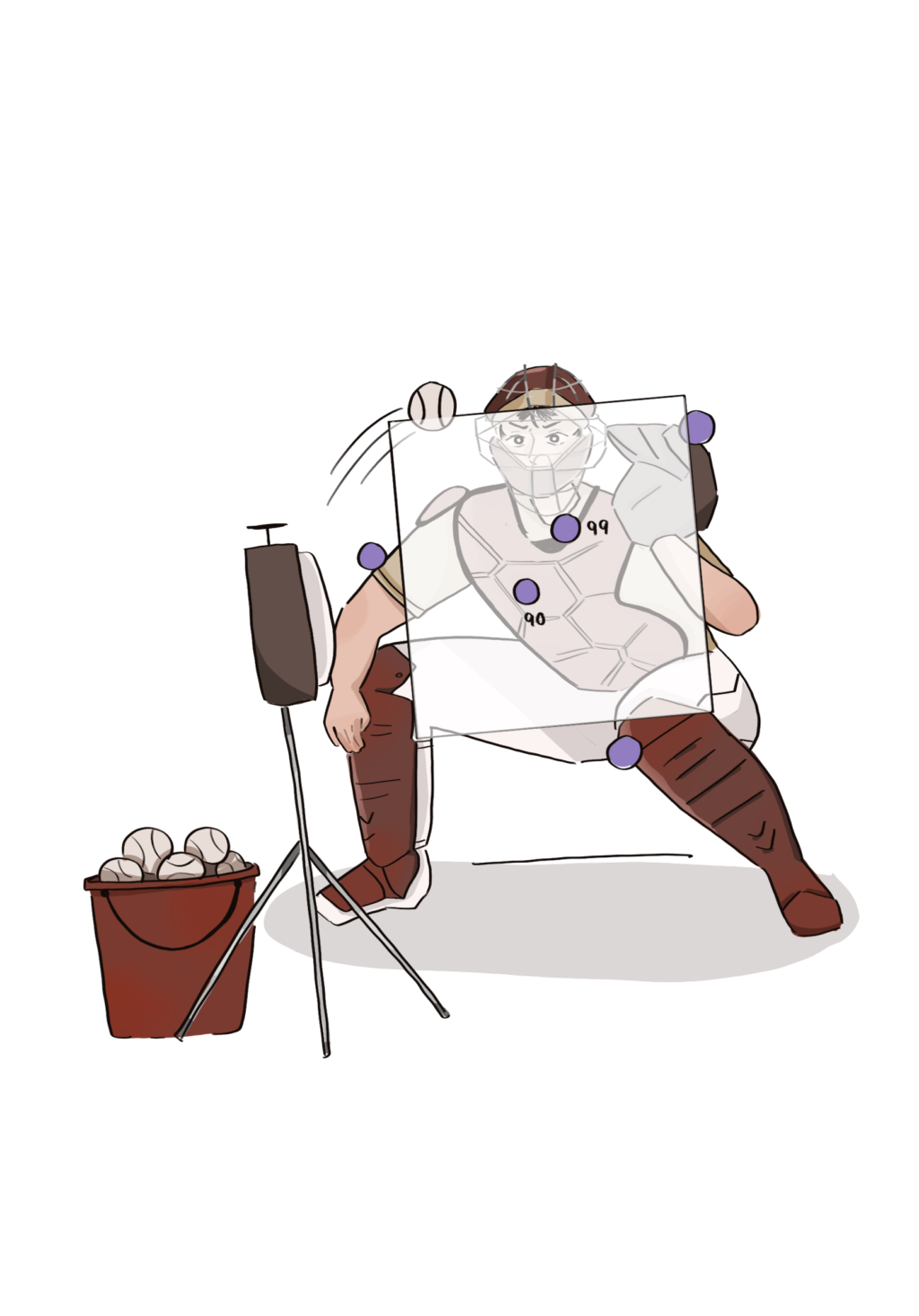
However, every rule change always comes at the expense of a certain group of individuals — in this case, skilled catchers who can frame pitches. The art of pitch framing relies on the human umpire’s perception and opinion, and so it seems that they’ll be the ones who suffer most from the introduction of an automated system.
“The game’s always evolving,” said senior Brandon Potter. “Some things are going to be left behind and it seems like the defensive catchers are going to be the ones that are going to be negatively affected by this.”
While first impressions of the new ABS system have generally been positive, a mysterious air still shrouds its long-term impact and what could lay in store for baseball in coming generations.
For many, this is an improvement, a confident stride forward; for others, it can be an uncomfortably substantial shift away from human authenticity.
These changes make it easier than ever to visualize a data-driven, mechanized future, and with the official implementation of the ABS system as a stepping stone, the sky really is the limit.