Mi Nguyen
Written by Naomi Kotani and Diya Poojary
Tensions in the Middle East have escalated after the United States and Israel launched attacks on Iran starting at the end of February, targeting military assets and killing several of the regime’s leaders, including Iran’s former supreme leader, Ali Khamenei.
BACKGROUND
In 1953, the Central Intelligence Agency helped orchestrate a coup in Iran that ousted the democratically-elected prime minister Mohammad Mosaddegh after he nationalized the country’s oil industry. Mohammad Reza Pahlavi became the shah, or monarch, and under his rule, Iran became an ally to western countries. Pahlavi also agreed to a deal that gave western oil companies considerable control of Iranian oil. During the Cold War, the U.S. supported Iran through an “Atoms for Peace” initiative, which helped launch Iran’s nuclear program.
In 1979, the shah was overthrown, ending his nearly 40-year autocratic reign. Ayatollah Ruhollah Khomeini led the establishment of an anti-Western regime in place of Pahlavi. The same year, Iranian students seized the U.S. embassy in Tehran, the capital of Iran, and held 66 Americans hostage for over a year in what became known as the Iran Hostage Crisis. This prompted the U.S. to cut diplomatic ties with Iran and impose sanctions that stopped the importing of Iran’s oil.
Over the next few decades, the relationship continued to worsen, especially with the September 11 attacks in 2001 by Al Qaeda, an Islamic terrorist organization. In response, then-president George Bush deemed Iran as part of what he called the “Axis of Evil,” grouping it with Iraq and North Korea, and accusing Iran of supporting terrorism.
In 2015, Iran, China, France, Germany, Russia, the United Kingdom and the U.S. came to an agreement called the Joint Comprehensive Plan of Action, which entailed Iran limiting its nuclear power in exchange for the lifting of existing sanctions. President Donald Trump took the U.S. out of the deal in 2018, claiming that it did not adequately restrict Iran’s nuclear abilities. This withdrawal put sanctions back into place, and Iran soon expanded its nuclear development efforts, exceeding limits outlined in the agreement.
In 2020, the U.S. launched an air strike that killed Iran’s top general, Qasem Soleimani, and in recent years, militant groups in the Middle East backed by Iran, like Hamas and Hezbollah, have been involved in intensified conflict with Israel, heightening Iranian–American tensions even further.
GOALS FOR THE WAR
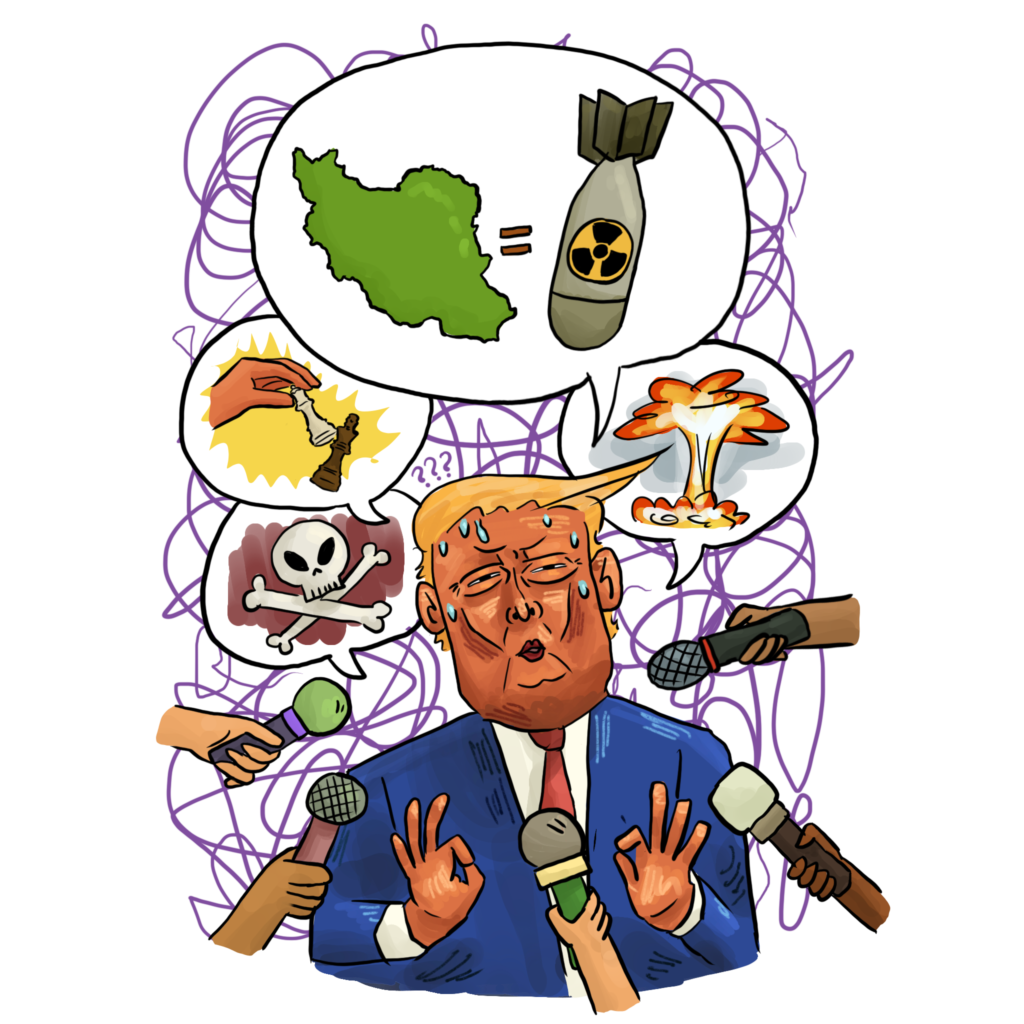
The White House released an eight-minute video on Feb. 27 stating that the ultimate purpose for the war was to eliminate the threat that Iran had previously demonstrated to the U.S.’ core security interests: namely, the American people, its allies and bases across the world. One way Trump claims to do this is by eliminating Iran’s nuclear program.
This goal had already been previously undertaken in June 2025 under Operation Midnight Hammer and the resulting Twelve-Day War, in which the U.S. Air Force and Navy launched airstrikes to attack three nuclear facilities in Iran. However, the new Operation Epic Fury was initiated on Feb. 28 with the same objective and no congressional mandate.
Its first strikes killed former Supreme Leader Ayatollah Ali Khamenei, who had served as the second Supreme Leader since 1989. After that, Israel and the U.S. have bombed key facilities in major cities like Isfahan and Natanz, where significant reserves of enriched uranium are reportedly being stored, although reports conflict on whether Iran pursued uranium enrichment covertly following the 2025 attacks.
Statistically, the operation has been effective in its objectives: by the fifth week into the war, the U.S. had destroyed, or severely damaged, much of Iran’s military arsenal, including ~50% of its missile launchers and most of its navy. Additionally, many of the top authorities in the regime’s hierarchy have been killed in the operation.
Trump stated that Iran with nuclear capability would not only be a dangerous threat against the American people and its allies, but also worsen its reputation as an oppressive regime to its own people. In the final minutes of the video, Trump directly addressed the people of Iran, supporting the overthrow of the current regime, which Iranian citizens have protested against for decades.
“[To] the great proud people of Iran, I say tonight that the hour of your freedom is at hand,” Trump said. “Bombs will be dropping everywhere. When we are finished, take over your government … This will be probably your only chance for generations.”
However, many believe achieving regime change is going to be very difficult, or even impossible, especially considering the fact that Trump has also stated he would like to have a voice in selecting a new western-friendly leader.
“[The U.S.] is a very powerful foreign influence, but the regime is not going to budge unless they’re literally all killed,” said junior Saurab Gulati. “Even then there are so many replacements and so many people who actually ideologically agree with the government and they will [replace the leadership] … I don’t see how they’re going to [introduce] someone in [a way] that’s fair to the Iranian people and isn’t just the same regime, or … is not just a Western figurehead.”
Others expect any such reform to be forced by the attacks on Iran, rather than it happening through diplomacy.
“The loyalist regime government is going to come to a point where it’s so small that the people will probably just take over,” said junior Thomas Carney. “Or else the strikes stop, the regime survives barely and they keep suppressing their people, and over time [the regime] will grow back.”
On March 8, about a week after Ayatollah Ali Khamenei was killed, his son Ayatollah Mojtaba Khamenei succeeded as the third Supreme Leader of Iran, illustrating the deeply entrenched hierarchy of Iran’s leadership.
“It’s that quick. It’s very seamless,” Gulati said. “It’s a hydra; the Greek mythological figure where you cut off a head, it’ll grow back two. They are a regime that is so established that it is very difficult, near impossible to unroot it.”
ESCALATION
Within the first week of the war, the Middle East was engulfed in chaos as Tehran responded with missile and drone strikes, targeting Israeli cities and U.S. bases in the Middle East, such as Iraq and Syria. Commercial shipping supplies in the Persian Gulf were blocked and attacks by proxy militia groups in the region also erupted.
These retaliatory actions were unexpected to the Trump administration, as the latter had based their attacks on the preceding victories of such conflict against Iran.
“[They’ve] massively underestimated the amount of time it was going to take, and that’s mostly because it’s been fighting from the air,” Gulati said. “Iran has been targeting U.S. bases around the Gulf, specifically … very costly infrastructure … What I’ve seen so far is Iran is not going to go down easy. The U.S. is more powerful, [but] it’s going to take a lot more than what they’re doing [to win this]. It’s [probably] going to take ground troops.”
The Pentagon has been preparing for ground operations in Iran, although no such plans have been approved by the president yet. However, the 31st Marine Expeditionary Unit, composed of about 2,200 Marines and sailors, arrived in the Middle East on March 27.
While the addition of U.S. troops in the Middle East is currently uncertain, many reports suggest that such decisions would require caution, as carrying out special ground missions could prove to be difficult in terms of numbers and the mounting economic costs, especially for sustained long-time operations. According to reporting by the Washington Post, 13 U.S. servicemen have already been killed in the war so far.
Iran also enforced a de facto blockade along the Strait of Hormuz, the primary exit route located in the Persian Gulf, where 20% of global oil and gas supplies pass through. Its closure for a prolonged period of time could spark a global recession.
Already, countries in Europe and Asia that depend heavily on supplies that pass through the point are facing shortages in food and other resources: crude oil prices have skyrocketed to their highest since the 2022 Russian invasion against Ukraine, fertilizer prices have increased by $100 per ton since the war began, gas prices in San Mateo alone have increased to $6 per gallon at some stations and postal and fresh food services have begun implementing payment surcharges to cover rising costs.
“Putting [the nation] in a situation [that] you know is going to affect American people and cause them to spend more money to travel or get around in their everyday lives, I don’t think that’s very fair to us,” said senior Michelle Dalporto. “Especially because during the election process, we were told by [Trump] that we wouldn’t go to war and prices would be lower. … That’s probably my biggest issue with it: we were told this wouldn’t happen.”
IMPACT
Although Israel and the U.S. have claimed its military operations are precise as to mitigate civil harm, at least 1,900 civilians have been killed since the Feb. 28 airstrikes, and about 21,000 have been reported injured.
Currently, the Red Crescent is the only humanitarian organization working across Iran, but its appeal for emergency medical supplies has only 6% of its funding. It has reported that emergency needs in Iran are rising exponentially, but medical supplies, such as trauma kits and other gear, are running low, especially due to delays because of choked supply routes.
“[It’s] awful,” said freshman Waylon Zargar. “Especially because my family’s in there, they’re all at risk of dying right now. Other innocent civilians [too] … It’s a war field out there.”
While the Trump administration assured that these higher costs were a reasonable tradeoff in the war, and that they would fall soon, analysts believe the spike in prices could be more enduring than it was in 2022 with the Russia–Ukraine war. Based on reports, it could take two weeks for maritime traffic in Hormuz to return to normal, and two months for oil production, as major oil refineries in the Middle East are scaling back productions due to Iranian strikes.
The war has also become increasingly unpopular among Americans; according to a poll by Pew Research Center, about 60% of Americans disapprove of U.S. actions in Iran, and about an equal number oppose the deployment of U.S. ground troops.
“You can interpret that as redeeming for the U.S. but 60% is still surprisingly low,” Gulati said. “It’s disappointing in other ways … Even though it’s less than half, 40% is a pretty great amount of people that actually believe something is going to come to pass … I am disappointed by the fact that 40% of people are supporting [this] war.”
The trajectory of the war is also threatening Trump’s promised economic agenda and his upcoming midterm elections in November.
“It will be interesting to see [Trump’s] hardcore supporters who still like him after all this time,” said sophomore Cohen Tabler. “After all these things keep happening, how far will they continue to support him?”
Others believe the war is distracting Americans from important domestic issues that need to be addressed.
“[Our government is] being run by people who are in the [Epstein Files], who don’t want to release the files, who are sending agents out into our streets,” Dalporto said. “That’s what we need to focus on … making our country better and giving the correct people power. I truly believe that they’re using this war as a way to distract the American people. Because ever since we’ve started threatening Iran or talking about this war, I’ve seen less coverage of U.S. politics and U.S. problems.”
While the outlook of the war is unclear, it will likely continue to cause strain and instability across the world.