Gemma Albertson
This editorial represents the opinions of 14 out of 14 Outlook editors.
———
After reviewing a district-wide survey and their task force consisting of a select group of representatives from San Mateo Union High School District schools, the district implemented a bell-to-bell policy against Superintendent Randall Booker’s suggestion. This policy, in compliance with Gov. Gavin Newsom’s Phone-Free School Act, will require students to put their phones into QuietCase lockable phone pouches for the entirety of the school day, a mandate the Outlook opposes.
During the decision process, Booker met with principals from all school sites to discuss options. His recommendation to the Board of Trustees was to implement a policy that did not extend into non-instructional times.
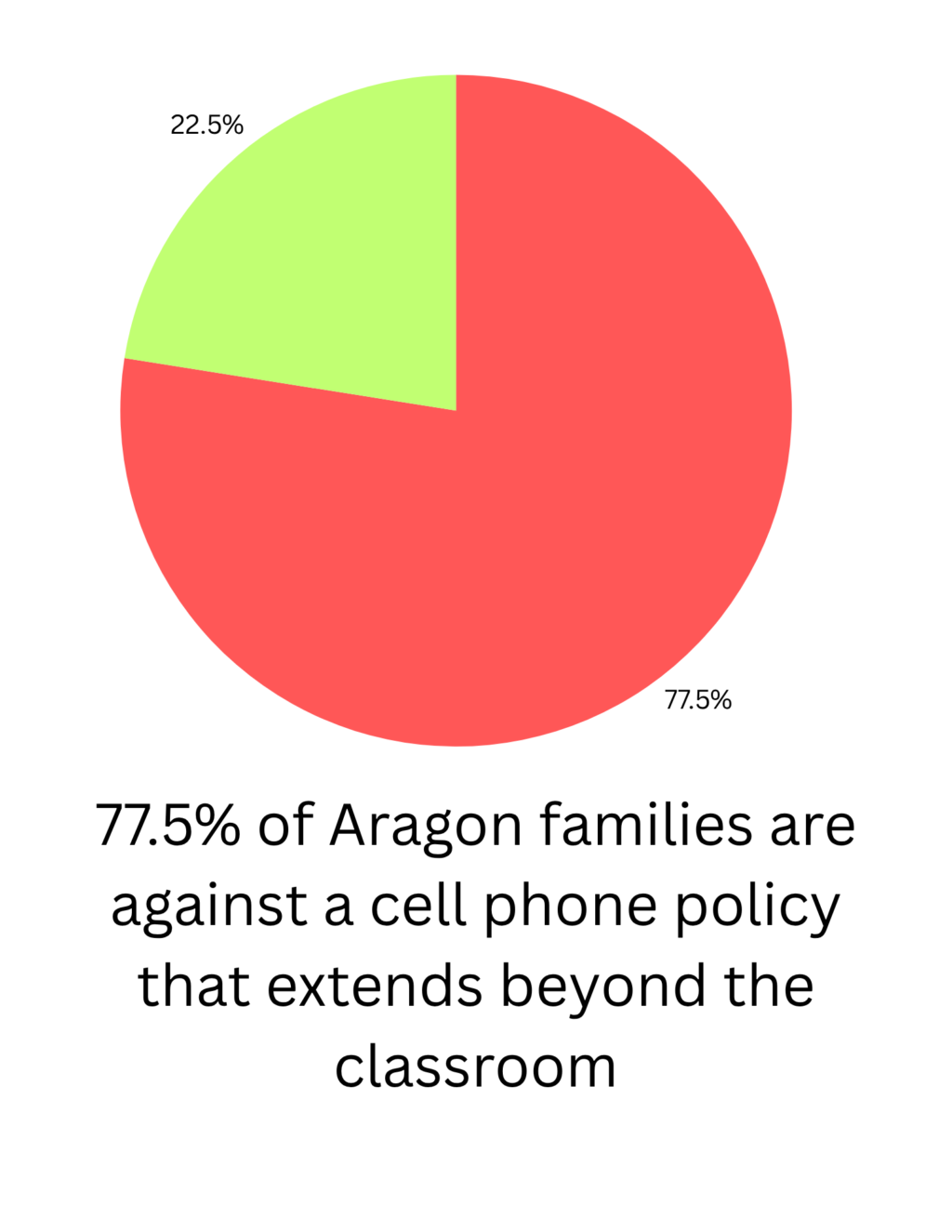
The Outlook stands behind Booker’s recommendation to the board to vote against the blanket bell-to-bell policy. A survey of 58 Aragon staff members found that 65.5% of respondents believed the district’s policy should include “site discretion to devise their own plans,” and a survey of 757 students and families saw that 77.5% were against a policy that extended into brunch and lunch times, which is what this new policy will do. The board neglected this data and Booker’s recommendation. Their decision was based on a broader district-wide survey and a task force that included a single Aragon student and two parents — hardly enough to be representative of the Aragon community.
Even the district-wide survey, which fails to break down site-to-site differences between schools, did not fully align with the final policy as passed by the board, finding that 56.6% of families, 30.8% of educators and 84.7% of students believed in keeping the current practices surrounding phone policy.
The Outlook asked trustee Jennifer Jacobson why the district did not allow individual sites to adopt their own policies.
“We just felt that we wanted this to be a unified choice,” Jacobson said. “One thing that was put forward was the idea of equity: San Mateo has this [bell-to-bell] policy and there have been positive benefits from it that are measurable and observable. Some parents felt that it’s not fair that those benefits are restricted to kids at San Mateo High School. Shouldn’t they be extended to all of the students in the whole district?”
However, data from both the district-wide and Aragon surveys conclude that the majority of parents and students simply do not take this stance. Each school community is different, and what works for San Mateo High does not guarantee success in Aragon, Hillsdale or any of the other diverse schools in the district.
“When you go [to] different places [that] have a … different culture, sometimes you do get kids who just sit in the hallway and scroll, and so they’re not having that interaction with their peers,” said assistant principal Andrew Hartig. “We see a lot less of that [at Aragon]. We have some students who do that, but most of our students tend to be far more social.”
The Outlook also has concerns about the cost of implementing this new cellphone policy. QuietCase lockable phone pouches cost upwards of $18 per pouch, and for the 9,000 students in the district, the grand total comes to approximately $162,000 taken out of the general fund, being routed from money that’s spent on teachers’ salaries, electricity bills and other school projects. If the concern is students’ mental health, the Outlook argues that these extensive funds could be better spent on other initiatives that may have a larger impact than removing phones from the equation: providing a designated wellness office for schools that don’t already have one, more wellness counselors, improved mental health resources and curriculum, among other efforts. Increasing the amount of student-student interaction isn’t solely accomplished by taking away phones either. More lunchtime student activities supported or created by the school would prompt students to connect more than simply removing phones from the equation.
“If we’re looking at student mental health crises, not only do we need access to a wellness center and wellness service, we also need a harm reduction program to educate people,” said assistant principal of Burlingame High School Jordan Loey. “[Burlingame is] one of the last schools that doesn’t have its own designated wellness center … [The bell-to-bell policy is] not the silver bullet that’s going to solve all of the student mental health crises.”
The Outlook chiefly recommends repealing this cell phone policy immediately; however, we recognize the unlikeliness that the school board would be willing to reverse such a significant decision so quickly. Thus, when the second semester repolling and reevaluation of the phone policy occurs, the Outlook must emphasize the weight of this data. Polling results and community opinions from students, teachers and parents should become especially influential when those community members have actually dealt with the changes in action. For a mandate this restrictive and wide-spread, the district must be open to feedback and fluidity.