Aidan Kasten
On April 24 and 25, Aragon held its inaugural Don Model Congress. The event was hosted by two clubs, Aragon’s Harvard Model Congress club and Model United Nations club.
“A good number of people that are in HMC are also in Model UN because it’s similar,” said senior HMC treasurer Kate Sato. “This is the first time that there has been an official Model UN and HMC coming together.”
The similarities lie in how HMC and MUN model real world political discussions.
“The aim of Model Congress is to [simulate] what it should be like,” said junior HMC Louis Riviere. “We’re not trying to be what it is like, but what it should be. And our club, we educate people on how the American government works.”
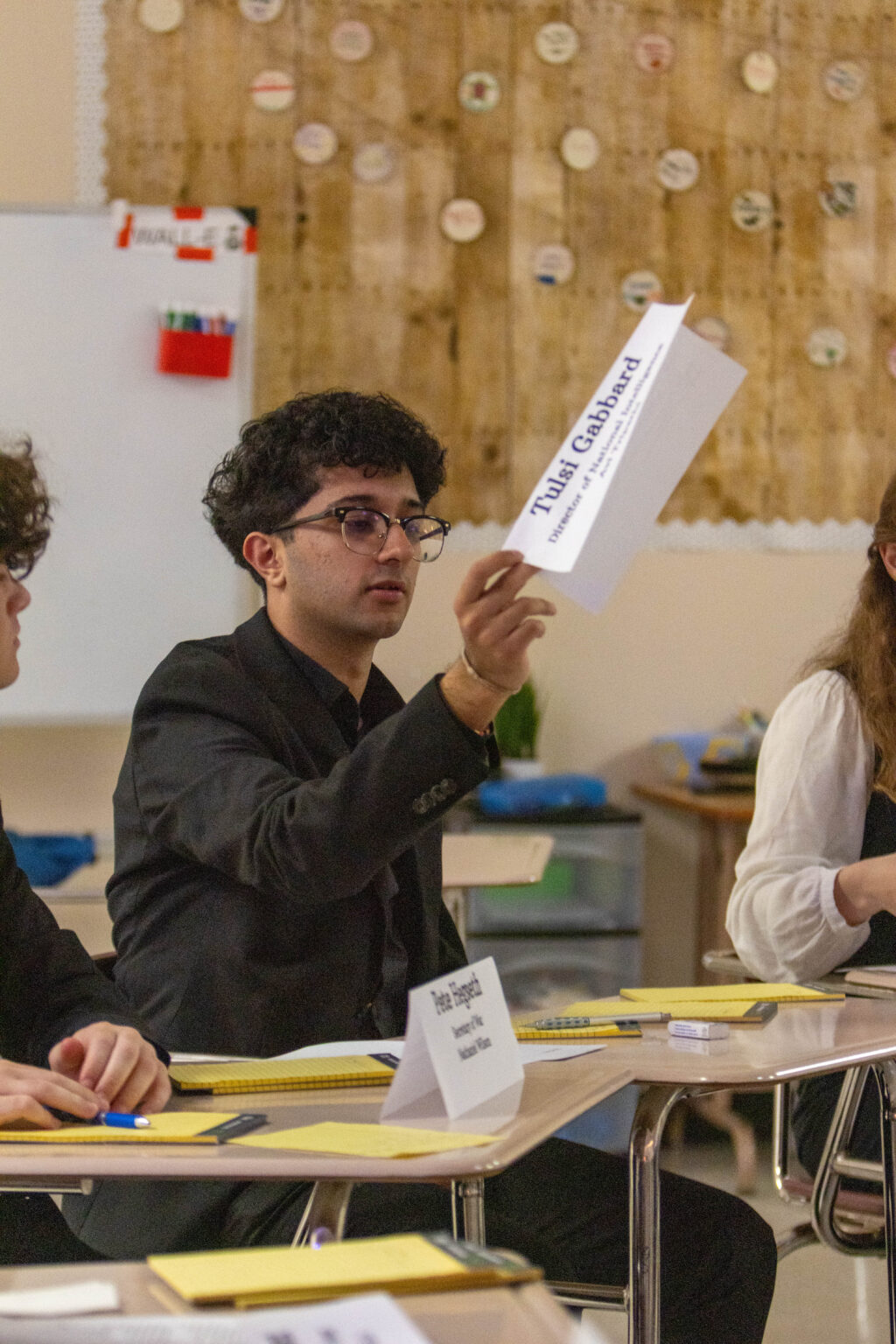
During the event, which was free to all Aragon students, people would act as either a member of the Presidential cabinet or a U.S. Representative. The mock house of representatives worked to pass a bill that helped their side as much as possible. In the presidential cabinet group, students worked together as heads of departments to advise the president of the best course of action in a mock crisis.
Discussion during the House of Representatives was split into two parts, moderated and unmoderated caucuses. In moderated ones, representatives took turns giving speeches to other students and the chair who moderated it, while in unmoderated caucuses, they could collaborate with members of their party to form a strategy or engage in open discussion with the opposite party.
“I liked the unmoderated caucuses,” said sophomore Rui Liu. “[There was] much less pressure because we’re speaking just as you would speak to a normal person.”
Representatives often requested more time for unmoderated caucuses rather than moderated ones, during which they often debated other people directly.
“There’s a lot of discussion involved in HMC,” said senior Calvin Baxter. “It’s important and it lets people learn.”
In the presidential Cabinet, a pretend crisis was going on: there was an outbreak of a dangerous disease along the front of the Russia-Ukraine war. Delegates had to advise the president with their expertise, such as how research for a treatment could be done, whether it was worth it for America to spend even more money to help Ukraine and considering the possibility that the disease was a biological weapon made by Russia.
“Crisis is a situation going on in the world,” Riviere said. “We’ll start it with something that’s actually going on, but then we’ll diverge it so that it doesn’t stay too political.”
The event was attended by around 20 students. Originally, many more students signed up but did not attend.
“There were supposed to be more people to turn out and that signed up,” Sato said. “Last minute, people had conflicts or they decided to drop out.”
Some attendees preferred the low attendance.
“I really liked the size of it,” Liu said. “It was very small, and it encouraged me to speak about my opinion without feeling too pressured that I’m gonna say something wrong.”
Both clubs have plans on expanding into district-wide participation next year.