Mi Nguyen
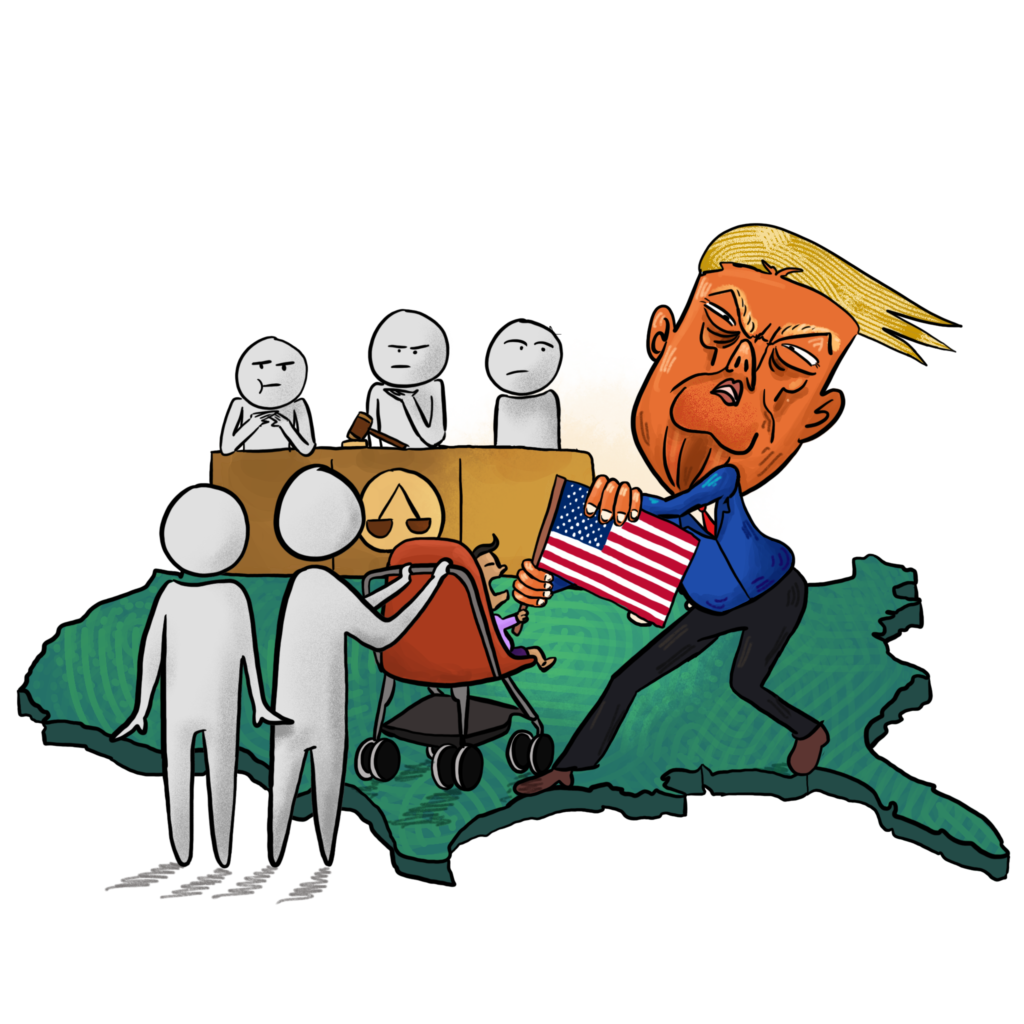
On Jan. 20, 2025, his first day in office, President Donald Trump issued an executive order targeting birthright citizenship for children born to parents who are in the country illegally. The order has since faced many legal challenges, with lower courts tending to block it as unconstitutional and against historical precedent. The Supreme Court heard arguments regarding the executive order’s constitutionality on April 1.
The 14th Amendment guarantees citizenship for anyone born in the U.S. and “subject to the jurisdiction thereof,” which has historically been taken to refer to someone under U.S. legal authority. However, Solicitor General John Sauer, who represented the federal government in the case, interpreted the clause in his arguments as restricting the group to which birthright citizenship can be applied.
Trump’s order asserted that people born in the U.S. can only become citizens if at least one of their parents is in the country on a non-temporary visa, claiming that the 14th Amendment does not consider individuals who don’t check this box to be under U.S. jurisdiction.
However, in 1898, the Supreme Court established in the case United States v. Wong Kim Ark that anyone born on U.S. soil was automatically given citizenship under the 14th Amendment, no matter their parents’ legal status. The case involved an American-born man with Chinese parents, Wong Kim Ark, who was denied reentry into the U.S. after traveling internationally.
In response to Sauer’s interpretation of the jurisdiction clause, several justices said that he was stretching the evidence he used to back up his claims.
Additionally, Trump has said that the 14th Amendment was intended specifically to ensure citizenship for the children of formerly enslaved people, but this has been disproved by legal experts.
“I see the Trump administration trying to use a selective, revisionist interpretation of the historical record of the 14th Amendment … to bolster their argument,” said Kyle Serrott, an ethnic studies and political science professor at Skyline College.
Trump sat in on a portion of the arguments, which no other president has done before.
“He was trying to intimidate the justices,” Serrott said. “During Sauer’s arguments with Trump sitting right behind him, the justices were pushing back and resisting some of those arguments by the Solicitor General. It is unprecedented for [presidents] to go to [the court] … This was a blatant disregard for any notion of separation [of government].”
Many legal experts expect the Supreme Court to rule that Trump’s executive order is unconstitutional. But despite that, the fact that birthright citizenship is being questioned at all has raised concerns for some.
“The amount of precedent that we’re setting moving backwards right now is absolutely sickening and horrifying,” said senior Sophia Rayes. “It’s so disheartening, because you think that there’d be linear movement, that we’d go forward and … strive to be better, and the fact that we are being worse right now is just terrible.”
For junior Cassey Rae Yokoo, who has citizenship because of the 14th Amendment, Trump’s attempts to change birthright citizenship has caused feelings of anxiety. It has also led her to reflect on her citizenship.
“It’s easy to take it for granted that I am a citizen of the U.S.,” Yokoo said. “But at the same time, I’m extremely grateful that I am a citizen [because of birthright citizenship] and I don’t have to go through any processes or have to be worried about, ‘Is [Immigration and Customs Enforcement] gonna be at my door? Do I have the right documents?’”
One of the reasons Trump has cited for wanting to limit birthright citizenship is to prevent tourists from giving birth in the U.S. to obtain citizenship for their children. This concept, known as birth tourism, or derogatorily, having “anchor babies,” accounted for less than 1% of births in 2020, according to the Center for Immigration Studies, which advocates for low levels of immigration.
Even if the Supreme Court strikes down the executive order, Serrott said that the case will likely have a long-lasting impact on the framing of immigrants, especially considering the historical use of certain anti-immigrant rhetoric which has been used to justify exclusionary policies.
“Stereotypes, racialized notions of who people are, those stay around,” Serrot said. “We’re seeing that all the way back from the 1880s. The federal government and the culture said that Chinese immigrants stole the jobs of hard working ‘real’ Americans. And then you see that today applied to people from Central and South America that are coming to the United States, this trope that they’re stealing jobs. These racist definitions that get applied to whole groups, they stay. We’re going to see the aftermath of this long after Trump is out of office.”
In the case that the Supreme Court decides the order is constitutional, there is uncertainty over how exactly it would be enforced.
“When you give birth to a child and you’re at the hospital, they print up the birth certificate and they send it to the state,” Serrott said. “Is the hospital supposed to check the citizenship status or the legal residency status of the mother? Do they have to go before a court to certify that they’re a citizen?”
=This could lead to such babies becoming stateless, meaning they are not recognized as citizens by any country, which could make it difficult for them to access rights like education and healthcare.
“You are taking away opportunities from so many people who did nothing but be born in a different country,” Rayes said.
Even though Serrott and other legal experts do not think that the Supreme Court will side with Trump, there are other ways birthright citizenship might be changed.
“There could be an effort to pass a law that further restricts who can and can’t be citizens, and to give further definition of birthright citizenship that would end up being litigated in some way,” Serrott said.
“But as far as changing or amending the 14th Amendment of the Constitution? That’s not likely at all … If you passed a law, you would get a lot more buy-in from judges, because they could say this is not just an executive order. This is Congress. It’s more legitimate than an executive order.”
The Supreme Court is expected to reach a decision over the summer.