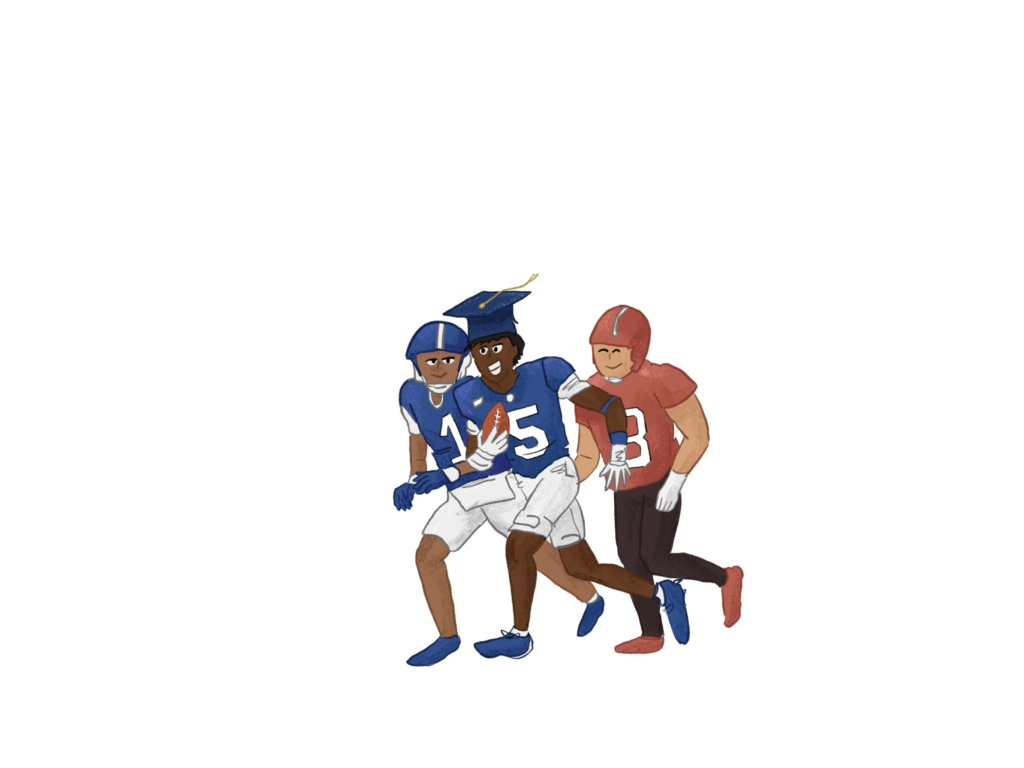
In college sports, there has always been a clear divide between college athletes and professionals. This season of college football, however, that line has become blurry.
Louisiana State University, with new coach Lane Kiffin, has found itself at the center of the debate. Lane Kiffin previously coached at Ole Miss, but left mid-season for LSU’s head coaching job.
During the offseason, Kiffin and LSU pursued former Ole Miss players Dae’Quan Wright and Zxavian Harris, both of whom had gone undrafted and signed with NFL teams for the summer. Wright signed with the Philadelphia Eagles and later spent time with the Cleveland Browns after being waived. Harris signed with the New Orleans Saints, and was also waived. Both players then pursued a return to college football at LSU, with their former coach.
Some agree with the concept of playing one more year in college for the sake of performance optimization.
“College athletes should be allowed to play a fifth year,” said senior Clemson softball commit Taylor Workman. “It gives the athletes the ability to make the most of their college careers and play at a point where they are at their most physically strong and mature.”
However, even though extenuating circumstances can pose reasonable justification, graduated athletes should not typically be playing at a college level.
“College athletes should not be allowed to play after graduation, because the NCAA starts tracking eligibility the moment you enroll,” said senior Oye Oyegbami. “However, there should be exceptions like medical redshirts.”
If an athlete suffers a season-ending injury, they are allowed to “redshirt” if their injury meets the specific standards for their sport. This allows them to make up lost eligibility in order to ensure four years of eligibility throughout a five year window, often granting them an additional year.
Trinidad Chambliss, Ole Miss’ quarterback, is an example of why exceptions can be reasonable. He sought an additional season after missing his 2022 season at Division II Ferris State because of medical issues. His case ultimately went to court after the NCAA denied his medical waiver, and he was granted another year with Ole Miss.
Athletes who miss out on seasons often do pursue a fifth year, and are usually allowed to play if they meet the criteria. The reason the LSU case is getting so much more attention is because it creates a situation where players who had already entered the professional system can return to college if their career has not taken off.
“The moment you sign a professional contract, you should be considered a pro,” Oyegbami said. “You’re no longer a college athlete.”
Workman, along with many others, agrees.
“College sports are like professional sports now with the way that the athletes are treated,” Workman said. “However, there needs to remain a distinction between the two.”
Wright and Harris sought a temporary injunction in Louisiana state courts, which put the NCAA’s rule barring professional athletes from playing in college on hold. This is what would have allowed them to play for LSU for an additional season.
“Ultimately, once a player has declared for the pros, that needs to be the end of their college eligibility,” Workman said. “Otherwise it just exploits the system that was first meant to be a means to get an education.”
The controversy became large enough that the Southeastern Conference considered terminating LSU’s membership. They also threatened to impose fines that would have cost the school more than half of its football budget. LSU eventually opted to fill its two remaining roster spots with other players, not Harris or Wright.
The situation was even acknowledged by Kiffin himself during LSU’s season opener against Clemson. After a blowout first half, Kiffin joked, “Imagine if we had pro players.”
The SEC opted to let LSU remain in the conference, and LSU suffered no sanctions or fines after backing down from its case.
While Workman supports fifth-year eligibility, she acknowledges that it creates problems.
“It takes opportunities away from younger players,” Workman said. “Colleges are taking smaller high school recruiting classes because there is more experience and talent available either from the portal or a fifth year.”
The NCAA’s eligibility rules are very clearly evolving, with people using loopholes to their advantage.
“The rules need to be made universal, to leave the least wiggle room for people to take advantage of college sports,” Workman said. “Specific outlier situations can be evaluated individually by the NCAA, but the rules don’t need to be variable to account for those one-offs.”
While athletes deserve flexibility surrounding circumstances outside of their control, there should still be a separation between college sports and professional level sports to avoid unfair exploitation.