Matilda Bacani
Written by Seona Srivastava and Ellie Blakely
At some point in the coverage of any political statement, a reporter or an editor makes a choice — use the quote or don’t, put it in the headline or bury it, provide context or let it stand alone. These choices happen dozens of times a day across hundreds of newsrooms, and for the most part, nobody outside the newsroom ever knows they were made.
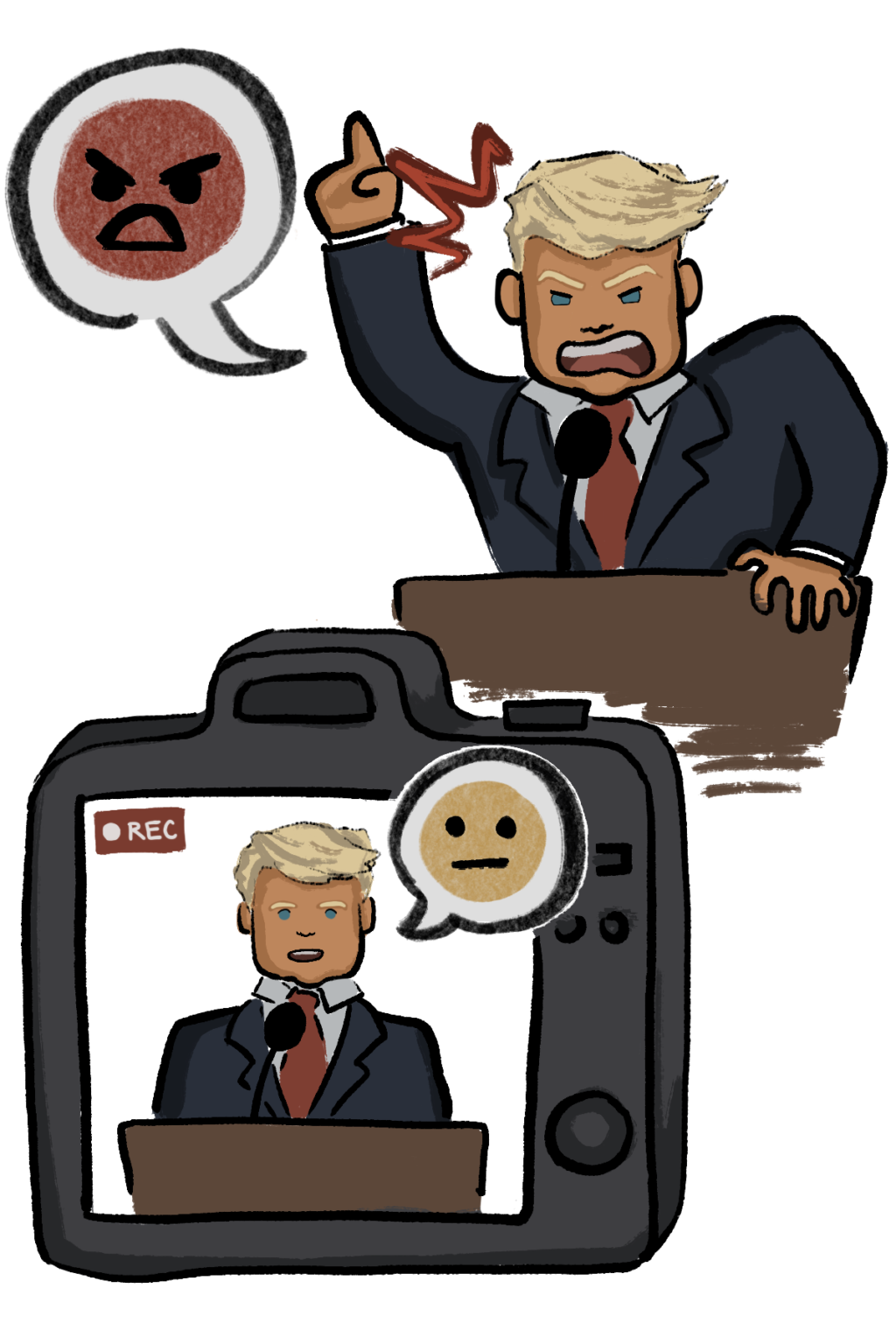
“Sanewashing” is the term that critics have started using to describe what they believe happens when those choices consistently soften the edges of extreme or incoherent political speech. The term didn’t start in politics; it appears as early as 2007, in a blog post by academic Dale Carrico, which described how fringe ideas get repackaged into respectable-sounding language. By 2020, it had moved into political forums online. It wasn’t until 2024 that the word attached itself specifically to the coverage of Donald Trump, migrating from academic blogs and political subreddits into the vocabulary of working journalists and media critics.
The examples most frequently cited involve headlines. In October 2024, Trump made the comment that people who commit crimes have “bad genes.” In its coverage of the president, the New York Times published a story with the headline, “In remarks about migrants, Donald Trump invoked his long-held fascination with genes and genetics.”
This headline was criticized by many in the media who believed it inaccurately captured Trump’s original statement. Critics say his statement encourages eugenics, and the New York Times headline failed to communicate that.
“People [want to] believe good or make things make sense,” said senior Sydney Miller. “Media outlets frame things in the way that people want to see it. When outlets are associated with one side they’ll tend to bring in something in [a way that is biased].”
The reality, observers note, is that people rarely read full articles. Many get their understanding of current events solely from headlines, meaning the framing of a headline carries more weight than the reporting beneath it.
Media outlets also frequently shorten quotes from Trump or only include the most cohesive phrases. This is a fairly common practice in journalism, but critics say it becomes problematic when Trump’s long-winded and frequently incoherent speeches are a part of his identity as a political figure.
In September 2024, Trump responded to a seemingly straightforward question about childcare with a two-minute-long answer discussing tariffs, fraud and more. The New York Times reported on the story with the headline, “Trump Calls for an Efficiency Commission, an Idea Pushed by Elon Musk,” and only briefly touched on Trump’s incoherence. The New York Times was again scolded for only covering part of the story and leaving out details that would have been damaging for Trump.
While sanewashing does not necessarily make media coverage inaccurate, critics say it portrays a different, more sanitized version of reality. This becomes an issue when it affects people’s perception of the world and encourages biases.
“Media is obviously really influential for what people believe, especially for people who are more vulnerable to believing what they see,” Miller said. “My grandparents watch just Fox News, and they believe everything. [People will believe the media if they portray] someone in a way where it’s making [them] seem more okay, even when [they’re] insane, and that can be dangerous.”
That concern extends beyond any single outlet. For some observers, the issue isn’t certain stories getting softened but rather the incentive structure of media as an industry that makes sanitized coverage more likely in the first place.
Understanding why sanewashing happens requires looking inside the newsroom, where reporters and editors describe a set of competing pressures that shape every story.
One is structural. Headlines have character limits. Quotes that wander, contradict or trail off midway can be genuinely difficult to compress without the headline itself appearing unserious. Editors have historically been cautious about writing headlines that could be read as editorializing, even when the underlying statement is simply what was said.
There is also what journalists describe as a saturation problem. For example, Trump’s verbal style — associative, digressive, sometimes contradictory — has been consistent since 2015. A comment that would have generated significant coverage if made by another politician might not clear the bar for a Trump story, simply because similar comments have appeared so many times before.
Neutrality is another factor. American mainstream journalism has long operated under a professional norm of not appearing to favor one political side.
If coverage consistently emphasizes incoherence or extremity, does the outlet begin to look like it’s taken a position? Some journalists navigate that tension consciously, making calls they believe are editorially defensible, while knowing those calls will read differently to different audiences.
None of these pressures require bad intent. Journalists as a whole strive to help readers make sense of what politicians are saying, which can mean gravitating toward quotes and headlines that are clearest and most coherent. When applied consistently to a speaker like Trump, it can produce coverage that leaves out some of his more inflammatory comments or illogical statements.
The debate is further complicated by the fact that the opposite approach carries its own risks. When an extreme statement gets prominent coverage, the coverage itself spreads the statement. Something that may not deserve attention may be spotlighted unnecessarily and thus give the speaker the publicity that they want and the reaction they were hoping to provoke.
Furthermore, there is no agreed-upon standard for where editorial restraint ends and sanewashing begins. This line is greatly contested, and journalists on both sides of it believe they are serving their readers.
It is also worth noting that the term itself is contested. “Sanewashing” emerged primarily in criticisms from left-leaning media towards mainstream centrist outlets. The political context doesn’t necessarily invalidate what the term describes, but it does shape who tends to make the accusation and how it lands.
When media outlets cover the same event differently, they present readers with what can feel like entirely separate realities, contributing to an already polarized media environment.
“I like to listen to multiple ideas [in the media],” said sophomore Tanya Lee. “And oftentimes the ideas are so different that it’s hard to think of them as the same situation, especially when there’s two different commentaries on a certain event, or somebody’s statements … It makes me a lot more cautious to trust the media.”
Trust in media in the U.S. is at an all-time low, largely due to perceived bias in the media and a shift toward more opinion-based commentary. The Pew Research Center reports that only 56% of U.S. adults say they have some or a lot of trust in information from national news sources.
Although sanewashing and polarization stem from opposite approaches to news coverage, they both exacerbate mistrust in the media. By perpetuating an altered perception of reality, critics say that sanewashing is detrimental to the public’s comprehension of world events and politics.
Some media outlets have internalized this criticism and are actively trying to avoid sanewashing Trump in their political coverage by reporting as accurately as possible, even if it differs from journalistic norms.
One approach some reporters are taking is to include Trump’s full quotes in their articles, no matter how much he rambles or goes off topic.
In an article published in 2024 by The 19th News, the writer contrasts Trump’s proposed childcare policies with those of then-presidential candidate Kamala Harris, using excerpts from their speeches. In lieu of a policy proposal by Trump, the article points out that he had not given clear answers on childcare policies and instead frequently rambled and made unclear statements about the topic. The article features an unusually lengthy quote that displays Trump’s incoherence to the reader.
Anti-sanewashing advocates applauded this effort, as they say it avoided altering Trump’s confusing quote and highlighted his lack of a clear policy plan.
Other articles attempt to go beyond fact-checking by exposing more of the context for Trump’s false claims. For example, National Public Radio published a story in 2024 that unpacked the history and racist tropes behind Trump’s claim that Haitian immigrants were eating cats and dogs.
The same outlet critics accused of sanewashing have also, at times, taken the opposite approach. On April 5, the New York Times published a story on Trump’s threats against Iran that quoted his social media post in full, influencing an expletive directed at Iranian leadership and the phrase “you crazy bastards,” without softening or paraphrasing the language. Whether that represents a shift in how the paper covers Trump, or simply reflects the escalating stakes of a wartime context, remains an open question.
However, articles that attempt to avoid sanewashing have also faced criticism by defendants of traditional journalism, who say that providing raw quotes ignores a need for context and that concentrating on a figure’s incoherence is a biased and editorialized style of reporting.
In reality, the media may always have some bias. This may be as overt as favoring one side when covering a political issue, but bias can also appear when media outlets focus too heavily on neutrality or conciseness. As a result, some are discouraging consumers from relying too heavily on the media.
“As citizens, we can try to do our own research and make our own conclusions and not always just trust what the media says,” Lee said. “There’s always going to be some element of this sanewashing.”
Whether sanewashing is a systemic failure, an unavoidable byproduct of editorial constraint or a politically loaded accusation depends largely on who you ask. What is harder to dispute is that the gap it describes — between what political figures say and how that speech reaches the public — has real consequences for how people understand the world. Closing that gap or even agreeing on its size remains unfinished business for American journalism.