Audrey Wang
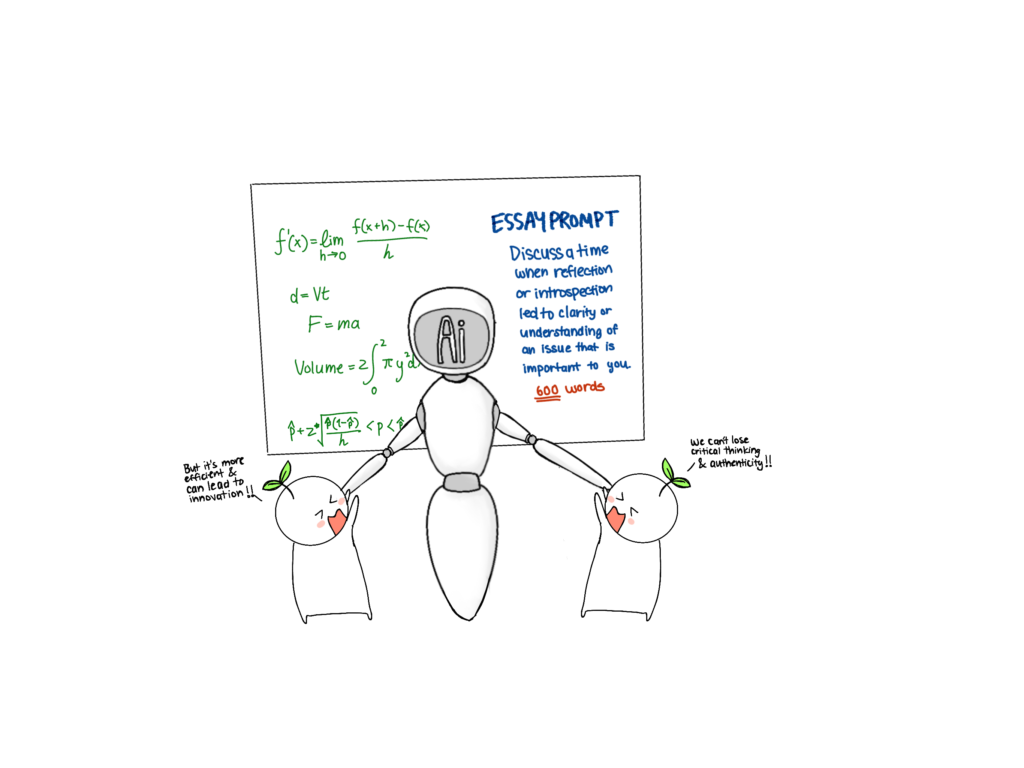
Whether it be for responding to emails, looking up sports statistics or planning a vacation, AI has become a tool that many people use daily. AI is also used by companies to automate jobs, teachers to create assignments and students to complete them. With AI at the forefront of the world, it also catapults to the forefront of education.
At Aragon, English classes prohibit the use of AI, while history classes also limit much of AI use. There is a school-wide policy that prohibits academic dishonesty, which humanities teachers interpret as AI use.
Many teachers and administrators have mixed feelings about AI.
“I hope, ultimately, that artificial intelligence allows humans to evolve, and if the computer is helping us think about some of those problems, then we can solve some of the really major problems in our world, like how to stop going to war, how to stop being dependent on natural resources that lead us to war,” said Julia Kempkey, assistant superintendent for curriculum and instruction. “I don’t know if we can get those answers from artificial intelligence … I hope we find ways that artificial intelligence does not really take over our ability to think critically, [and] that we don’t get too reliant on it.”
Some teachers also feel that students are aware of the dangers that AI poses.
“I’ve always been very encouraged [because] a majority of people have an honest understanding [of AI],” said Advanced Placement Physics teacher Steve Ratto. “I guarantee [if] you pull students, they’re going to tell you, ‘I understand why [my] teacher doesn’t want AI to write a paper for me [or] why a teacher doesn’t want me to look up an answer to a math problem and just write down the answer.’”
However, people who use AI are often able to get their work done more quickly.
“It saved me a lot of time,” said senior Matthew Chong. “A drawback would be after I learned stuff for a test, it goes into my short term learning and not long term learning, because you end up spending less time on it. [But] even before, when I studied [without using AI], I would forget everything that was on the test anyway.”
With AI use being such a hot button issue, some believe that educating students would be ideal.
“You should be explicitly taught how to … appropriately incorporate AI when you’re writing an essay,” said history and special education teacher Anton Moshkounian. “Because you can, to a degree, use [AI], and it can be a helpful resource. But that certainly needs to be explicitly taught to students. It should be a part of some curriculum … we should tell students how to do that so it’s not a mystery to them.”
Currently, no school in the San Mateo Union High School District teaches an AI literacy course. The district has formed an AI task force made up of teachers, students and families, which is working on how teachers throughout the district should treat AI. In addition, the district has also provided guidelines on their website for teachers on AI.
“One of the things the task force is coming up with, not necessarily a standalone course, [is] how do we integrate some of the things that students should know about AI through the current courses that we have,” Kempkey said. “In our health classes … there was a unit that was healthy relationships, how to have healthy relationships. When you’re either in a romantic relationship or otherwise what that looks like. The same could be applied to how to have a healthy relationship with AI.”
With AI at the forefront of nearly every frontier, the issue of AI use in education has become widely debated.