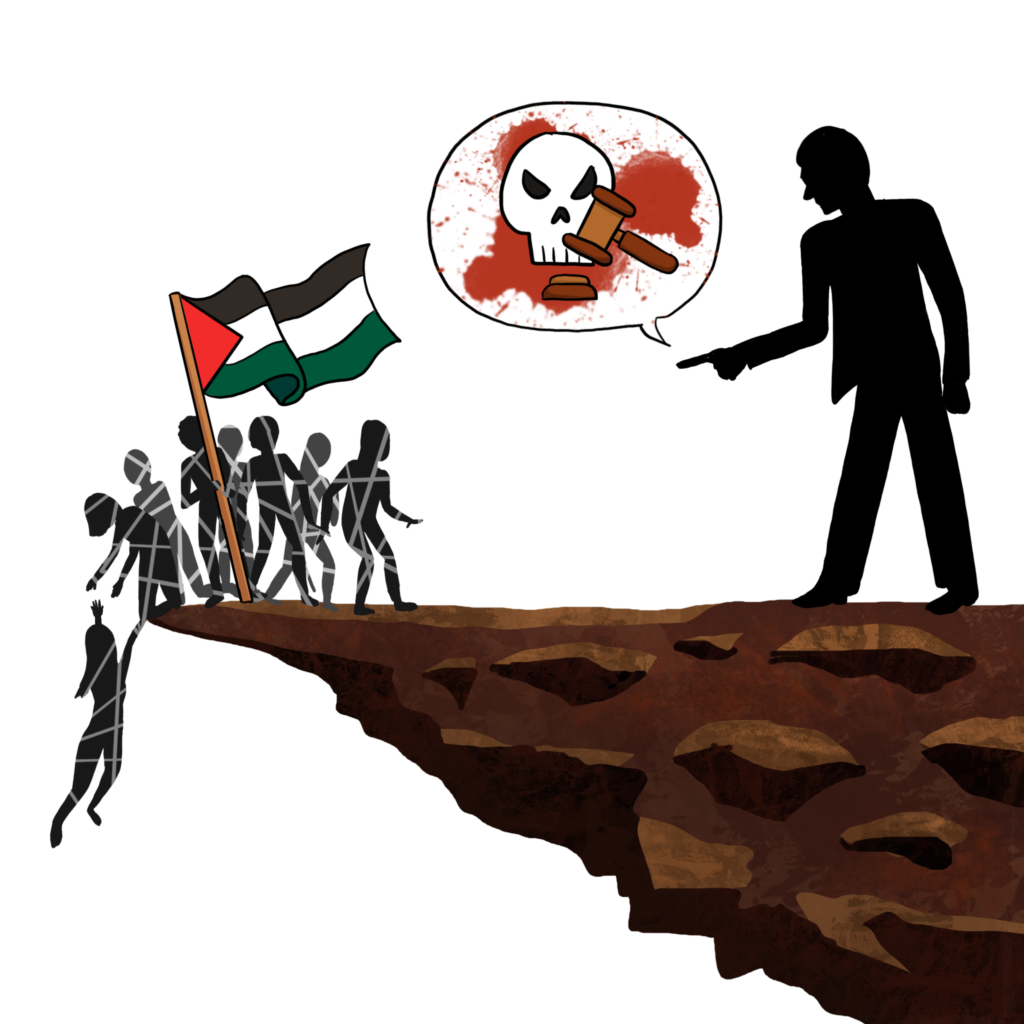
Earlier this month, the state of Israel passed a law prescribing execution by hanging for any Palestinian convicted of “terrorism-related” acts. The death sentence will exclusively apply to Palestinians in the occupied West Bank, but not Israeli settlers convicted of terrorizing Palestinian residents; hangings must be carried out within 90 days of a ruling.
Proceeding the passing of the act, Itamar Ben-Gvir, the Israeli Minister of National Security, popped champagne, while wearing a noose pin on his suit. Days later, Ben-Gvir celebrated his birthday with a cake picturing a noose on it as well as the message “Sometimes dreams do come true.” A law assigning the death penalty to one race, but not the other, is similar to regimes such as Nazi Germany. Israel’s actions are ironic; descendants of genocide victims are now emulating their oppressor.
The Death Penalty Information Center reports that the death sentence is prescribed for those who have committed deadly “terrorism-related” acts seen in Israel’s “Counter Terrorism Law 5776-2016” with the goal of “negating the state of Israel.” The issue with applying such a grim, irreversible sentence to cases of terrorism, is that the legal bounds and specifications of “terrorism” as defined in such a way that they could apply to a Palestinian acting in self-defense. On Oct. 29, 2000, Faris Odeh, a 14-year-old boy, was shot in the neck seconds after throwing a rock at an Israeli tank. The snap shot of this scene became the face of resistance in the West Bank as a symbol of a popular means of self-defense amongst Palestinian children, known as “Dabash” in Arabic.
General Avi Bluth, responsible for managing the occupation of the West Bank, confirmed that Israel was practising a two-tier firing policy where the military freely fires at Palestinians throwing rocks but specifically avoids shooting Israelis who do the same. Avi Bluth mentioned that the Israeli military killed 42 Palestinians who threw stones in 2025, and admitted that the Israeli Defense Force does not shoot at Israeli settlers for doing the same, due to the “profound societal consequences.”
The difference between Dabash and Israeli-settler violence is that the former is done by children against military personnel responsible for terrorizing Palestinian families. The latter is done by settlers against Palestinian families resting in their homes. Not two weeks ago, an Israeli settler was filmed throwing rocks and attempting to break into the home of activist Issa Amro, a stark difference from children pelting a tank. And yet, under the law, the settler is considered blameless and Odeh a terrorist.
In an interview with Middle East Eye, Knesset member Amit Halevi stated that during the IDF’s raid of Al-Shifa hospital, “300 terrorists were born” in the maternity ward. When the interviewer corrected him, stating “300 children, not terrorists,” he stayed loyal to his statement, repeating “No; terrorists.” When even Palestinian babies are called terrorists, this death penalty law cannot be relied on to only apply to actual violent acts.
Israeli courts have historically been unreliable and biased regarding the convictions of Palestinians, and cannot be trusted with the responsibility of justice. According to Amnesty International, Israeli courts have a conviction rate of over 99% regarding Palestinians accused of crimes, and Israeli authorities have notoriously used cruel and humiliating punishment to evict false confessions. In reports by Al-Jazeera, the Peoples Dispatch and Defense for Children International, Palestinian men, women and children have testified to being waterboarded, severely beaten with batons, sleep deprived, sexually abused and attacked by dogs among other torture methods. B’Teslem, the Israeli Information Center for Human Rights in Occupied Territories, reports that 60% of children jailed for throwing stones between 2005-2010 were under 14, and 852 out of 853 children arrested were imprisoned. Such examples prove that there is no course of action a Palestinian can take to shake off being considered a “terrorist” unless it is in compliance with Israeli colonialism.
The Israeli government is able to rationalize the death penalty by using sensationalist labels against Palestinians, and shuts down criticism by weaponizing antisemitism.
“This [Labelling pro-Palestinians as anti-semites] makes it easy for [Israelis] to do whatever they want,” said sophomore Dimitri Cooper. “[It lets] Israelis get a chance to be the victim and get away with a lot of things.”
This law isn’t an isolated act of racism against Palestinians, but rather a part of a larger trend in Israel’s continued oppression of the Palestinian people. It supports settler occupation of Palestinian land by intimidating the Palestinian people into silence. Genocide cannot become normalized, racism cannot be the standard and the murder of Palestinians cannot be a headline we ignore. As youth, we have the responsibility of creating change through questioning the status quo, humanizing the oppressed, remaining educated and fighting oppression through any possible way. Whether it be through awareness on social media, boycotting or educating oneself, we must find avenues for change and cannot remain silent on injustices being imposed on Palestinians.