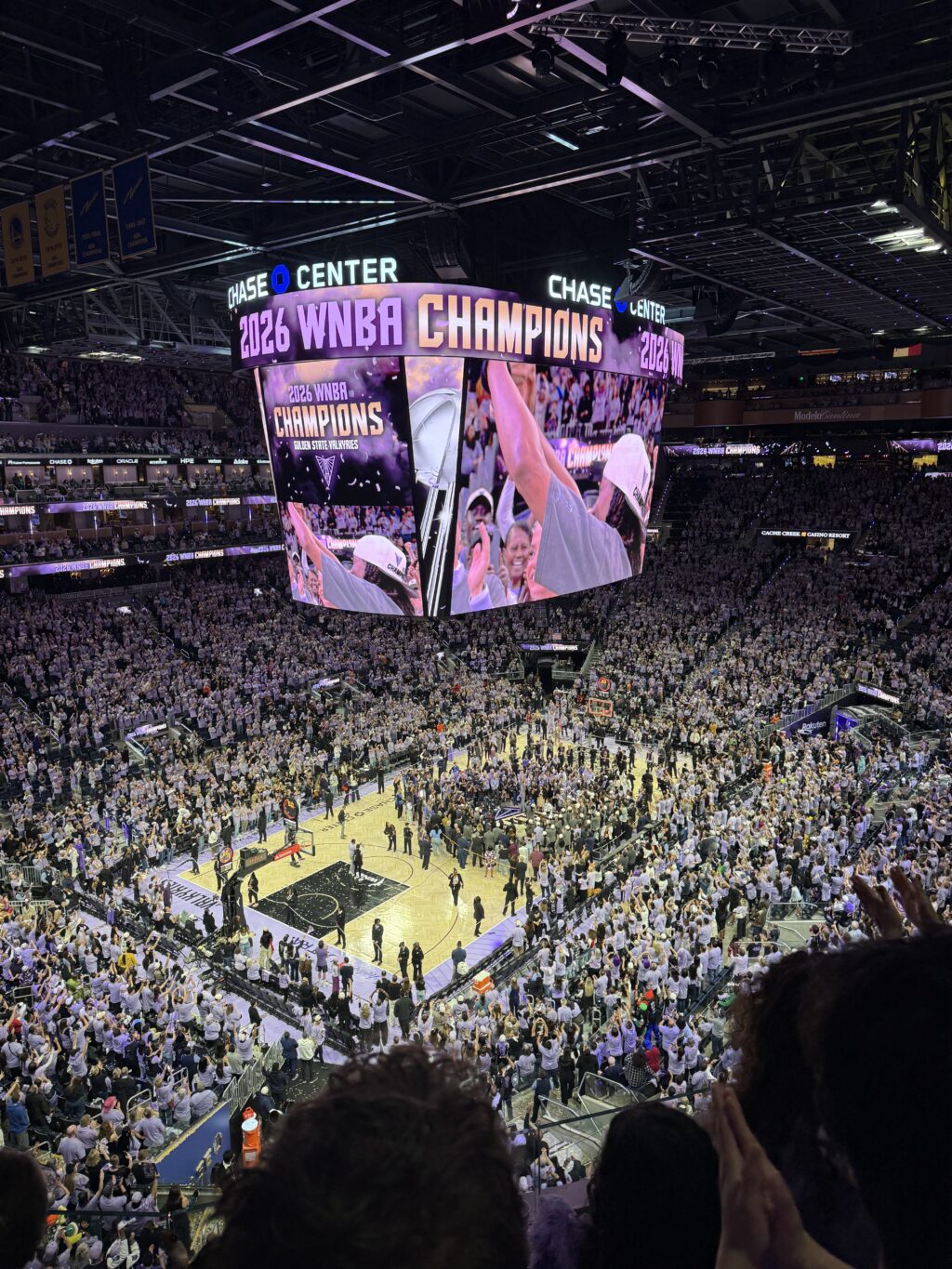
Chase Center celebrates after the Valkyries' Game 7 win
On Oct. 31, the Golden State Valkyries defeated the Atlanta Dream in the Women’s National Basketball Association Finals to capture their first championship in only their second year of existence. Golden State entered the Finals with a record of 32-12, while Atlanta had a record of 30-14. In the regular season, the teams played each other 3 times, where the Valkyries had a clean 3-0 sweep.
“[The Valkyries’ win has] gathered so much well-deserved support, which is hard to find in women’s sports,” said freshman Lilly Lewis.
Both teams have important players who could decide the outcome of the series. For the Golden State Valkyries, Gabby Williams is one of the team’s biggest strengths, averaging 14.4 points per game and for her defensive versatility. On the other side, the Atlanta Dream relied on Angel Reese, who averaged 16.4 PPG and is known for her elite rebounding skills both on offense and defense.
“I do feel like Williams is the star of the [Valkyries], but like there’s not just one star and everybody plays together, and everybody wants to win, no matter who’s on the court,” said math teacher Denise Morones.
Williams’ 16-point second quarter led the Valkyries past Reese and the Dream for a 68-64 Game 1 win, as she locked down the win with a 6-for-6 fourth quarter at the free-throw line.
“I’ve been to regular games during the season, but this one was just a different atmosphere,” said instructional aid Kristie Hala’ufia, who attended in person to Game 1 of the WNBA Finals. “[It was] super positive, extremely loud and just a lot of fun with great competition to watch.”
In Game 2, the Valkyries took advantage of the homecourt game early, but the Dream’s offense scored 21 points in the second quarter alone to build a double-digit lead. Despite holding the Dream to just 9 points in the third quarter, Atlanta maintained control until the final buzzer to win 79-65.
In Game 3, the Dream took advantage of homecourt momentum to build an early 7-point lead and hold a 46-40 edge at halftime. Golden State caught up after halftime, but Atlanta quickly responded to extend their lead to 14 points in the third quarter and continued their run through the fourth quarter to win 96-71.
With the losses stacking up, Valkyries fans were starting to worry, especially after how well they played in Game 1.
“I went to Game 1 of the finals at Chase Center and it was a pretty disappointing game in the beginning, but then we pulled through at the end and had a comeback to win the game,” said freshman Ashlyn Chin. “[But some of the other games] we [didn’t really] pull through like we did that game.”
Facing a 2-1 series deficit in Game 4, the Valkyries put Tiffany Hayes into the starting lineup and dominated early, building a 26-point halftime lead. Despite Atlanta mounting an aggressive second-half comeback, Golden State’s defense held on for a 67-62 victory.
In Game 5, tied 2-2 and back in the Bay, Veronica Burton helped the Valkyries build an early lead before Reese just barely pushed the Dream ahead 31-30 by halftime. Williams and Kiah Stokes spearheaded a second-half run by using sharp ball movement and lockdown defense to secure a 64-55 victory.
“[Game 5] was really fun to watch, they looked really good,” said math teacher Rafael Montelongo. “They seem to be really poised and so it’s just nice to see that they’re having fun too.”
The Dream exploded early with 22 points in the first 6:30 in Game 6, pushed by back-to-back triples from Jordin Canada, completely catching the Valkyries flat-footed. Atlanta’s defense silenced Golden State’s rhythm in the second quarter and maintained control through the second half, fending off a late Valkyries press to win the game 80-69.
After tying the series 3-3, Golden State won the deciding Game 7 68-63. The Valkyries opened with a record-setting five-minute defensive shutout, where Atlanta remained absolutely scoreless, but the Dream then rallied to take a 30-24 lead by halftime.
Williams then took over for Golden State’s offense in the third quarter, scoring 11 points to cut the gap down to two. Tied 55-55 in the fourth, Williams hit key three-pointers to spark a 7-0 run, leading the Valkyries to the deciding victory.
Though the fans enjoyed watching they couldn’t help but comment on the seemingly unpreparedness of the WNBA and the poor timing.
“It’s unfair that the time was moved,” said freshman Lillian Kerwin. “A finals game should get more publicity than a regular season game for the NBA. I feel like [the WNBA] is getting treated as secondary [to the NBA].”
One of the biggest examples of disorganization from the WNBA that fans point to was the Game 6 venue change, where the league had to scramble to move the game from the Dream’s regular home venue, the Gateway Center, which holds about 3,500 people, to the 17,000-seat State Farm Arena. But the State Farm Arena was already booked for a regular season Atlanta Hawks NBA game that evening, causing the game to be moved all the way up to 12:30 p.m., the middle of a school and work day. Afterwards, the Dream ownership released a letter revealing they had warned WNBA leadership two months in advance about this exact scheduling conflict, but leadership didn’t listen.
“It’s disappointing to see that they’re not supporting the teams as much, or the league,” Montelongo said. “But it has been nice to see the support that the Valkyries are getting in San Francisco.”
Regardless of the heavy backlash, both teams still showed the importance of teamwork, strong defense and performing under pressure, ending with the Golden State Valkyries winning the series 4-3.
“Even though the Valkyries are an expansion team, I feel like they’ll do really well next season,” said junior Brandon Grant. “I hope that they can defend their championship and win again next year, that would honestly be the best.”
With their first WNBA title in their second season, the Golden State Valkyries have solidified their spot in sports history.