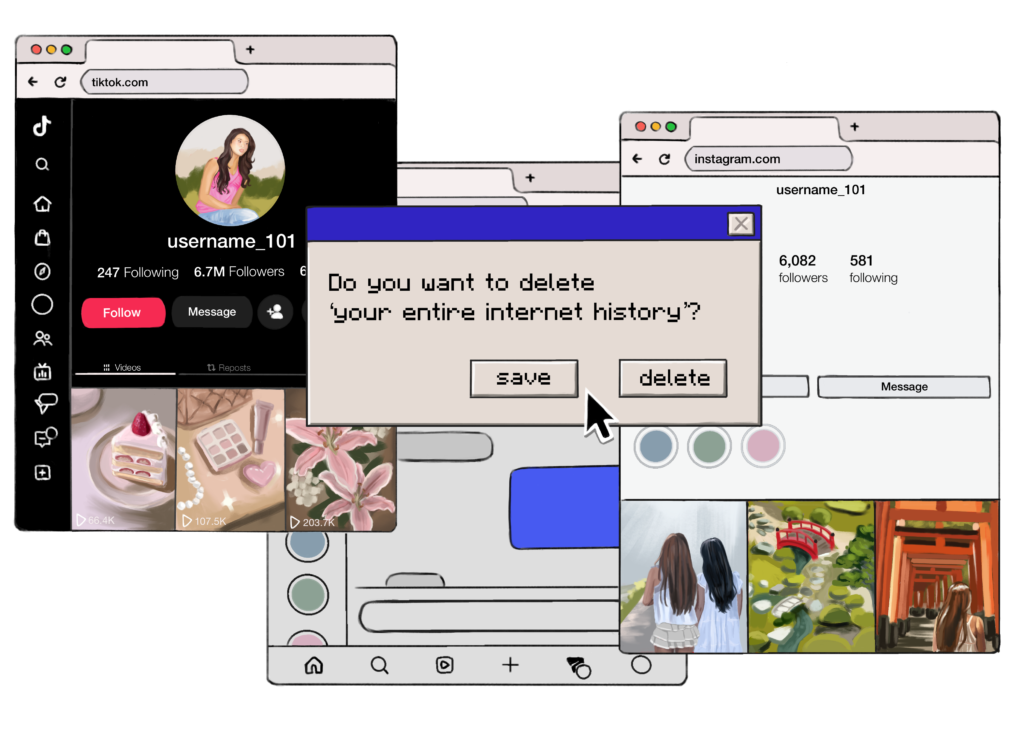
Look anyone up and see what pops up. Maybe it’s a social media account, collections of random photos or even websites they were briefly mentioned in. So much information can be pulled from just one Google search.
As people’s usage of social media has grown, sayings like “the internet is forever” have become increasingly relevant. Debates around the lifespan of the internet have emerged with the evolution of the web, raising questions about whether content can be permanently deleted and how it instigates fear of one’s private information existing elsewhere.
For example, before a user unsends a message, the message receiver may screenshot those messages or photos, which can be edited and used without the owner’s permission.
“Taking [content] off [the internet] doesn’t mean that it’s not [still around],” said sophomore Kylie Huang. “You can’t take something out of someone’s memory, that’s for sure. “
California law requires online service providers to allow “permanent deletion” of minors’ data and activity. This law can help ease some fears, but it does not protect all minors’ internet privacy. Due to the permanence of social media, some feel pressured when posting, as they fear they will later regret what they shared and be unable to change or completely erase it from their internet presence.
“If someone sees your social media, they see what you’re showing to the world as your identity,” said sophomore Luna Pérez-Passamani. “I try not to have regrets [but] nowadays everything is … scrutinized. So you have to be very careful with what you put out because otherwise, people are just gonna use it as fuel to either hate or make fun of you.”
When people post on social media, it’s shown to all their followers, even if the account is private. Often, a wide audience of people can access the information, making posts actually somewhat public. Some students combat this by using spam accounts, available to only their closer friends.
[Spam accounts are] pretty private so I don’t think your data will be leaked,” said sophomore Vienna Liu. “I don’t think your data will ever be leaked in general because there’s really no reason to [leak your data] unless you’re [posting about criminal behavior].”
Hesitancy towards posting and expressing opinions on non-spam accounts is common, especially as the content one posts is stored in their digital footprint. This is accessible by anyone who can access the internet.
“People go into deep dives [into other people’s information online],” Quinn said. “I met someone like that before. [He] knew everything. I didn’t know [him], but apparently he found my entire schedule. He might have not even been in the school, but he said that he was … I’ve been fine since, but it was weird.”
Additionally, because cybersecurity is not typically a topic of discussion among teenagers, posters’ awareness of what their internet presence is can dull over time.
“[Digital footprints] might be underemphasized because they’re not in everyday conversation,” said junior Joshua Wu. “I haven’t thought about it [digital footprints] in probably a year because it’s just not brought up. It’s not something that people talk about.”
Digital footprints may become more prevalent as people leave high school and college. Admissions officers, employers and anyone reviewing an application may run background checks on potential candidates with a simple LinkedIn or Instagram search of a name.
“If you search up someone’s name, there are all these background check websites that take … your social media, your address, your phone number, everything,” Perez-Passamani said. “It’s like a phone book from the ’80s, but it’s for everyone in the world and anyone can access it.”
What pops up could become part of the first impression, even before the interview itself. When unprofessional photos, ideas and statements come up in this process, interviewers may form an unfavorable impression of the candidate.
“People change,” Perez-Passamani said. “It’s not often that people change, but it does happen. And if their whole past is just on the internet, that sucks, especially if it’s something you don’t want to think about [anymore].”
Looking back on their past, many may feel that they wish to hide content that they’ve shared publicly. However present one is on the internet and social media, the lifespan of media on the internet affects everyone in some way.