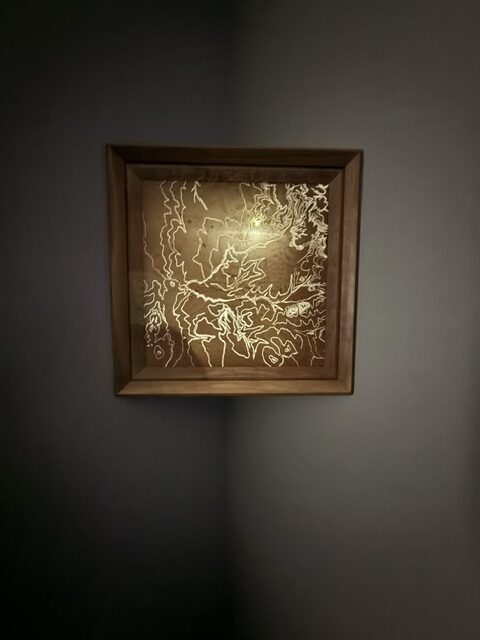
Two aerial maps, the same but different, face each other, telling overlapping stories of tragedy. Eerie but welcoming, Raven Chacon’s new exhibit at the San Francisco Museum of Modern Art displays his scenography craftsmanship in an abyss of film and noise on the sixth floor. His video, “The Naming of Names,” along with a spatialized re-cording of wordless noise guides viewers through the seven screens of footage that surrounds the room.
Best known as a composer and installation artist, Chacon was the first Native American to win the Pulitzer Prize for Music and has released over 80 music pieces across a 24-year-long career. He unveiled his exhibit at the SFMOMA on Oct. 24 and the artwork will be on display until Nov. 7, 2027.
Chacon, being raised on Navajo Nation — the largest Native American reservation in the United States — looks to highlight the erased history of Indigenous people and culture. He furthers the experience by using subtitles from “The Martian Chronicles,” by Ray Bradbury, a science fiction novel and TV miniseries that warned against humanity attempting to colonize Mars. Enhanced by tourist clips to the U.S. from the 1950s and 60s, Chacon compares human settlement to the settlement of colonials on Native land, and the renaming of landmarks and territories.
Chacon’s Diné, or Navajo culture, is shown through the ideas he conveys, revealing the message hidden behind the voiceless noise and contextless video. Each of his pieces and installments play a meaningful part in telling his unseen perspective on the Navajo land.
“It was like putting a puzzle together in a way where I didn’t understand right away,” said viewer Rylan Croft Lofgren. “I had to keep watching more to really start to understand … Especially towards the end, where it was this realization of what [the exhibit] really was. It was almost enlightening because the music changed, where it gave me a little bit more sense of comfort versus the beginning.”
The exhibit’s medium uses a dim room with projections on each wall, some walls with multiple. In the middle of the room is a round ottoman, assisting the frequent turning of attention that viewers will have. Across the room from each other sit two topographical drawings of a canyon on Navajo Nation and a valley on Mars. They are layered and inverted to further relate his comparison of Mars and Ray Bradbury’s novel to the Navajo Nation land and what happened to its people.
“[The exhibit] definitely immerses you,” Lofgren said. “I really enjoy exhibits like those, just because it really puts me in the position of almost being there, versus just a regular screen and audio.”
The exhibit uses special audio made by Chacon, which are field recordings and electronic music that he orchestrated specifically for the video used to further immerse the viewer in his scenery. The sound is intentionally used to direct the viewer to different screens at specific times. This adds an even deeper sense of reality, as if audiences are present inside of Chacon’s work.
“I thought the piece was a little haunting because it was very quiet and there’s not much noise,” said viewer Nick Mata. “[With this exhibit], you’re constantly thinking in your head, but you’re left with a lot of quietness right after [it ends].”
The excellent usage of subtitles and mixed media in the “New Work” exhibit further highlights the realities of Navajo history with subtle, yet impactful commentary.
“[My favorite part] was when I started to actually understand the message [of the exhibit],” Lofgren said. “I like the wordplay that [Chacon] uses, especially when it starts showing all the civilizations and artifacts.”
This exhibit’s intensely in-depth and intricate story does an exceptional job at fabricating a fresh and new perspective on the traumatic story of Indigenous people in the U.S. It serves as a somber and harsh exhibit, requiring one to formulate a theme from pieces. And although many merely glance in or leave with more questions than before, the viewers who do understand it appreciate Chacon’s message on a larger scale.
Chacon’s “New Work” exhibit at the SFMOMA deserves four out of five stars due remarkability, synchronization of many moving pieces and truths and revelations. The SFMOMA is a great place to explore the not-so modern history of the Navajo land by Raven Chacon.