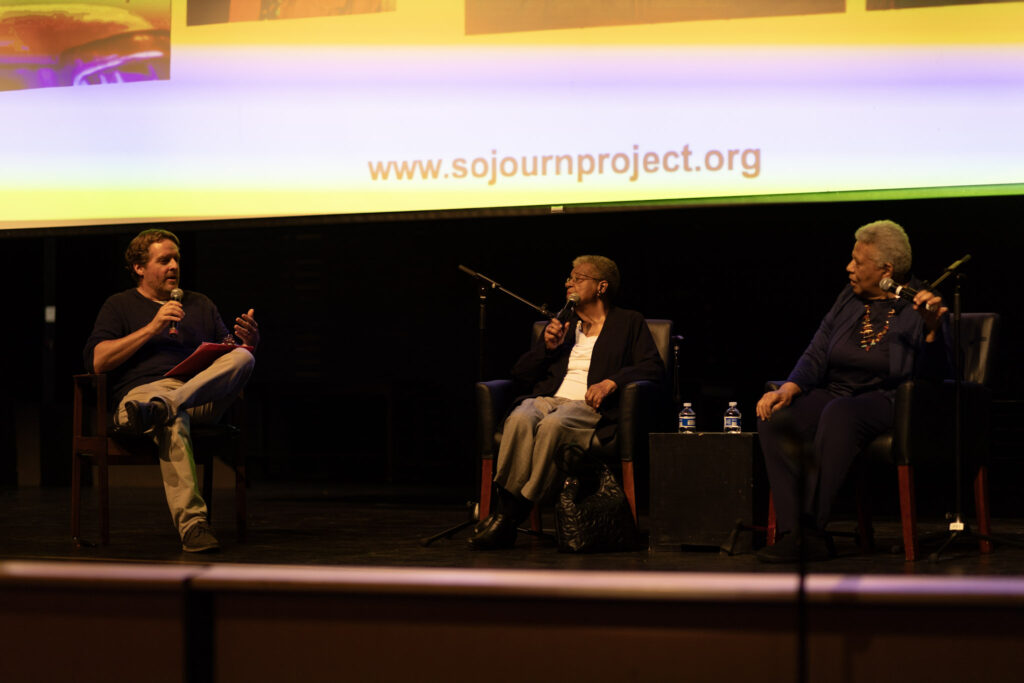
On Oct. 14, two members of the Little Rock Nine, Minnijean Brown-Trickey and Elizabeth Eckford, visited Aragon and other San Mateo Union High School District schools. The event, a question and answer session mediated by social studies teacher Carlo Corti, was held in the theater.
The Little Rock Nine were a group of African American students who were the first to integrate Central High School in Little Rock, Arkansas, a previously whites-only school, where they faced backlash from the white community.
Attendees were mainly U.S. History and Government and Economics students, though other social studies teachers who brought their fourth period classes. The event was planned with the Sojourn Project. This is the second time Aragon has hosted Brown-Trickey.
“[Sojourn Project leader] Jeff Steinberg has relationships with these people,” Corti said. “Since [Brown-Trickey and Eckford] are coming out here, he reached out to a few people that he knew … and said, ‘Do you have any interest in having them come and talk to your school?’ Because I knew Jeff, we worked [it] out that way.”
At the beginning of the event, Corti gave a brief overview of the Little Rock Nine, specifically focusing on Brown-Trickey and Eckford’s experiences. During the speech, Corti showed images of Eckford being prevented from entering the school on the first day by white parents and students.
“Images of Eckford [walking] up to the school and armed officers being there and her being turned away were really impactful to me,” said sophomore Noe Miyashita. “I could see that person in the picture, but I could also see her on stage, and it really felt like there was a real-world connection.”
After the overview, Corti asked questions based on those students had written on the back of the field trip forms.
One of the first questions Corti asked Brown-Trickey and Eckford was about what students at Central High School had been like.
“I was 15 years old and I saw these people who had given up their minds, given up their intellect, given up their decorum [and] had become monsters,” Brown-Trickey said during the question and answer session. “I said to myself, ‘I’ll never be that way’ … Sometimes you can take good things from bad events.”
Corti then moved on to ask if Brown-Trickey or Eckford had people on their sides when they attended Central High School. Eckford explained that though there were a small number of students who were nice to the Little Rock Nine, they were in the minority of an otherwise unwelcoming school.
“What I remember most is the people who passed right by [us] when we were being attacked and didn’t seem to notice,” Eckford said during the session. “It made me feel as though they thought we were getting what we deserved. And they [said later] that they didn’t do anything. But not doing anything is a decision that you make to let things continue as they are.”
Later, Brown-Trickey left the audience with a word of advice.
“When you see something that is so wrong, sometimes you’ve got to see what you can do to change it,” Brown-Trickey said. “Don’t try to do it alone. Work with other people of similar interests and make a difference.”
To conclude the event, students asked the speakers questions or expressed gratitude by approaching the main stage. Afterwards, students reflected on what they observed.
“The most important moment was when [Brown-Trickey] was apologizing to the audience, saying, ‘I’m sorry that we couldn’t have done enough [to deter racism],’” said senior Devyn Lee. “It was insane to hear that because … [they’ve] already done so much and the fact [they] feel bad that we have to carry it on was [both] sad and interesting to hear.”
Miyashita took a meaningful lesson from the speakers’ comments.
“I learned that there was a lot of injustice during the time, but [also] that it’s still a problem today,” Miyashita said. “It’s not completely solved like they hoped; but there’s a lot of things we can do to continue to work towards the goal of equality.”
Sophomore Amen Yosief also noted the new perspective that he gained.
“Whenever I get called slurs … and every time I say, ‘Wow this is the worst,’ I can remember [this] and be like, ‘I live in a pretty good time, because if I lived back then it would have been much worse,’” Yosief said.
Lastly, Lee wants to follow Brown-Trickey’s message about not being a bystander.
“Brown-[Trickey] went on this [talk] about how things aren’t going to change unless you stand up and try to speak out for people who can’t,” Lee said. “That overall message stuck with me.”
The history department hopes to host Eckford and Brown-Trickey again so more students will be able to meet the speakers.