Matilda Bacani
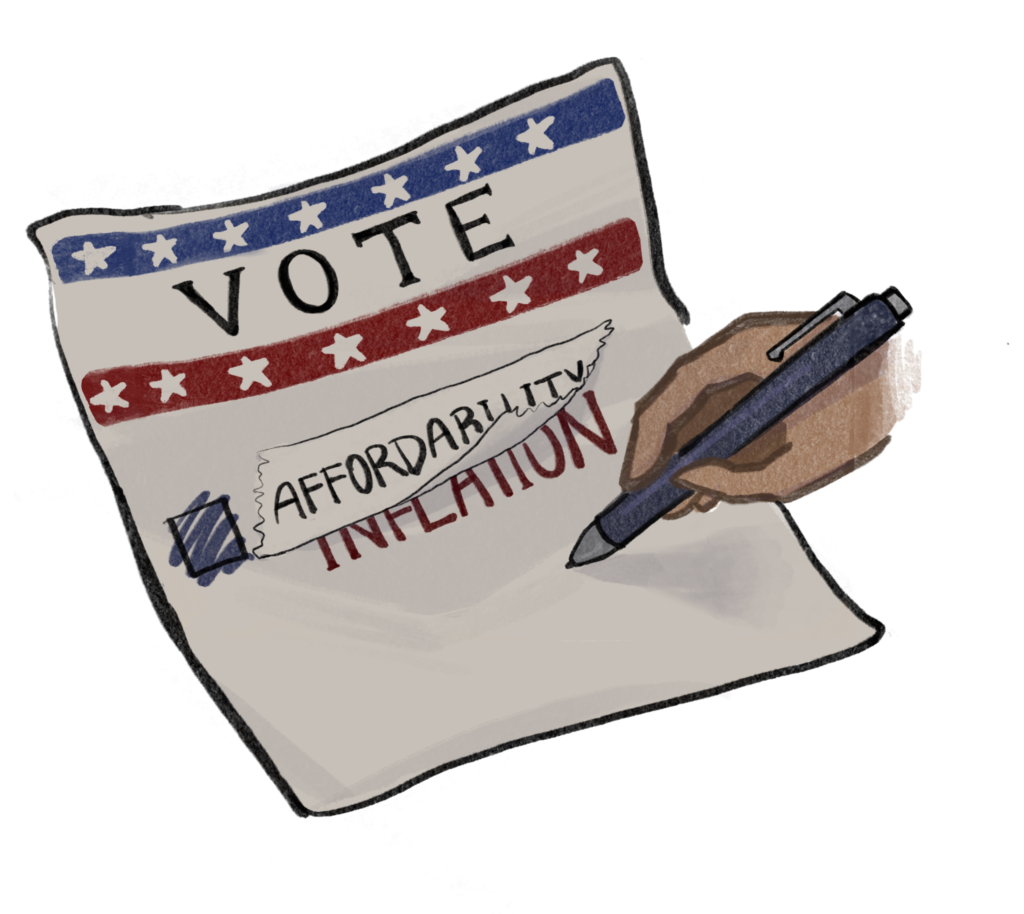
When Donald Trump ran for president in 2024, he made one promise above all others: he would make things affordable again.
In the 2024 election, the word was everywhere in his campaign — on the trail, in speeches, in policy pitches. But not everyone was convinced by the rebranding.
“He sees some value in the disaffected worker, which has definitely been a big part of his base — people that are either being laid off or not employed in the same way they once were as a result of shifts within the kind of jobs we have in this country,” said senior Oscar Nicolson. “He thinks he can use these people and still take their votes in the [Grand Old Party] without actually helping them because once you get into his base, everything is blamed on outside forces. By not taking any accountability, it’s very easy for him to not help those people and help people within his own interests.”
More than a year into his second term, the results are mixed at best. Inflation rose again in March. Gasoline prices have climbed with the Iran war. Federal cuts have squeezed low-income households further.
The University of Michigan’s Survey of Consumers, often dubbed the gold standard for measuring consumer sentiment, hit a record low with its index dropping to 47.6, signaling low consumer confidence in the country’s currency.
“Expectations for inflation in the short run are changing,” said senior Matthew Hagedorn. “There are immediate and pretty damaging consumer affordability and also concerns about … the uncertainty it brings to financial markets … Of course, energy is an input for every business, so that’s a lot of where we see inflation getting passed on to consumers more … Blocking the Strait of Hormuz really messes with logistics and supply chains. That incurs costs; even if it’s small, it’s still going to be there — plastics for healthcare, fertilizer [and] a lot of basic inputs are being affected.”
The gap between political promise and lived reality is hard to ignore. During times of economic uncertainty, even ordinary choices start to feel like they’re consequential.
“My parents and I complain about [the gas prices] a lot,” said junior Tristan Levadoux. “It becomes harder for me to drive because I don’t want to use as much gas. I feel bad spending my parents’ money, and my parents get mad at me if I spend too much … So I think we should pull back [our forces in Iran] so we can focus on ourselves.”
The power of “affordability,” experts say, comes from its universality. University of California, Los Angeles linguist Jessica Rett describes affordability as “a much weirder noun than economy” because unlike broad economic terms, it carries deeply personal meaning. But that experience isn’t universal, even within the same hallways.
“Most students here, because we live around such privileged areas, won’t personally care about changes from the Iran conflict, because it won’t really affect them personally,” said junior Lam Le. “Even if they work a job, everyone is usually supported by their parents.”
That unevenness is, in many ways, exactly what politicians are counting on. Democrats point to child tax credits, paid leave and subsidized child care. Republicans point to deregulation and energy production. Both call it affordability. When the same word can mean everything, it risks meaning nothing.
A younger wave of politicians, including New York City mayor Zohran Mamdani and Texan Democratic nominee for Senate James Talarico, represent a left-populist strain, appealing to a similar base as Trump: working people frustrated by rising costs. However, they offer different solutions. For example, Among Mamdani implemented Streamlining Procedures to Expedite Equitable Development, a program that would expedite the process for affordable housing projects by eight months.
“Looking at Zohran Mamdani as an example, I feel like he’s more believable, because with the policies that he’s implementing in New York, he’s actually trying to fix housing and rent and doing things for the people,” Le said.
Whether the messenger is Trump, Mamdani or anyone in between, the word itself remains slippery — powerful precisely because it means something different to everyone who hears it. What it means to a student planning retirement accounts at 17 is not what it means to a family stretching a paycheck through a month of rising grocery bills. Politicians know that, but the question is whether voters do.
“The best thing that we can do for this country is inform more people,” Nicolson said. “And the best thing you can do as a voter yourself is to be informed.”