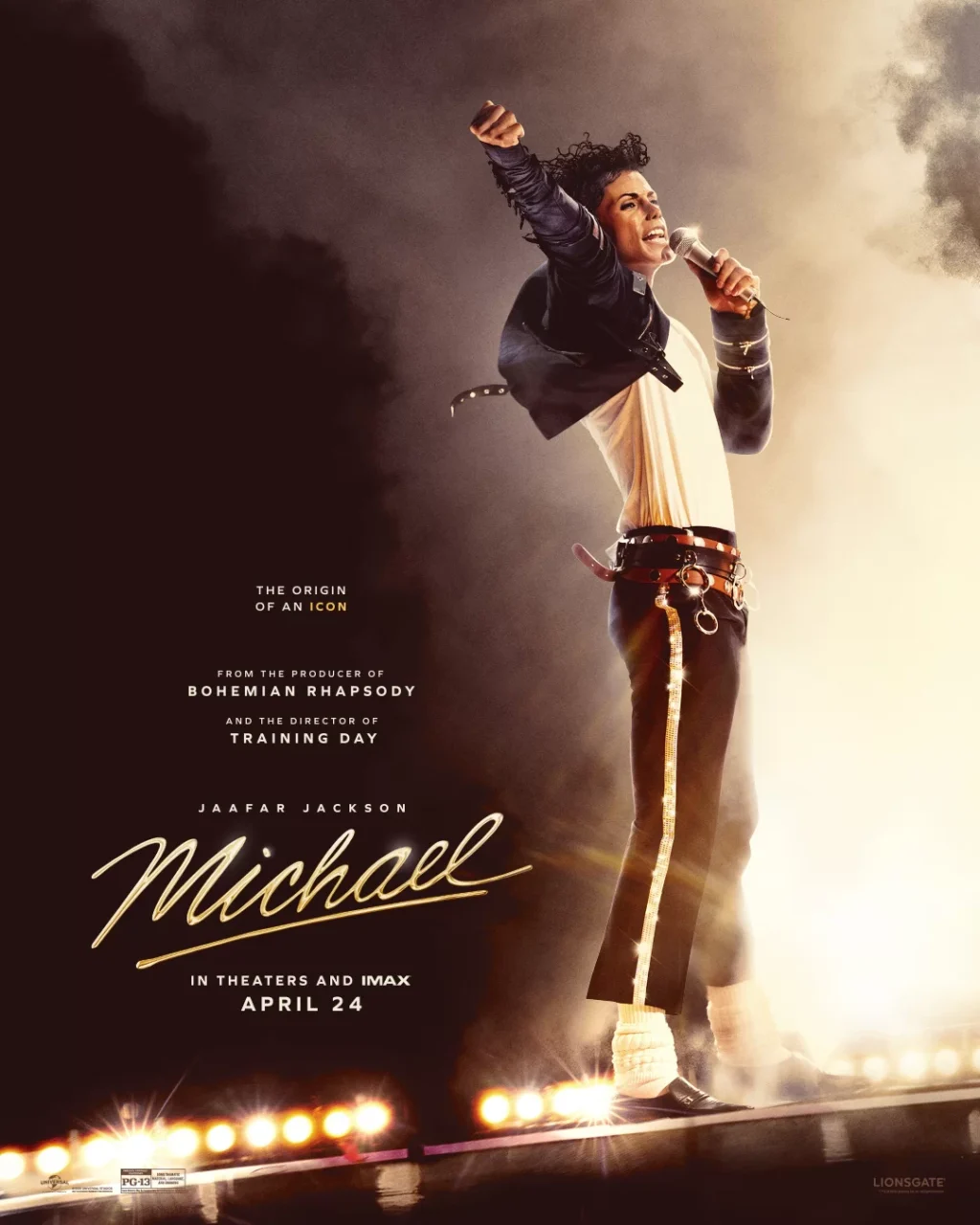
The “Michael” biopic finally moonwalked into theaters on April 24. It chronicles the first three decades of singer and songwriter Michael Jackson’s life, from his childhood up until the end of his “Bad” album tour. Directed by Antoine Fuqua, written by John Logan and starring Jackson’s nephew Jaafar Jackson, as Michael Jackson, the biopic was a peculiar ride exploring Michael Jackson’s music and upbringing.
The movie has received skewed reviews, with stunning reviews from some of Michael Jackson’s fans but deplorable ones from critics.
“I liked the movie,” said junior Azul Tepeu. “I loved it, matter of fact. I think it was one of the best films I’ve seen in my whole life.”
The film opens with him walking into Wembley stadium for his “Bad” tour before thrusting the audience into a flashback of Michael Jackson’s childhood that takes up much of the first act. His raw emotion is amazingly portrayed by child actor Juliano Valdi. His voice was almost identical to Michael’s, with perfect pitch and a rich quality to it.
“[Something that] surprised me was how [well] the little version of Michael acted, performed and just sang,” Keenan said. “He sounded amazing.”
While the first act feels rather slow, taking up around the first 45 minutes, it discusses Michael Jackson’s feelings of alienation and loneliness and his conflict with his father, setting the scene for the remainder of the biopic.
In acts two and three, the conflict between Michael Jackson and his father, Joseph Jackson, continues to build. It finally comes to a climax when, in a freak accident filming a Pepsi commercial for his father’s tour, Michael Jackson’s hair lights on fire. It symbolizes how the bridge has been completely burned between Michael Jackson and his dad and how he no longer feels obligated to listen. Their relationship was beautifully developed in the film, and some of Joseph Jackson’s behavior explained some of Michael Jackson’s eccentricities later in life.
The movie ends feeling very rushed as the finale of the Victory Tour is shown immediately after Michael Jackson’s burn recovery and then transitioning into a full circle moment as he walks into the stadium shown in the opening of the movie. He sings “Bad” and as the song concludes the credits begin to roll.
Overall, the movie’s pacing felt accelerated at times, and they should have focused a little less on Michael Jackson’s upbringing to include key parts of his adult life.
“[The plot] was a little fast,” Keenan said. “They skimmed over a lot of stuff … It also just felt like they were going through every step of Michael’s life, but fast.”
The producers entirely gloss over Michael Jackson’s first four studio albums, and annoyingly, Michael Jackson’s formation of a relationship with a key figure in his life, his lifelong friend and mentor Diana Ross. In fact, she is not included whatsoever throughout the entire movie despite Kat Graham originally being cast to play her. Significant developments like when he filmed the charity single “We Are The World,” or anything about the filming of “The Wiz,” which could’ve enhanced the plot, were also completely removed. It really could’ve helped to diversify the plot, giving more insight into Michael Jackson as an artist outside of his most popular albums.
Additionally, the questionable decision to omit introducing Quincy Jones and Rod Temperton, producer and songwriter respectively, was irritating considering they were crucial elements in the production of “Off the Wall,” “Thriller” and even “Bad.” On the topic of “Bad,” they also failed to include the production for the follow-up to “Thriller,” which is widely regarded as on the same level of popularity and acclaim.
During this period in Michael Jackson’s life, they also skipped over a lot of controversies, like the tabloids calling him “Wacko Jacko,” or how the general public saw him. The movie seemed like it was, at times, filmed through the rose-tinted goggles of its producers, an idealistic contrast to how many people see him in reality. Specifically, their choice to end the movie two years before the prevalent child abuse allegations against Michael Jackson sparked a lot of controversy amongst viewers.
Despite all of this criticism, the film has many redeeming qualities. Colman Domingo’s portrayal of Joseph Jackson was commendable, and his acting was the highlight of the movie. He truly did feel like a villain, whether it was him leaning in to beat Michael Jackson and cuss him out, or when he delivered lines so raw as “I own [Michael] nine to five.”
Another redeeming aspect of the film were some recurring characters, like Michael Jackson’s bodyguard, Bill Bray, played by KeiLyn Durrel Jones, and Michael Jackson’s mom, Katherine, played by Nia Long. Bray truly developed a connection with Michael Jackson, a theme that sometimes felt missing with other characters like Michael Jackson’s brothers or even someone as pivotal as Quincy Jones. Similarly, Katherine Jackson served as a guiding totem in Michael Jackson’s life, helping him to make tough decisions regarding his father and becoming an adult. Scenes of them watching movies together or Katherine standing up to Joseph for Michael Jackson to have more agency was useful in conveying the genuine mother-son connection they had. While most of the characters were not overly relatable, the ones that were, and their relationships with Michael Jackson, were very prominent and added a lot to the movie overall.
Another redeeming aspect of the film wereLastly, the scenes of Michael Jackson performing, whether that was at the Motown 25th anniversary or on the final day of the Victory Tour, truly transports the viewer back to a time when he ruled the world. In terms of the soundtrack, the mixing was beautiful, almost as if Michael Jackson was having the concert right in front of the audience. The recreation of the iconic Motown 25 moonwalk performance was beautiful to say the least, and the music video and studio scenes felt very real.
Overall, the movie’s goal was to boost Jackson’s legacy in a time when most news about him is bad.
“I always felt that younger generations didn’t know Michael or his story,” Fuqua said in an interview with Deadline. “In order to tell anything about Michael, you had to remind people about the magic of him, the power of the music, and the fun that he brought into the world and his own insecurities.”
The theme of isolation and conflict between Michael Jackson and his father provided a very interesting backbone to the movie that brought insight into Michael’s background and character to a broader audience. While critic reviews were quite low, I feel the main goal of the movie was accomplished, and despite how the overall plot of the movie was sometimes incomplete or bland, I would give the movie three out of five stars.