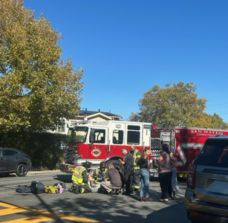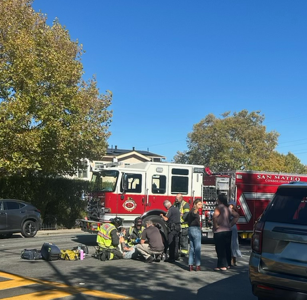
Walker is treated by first responders.
Written by News Editor Ellie Blakely and Features Editor Naomi Kotani
A vehicle operated by an Aragon student struck an Aragon sophomore at the intersection of Alameda de las Pulgas and Aragon Boulevard on Sept. 14, sparking an outpouring of calls from the community and local leaders for improved traffic safety measures at the intersection.
The victim of the incident, London Walker, was walking in the crosswalk during the designated pedestrian signal when the driver of a truck made a left turn into the crosswalk and hit her, the impact sending her several feet. The pedestrian signal currently occurs at the same time that drivers turning left have a green light.
“I [saw] the front of the truck, and I don’t remember it hitting me or feeling pain at that moment,” Walker said. “I just remember hitting the ground, my head and my whole left side, and then seeing people around me.”
Sophomore Erin Gage was crossing with Walker and witnessed the incident. She initially thought that the driver was just inching forward while waiting for the pedestrians to finish crossing, a common occurrence at the intersection.
“Then I saw [the driver] start to speed up, and I looked for [their] face, [for] eye contact, and [they were] looking down,” Gage said. “I saw the top of [their] head so I thought maybe [they’re] on [their] phone, then I saw [them] start speeding up more. I was like, ‘[they’re] not gonna stop for me.’ My instincts kicked in and I started running … I didn’t call out [to warn Walker] because in the heat of [the moment], my reaction [was just to run]. I heard the big thud of the car hitting [Walker] and [the driver] stopped right away. I heard the screech of [the] tires and she flew off the crosswalk, probably seven feet.”
Emergency responders arrived within minutes and transported Walker to the hospital. She sustained minor injuries from the collision, including abrasions and soreness in her muscles and ribs.
The driver of the vehicle did not respond to a request for comment.
In response to the incident, local traffic and pedestrian safety advocacy group Move San Mateo organized a community meeting on Sept. 19 near the site of the collision. Attendees discussed changes they wanted the city to make to improve traffic and pedestrian safety.
“Another kid is going to be hit if we don’t do anything right now,” said organizer Allison MacQueen. “I can’t have another kid hit next week. It just can’t happen.”
Among the attendees were Walker and her parents, the Aragon Parent Teacher Student Organization co-presidents, San Mateo Union High School District Board of Trustees Vice President Jennifer Jacobson and District 1 city council candidates Taso Zografos and incumbent Lisa Diaz Nash.
For the majority of the meeting, attendees deliberated on a list of Move San Mateo’s proposed changes to the intersection, including prohibiting right turns during red lights, adding an additional pedestrian signal to Aragon Boulevard, increasing or isolating pedestrian crossing times and narrowing lanes on Alameda, a measure that has been shown to generally reduce vehicle speeds.
There was unanimous support for increased safety measures at the meeting, although some community members disagreed about specific implementations. Both at the meeting and in the Outlook’s reporting, many also expressed concern about how traffic flow would be impacted by the proposals.
“A protected left [turn] could be a good idea,” said senior Jasmine Tam. “However, it would be hard to implement because it’s going to cause more traffic [since] there’s only two lanes. Normally, for protected lefts, there are [more than two lanes].”
Following the meeting, Move San Mateo and the PTSO collaborated to put together a letter residents could send to City Council, urging local leaders to address the issue. The PTSO also created a newsletter to parents and staff titled “Dons Community Action,” specifically focused on advocacy in the Aragon community.
“I was very pleased with [the letter writing and newsletter],” said PTSO Co-President Margie Kim. “That really produced the kind of change that we needed in a short amount of time.”
At a City Council meeting on Sept. 22, many residents and local leaders spoke in favor of the proposed changes.
In response to the community advocacy, the city announced that its staff are evaluating existing infrastructure in the intersection and the possibility of “Quick Build” changes, which can be implemented in six months or less. Additionally, Assistant City Manager Jennifer Yamaguma said in a statement that the city is conducting an “accelerated review” of the intersection in order to determine the feasibility of some of Move San Mateo’s proposals.
In an interview with the Outlook on Sept. 28, Council Member Diaz Nash described the changes as fitting into three categories: the short-term Quick Builds, such as implementing additional pedestrian signage; mid-term solutions, like pedestrian-only crossing times; and long-term approaches, which could include evaluating traffic lights in order to add a signal prohibiting right turns during red lights or indicating a protected left turn.
“The [Quick Build] ones are more favorable,” Diaz Nash said. “They’re quicker, they’re easier and they’re cheaper.”
However, the Outlook obtained an email Diaz Nash sent to the PTSO co-presidents and other attendees of Move San Mateo’s meeting on the evening of Oct. 7 informing them that several Quick Build changes were approved for the area. The changes, which Diaz Nash said in the email are expected to be completed by early November, include a pedestrian-only crossing time for east-west crosswalks; “No Right on Red” signs for all right turns in the intersection; centerline hardening on Alameda; daylighting, the removal of parking and other objects that could reduce driver visibility on corners; and increased presence of traffic enforcement officers.
Prior to the Sept. 22 city council meeting, the city considered enforcing speed limits on several streets which state law requires to be done through first increasing the speed limit. However, this proposal received intense community backlash, so City Council decided to delay the increase and hold a study session to discuss the issue further.
Aragon’s Student Equity Council is working on preliminary plans to provide scholarships to students for mandatory driver training courses, with the goal of decreasing the financial burden of obtaining a driver’s license and making the courses more accessible. ASEC was already planning to implement this program before the incident happened.
While changes to traffic infrastructure are within the jurisdiction of local government, not that of SMUHSD or Aragon’s administration, both have said that they will collaborate with the city.
“Someone from the city is going to come out and talk with [the school and district] and look at some of the proposed changes,” said Principal Peter Alvarez. “[We’re] trying to develop that partnership. [Traffic safety on Alameda has] been a longstanding issue … Some changes hopefully will get done to keep our students safe.”
The recent collision is not an isolated incident; several have occurred at the Aragon and Alameda intersection and students agree that the crossing feels unsafe.
“Cars do go quite fast down there sometimes, especially when no one’s there,” Tam said.
In addition, there is a wider pattern of drivers hitting pedestrians at intersections across San Mateo, including a January collision at the intersection of 17th Avenue and El Camino Real and a 2025 collision on Fashion Island Boulevard, both of which resulted in pedestrian fatalities.
“It’s been a chronic problem, but it’s only when there’s an incident that people feel moved to action,” Jacobson said. “It’s unfortunate that it takes an incident where somebody gets hurt in order for people to take action, in order for the city to start listening.”
Although advocates have been calling for the city to take stronger action on what they describe as dangerous intersections for over ten years, the amount of incidents concentrated in recent years has prompted a more intense push for improved traffic safety measures.
“We’ve been waiting long enough, and the community has talked about Alameda safety for over a decade, and it upsets me that we’re still talking about it today,” Kim said. “This cannot happen to anybody else, whether it be a student or a community member. This change needs to happen now.”