Mi Nguyen
Reporting by Diya Poojary and Addie Rose
On your drive to school, a small black camera mounted alongside the road can be easy to miss. But the cameras throughout San Mateo County are capable of recording much more than just a passing moment.
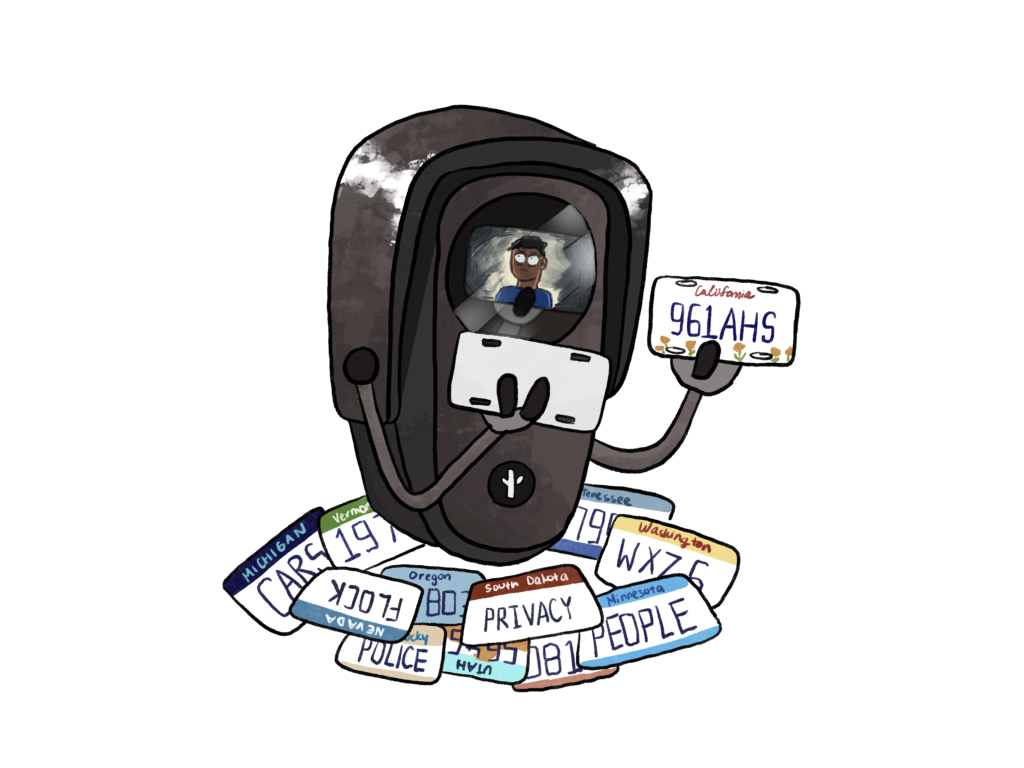
These cameras, distributed by security company Flock Safety, use Automatic License Plate Reader algorithms to read letters and numbers on a vehicle’s license plate, as well as determine its make, model, color, location and the time it was recorded. This information is then stored in a searchable database that allows law enforcement to use the information during investigations.
For students who drive around San Mateo County every day, that means that an ordinary drive to school, practice or a friend’s house could leave a digital record of where their vehicles were seen. Just around Aragon, there are three Flock cameras surrounding the campus.
The cameras are used to help law enforcement solve crimes and locate stolen vehicles and missing people. But their growing presence has raised questions about privacy, data retention and who should have access to information about people who are not suspected of a crime.
Flock Safety, an Atlanta-based company founded in 2017, has become more widespread as a large provider of ALPR technology across the country. In explaining the benefits of Flock cameras, the company website provides the statistic of over 10,000 missing people being located through use of the cameras and that “42% of Flock customers recovered more than half of all stolen vehicles in their jurisdiction,” as stated on their website.
When a car passes a Flock camera, the system automatically records information about that vehicle, detecting up to 75 feet away. According to Flock, information is immediately sent to a cloud-based database, where it is compared with law enforcement watch lists containing vehicles associated with stolen cars, criminal investigations, warrants or missing person alerts.
The cameras are also part of networks, meaning if the same vehicle is caught by multiple cameras, investigators can use those records to determine when and where the vehicle traveled. Flock claims that this is one of the biggest reasons why law enforcement uses this technology.
If police were looking for a stolen vehicle, they do not have to rely on an officer happening to see it. An ALPR system can send an alert directly to officers as the cameras detect the vehicle.
The San Mateo Police Department says on their website that they specifically use ALPR technology as a tool for locating stolen vehicles, missing persons and violent felons.
“ALPR information is an investigative lead; it does not by itself establish that a crime occurred or that a particular person committed a crime,” said SMPD Police Lieutenant Steve Casazza in an email. “Officers are expected to independently verify information and develop the appropriate legal justification before taking enforcement action.”
But the cameras don’t only record vehicles of suspected criminals. They capture all vehicles that pass the camera. This distinction is the root of the privacy debate.
As of March 30, more than 580 ALPR cameras were deployed throughout San Mateo County. They are used by the County Sheriff’s Office and by most of the county’s law enforcement agencies, which include departments in Burlingame, San Mateo, Foster City, Daly City, Redwood City, Hillsborough, Menlo Park and other communities.
The city of San Mateo operates 66 Flock cameras, according to an August San Mateo Grand Jury Report.
This means that students may pass Flock cameras as they drive to school without realizing their information is being tracked. For some students, the cameras represent an extra safety measure, but others may be more concerned about the amount of information being collected and how it is being used.
“Officers are using Flock cameras for uses that aren’t necessarily what they’re meant to be used for,” said senior Anjalika Khare. “A lot of people have compared these Flock cameras to that of a surveillance state, where everybody’s being watched, everybody’s face is being monitored, people are being tracked, people are being unnecessarily caught for things because an AI or someone monitoring the cameras is [misinterpreting] what they’re seeing.”
These concerns are not unfounded; The Washington Post reported in August that at least 50 law-enforcement officers have been accused or charged with using their access to Flock’s data inappropriately, for uses such as stalking ex-partners, people from their personal lives and others not suspected of crimes.
The American Civil Liberties Union argues that this technology could affect a person’s freedom through perceived First Amendment violations, and should only be used if the vehicle is on a legitimate watch list.
A frequent concern about ALPR cameras is what happens to the data after a camera records it.
In order to find out, San Mateo County’s Civil Grand Jury recently investigated how local agencies operate ALPR systems, releasing its findings in August. They examined agency policies, audit reports, contracts and data-sharing practices of the county law enforcement agencies using ALPR cameras.
One concern the report brought up involved data sharing between law enforcement agencies and private university security departments. The Grand Jury found that most of the agencies it reviewed shared ALPR data with the university departments without establishing whether those departments were public agencies under California law.
The Jury called for stronger oversight and more consistent policies so agencies can maintain public trust, while balancing safety and privacy. SMPD has since begun reviewing their own practices based on the investigation’s results, specifically with regards to the ALPR policy and operating procedures.
“The revisions are intended to more clearly address [the concerns outlined by the Grand Jury],” Casazza said. “We also believe policies involving rapidly evolving technology should not remain static. We will continue to review our ALPR practices as technology changes, laws are updated and we identify opportunities to improve accountability and transparency.”
Additionally, SMPD has reduced the number of agencies with which it previously shared Flock’s data, working with a more limited group of law-enforcement partners.
Flock has also made several changes to its own policies and technologies in response to the growing concerns about privacy and misuse.
In August, Flock added new restrictions on how agencies can search within each other’s camera networks. Agencies can now pick what types of offenses other agencies are allowed to search for. For example, an agency could allow another department to search its cameras for stolen vehicles or missing persons, while blocking searches related to immigration enforcement.
Another change is that law enforcement users will be required to enter a case code connected to a specific investigation before conducting a search. In July 2025, Flock had made this case code optional, but to ensure security, the company now requires them for all law enforcement agencies. Emergency scans can still be performed, but will be flagged for administrator review.
In addition, Flock announced that it would reduce its recommended default data-retention period from 30 days to seven for new law enforcement customers, while existing customers keep their current retention period. Flock also introduced a new “Evidence Mode,” which allows specific information to be preserved when it is connected to an active investigation and is given to the new customers free of charge.
After an Oct. 5 City Council meeting at which members discussed the city’s use of ALPR cameras, the city decided to sign a purchase agreement with another company providing ALPR technology called Axon. The agreement involves a one-year free trial of Axon’s services, during which the city will conduct a side-by-side comparison with Flock cameras to determine which company they prefer.
The council voted four to one in favor of proceeding with the agreement, with the exception of Mayor Adam Loraine.
At the City Council meeting, a primary concern brought up by many public comments was regarding Axon’s contract with the United States Immigration and Customs Enforcement Agency. However, both Diaz Nash and Casazza have reaffirmed that SMPD has strict regulations regarding this issue and does not share any information with federal immigration authorities or with any law enforcement agencies outside of the state, aligning with Flock’s safeguards specific to California. Immigration and reproductive care-related searches are automatically blocked within the state.
However, Khare believes that there are better methods of finding criminal suspects that would put an end to the privacy debates.
“[Finding] an alternative would be better … because regulations will always have people [evading them],” Khare said. “People are swerving around the Constitution these days. It’s like the Constitution is bendable. You don’t know what else is.”
Diaz Nash noted that the debates surrounding Flock are complicated, but believes it is possible to address public concerns without having to completely replace the technology.
“[It’s] not all white or black, and we definitely want to protect our residents and businesses’ safety and privacy,” Diaz Nash said. “That’s of paramount importance to us, and that’s why we insist on the audits and the guardrails … But we also really value the use of these tools to reduce crime, to find missing people, to find people [involved in] hit and run incidents … We want both, and we think it’s possible to do both.”
Concerns voiced by a significant population during the regular City Council meeting on Oct. 5 led to the decision to hold a town hall meeting in the near future, though the date for the meeting is unconfirmed.