On Sept. 14, the Supreme Court blocked the United States Postal Service from implementing President Donald Trump’s executive order to limit mail-in voting.
“[The purpose of the] Supreme Court is to keep all these crazy things from happening,” said junior Jaydon Li. “You can’t just have the president say whatever he wants and get what he wants … It is good that the Supreme Court is stopping that from happening because [they] know that this is a decision that was so abrupt [and] might not be thought through.”
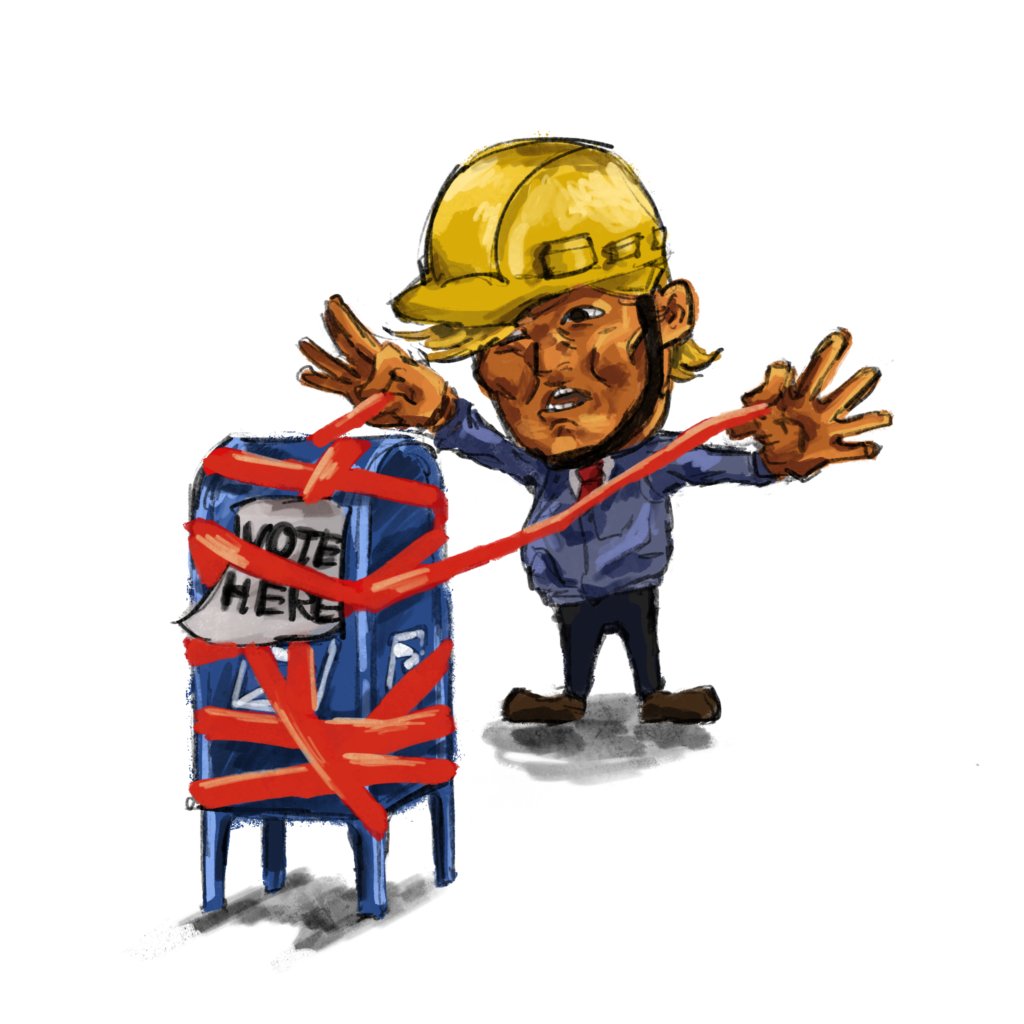
Earlier this year, on March 31, Trump issued an executive order that instructed the Department of Homeland Security to collect lists of citizens and prohibited the USPS from delivering mail ballots to voters that don’t appear on the list. The order also threatened to not deliver voter ballots unless states submit lists of eligible mail voters to the USPS 60 days before the election.
Later, to comply with the executive order, the USPS released rules that required ballots to be sent in envelopes that meet new design standards, which included unique bar codes for every ballot, and mandated that states upload a list of participating voters in advance. The USPS would not have delivered ballots that didn’t meet the design standard or belong to someone not on the list.
Almost a third of Americans voted by mail in 2024, including one-third of Democrats and one-fourth of Republicans.
In his executive order, Trump claimed that these measures were necessary to ensure election integrity and prevent fraud.
However, some experts say the harms of the executive order would have outweighed any benefits.
“If implemented, the executive order would inject chaos into our elections, block eligible American citizens from voting, undermine voter privacy, and expose election officials and others to criminal prosecution simply for doing their jobs,” said Wendy Weiser and Sean Morales-Doyle, writers at the Brennan Center for Justice, in an essay.
In fact, some have cast doubt on the validity of Trump’s claims.
“[Trump’s] claim has always been voter fraud,” said Modern World History teacher Jon Felder. “Going all the way back to the 2020 election, which Biden won, [Trump] claimed the reason that Biden won was because of voter fraud, and so he’s brought that narrative forward. It’s hard to know what his intention is, but [trying to] gain an advantage in the election in this midterm election seems likely.”
Opponents to the rules argued that complying would have increased costs and caused confusion for election officials, voters and the USPS. In addition, they argued that the USPS’ refusal to deliver noncompliant ballots would have caused disenfranchisement as states wouldn’t have enough time to comply with them. Trump’s policy also had the potential to eliminate mail-in voting in states that don’t give voter data to the USPS.
“He’s very clearly trying to influence the election to not be 100% fair,” said junior Benjamin Chang. “The whole point of an election is that it’s fair between all candidates … so it kind of defeats the whole purpose of [it]. The whole idea of America is this democracy. But if democracy goes out the window, what are we anymore? A dictatorship?”
Whilst Trump has been claiming there is fraud in elections, the percentage of Americans that trust election certification has dropped since the last election from 40% in 2024 to 34% in 2026.
On Sept. 4, a federal district court blocked the USPS from implementing its rules after a lawsuit from several civic organizations.
“A few judges [were] using the last-minute aspect of [USPS’s rules] to try to say, ‘let’s make sure ballots actually get sent out to voters rather than the postal office going through all of them so carefully because that could lead to mistakes,’” Felder said. “A couple of judges have said that the risk of voters who are qualified to vote not being able to vote is greater than the risk of unregistered voters voting.“
The U.S. Constitution gives states, not the president, the power to regulate elections. The voter organizations that had sued argued that Trump’s executive order violated this principle by forcing states to change their election laws. They also claimed that the executive order violated the Voting Rights Act and Privacy Act by making the USPS unable to deliver ballots to eligible voters and by compiling personal data of Americans without public notice, respectively.
Ultimately, the case reached the Supreme Court, which chose to keep the preliminary injunction blocking the order, ruling that election officials did not have enough time to implement the rules before the midterm elections. As a result, mail-in voting will continue with no new restrictions in the midterm elections, which will be held on Nov. 3.