Makenna Nguyen
Celebrities are no strangers to controversy. Their every word and action is meticulously studied by superfans and critics. In this light, some celebrities have chosen to speak out in support of a political party, especially during key moments such as the 2024 presidential election. However, others have taken a different path, instead advocating for specific issues they are passionate about while remaining nonpartisan.
Famously, Dolly Parton took this latter stance due to her belief that she was a role model to all and because she did not want to offend other people with her beliefs.
“Everyone loved Dolly Parton,” said freshman Charlotte Santiago. “It was nice that she never … announced herself to a certain party … it kept her open, in a sense. I think [she did so] just because … she has such a big influence.”
Parton’s nonpartisan yet distinctly liberal activism spanned many topics, such as the promotion of LGBTQ+ rights, children’s literacy and donations to vaccine research during the COVID-19 pandemic. Parton’s activism has led to the donation of over 300 million books to children around the world, encouraging them to work towards stronger literacy habits.
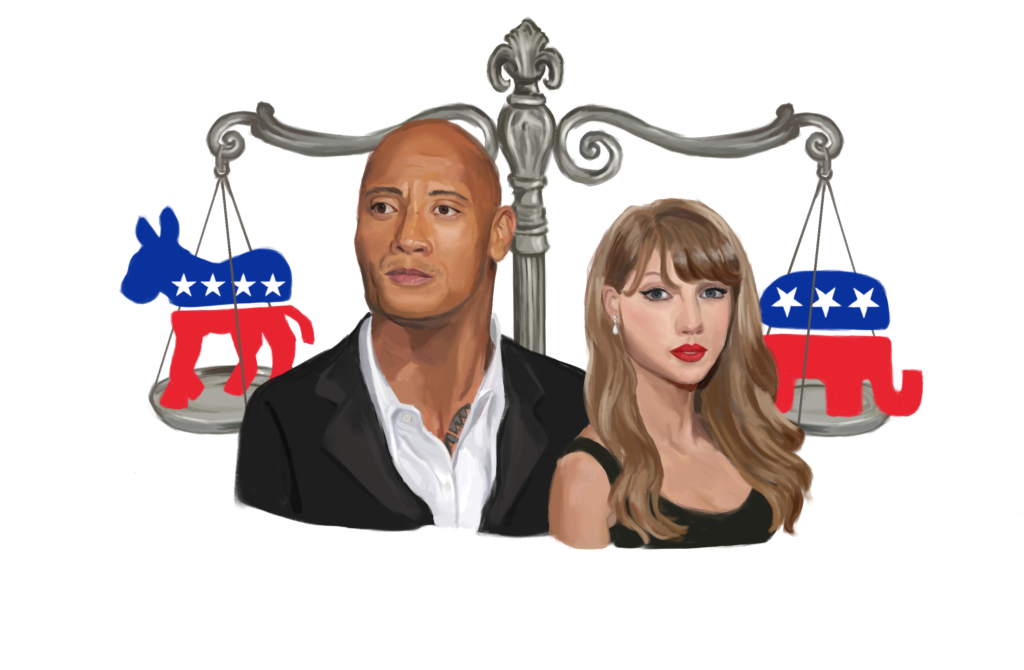
Conversely, many other celebrities have openly sided with one party or another. During the 2020 U.S. presidential election, Dwayne “The Rock” Johnson openly endorsed the Democratic Party. Johnson later said he regretted the endorsement, changing his tune during the 2024 presidential election and becoming nonpartisan. Johnson reasoned that the shift was due to a desire to avoid angering his fanbase and supporters.
“If the celebrity comes out to say that they’re [endorsing] one party, the other party might not agree,” said senior Rodrigo Gomez. “They might lose recognition or fans or money.”
Online, people have speculated that Johnson’s shift was due to a large portion of his fanbase being from wrestling, a sport where people generally lean more Republican.
However, this shift from open political views to nonpartisanship has not been seen in all celebrities. Amid the 2024 presidential election and her Eras Tour, Taylor Swift posted an endorsement on social media for the Democratic Party. The endorsement itself was not particularly shocking, as she had previously supported many Democrats’ ideas, but the open support firmly declared her views to fans once and for all.
“I’m a Democrat, so [it] definitely strengthened my perspective and my opinion on her,” Santiago said. “It was almost comforting to know that … our views aligned … For some of her super fans, that could have been … a deciding factor [in the election].”
However, the endorsement alienated Swift’s Republican fanbase. NBC reported that after the endorsement, 47% of Republicans said they viewed Swift negatively. Despite this statistic, no research found that Swift’s Eras Tour, happening at the same time as the endorsement, was significantly affected.
“[Swift supporting the opposing party] would definitely make me not support her as much, but I would still listen to her music,” Santiago said. “[At] the end of the day, she is still very talented.”
Rather than changing how people vote, celebrity endorsements instead bring attention to politics itself, making more people overall vote, according to an article from the University of New Mexico citing political science professor Jessica Feezell. Voters generally choose who to vote for based on factors such as socioeconomic status and demographics, rather than celebrity endorsements. This idea contrasts with Swift’s 2024 endorsement that led over 400,000 people to make their way to the voter registration website.
Experts say that celebrity endorsements are much more powerful for candidates during primaries instead of during general elections, such as the presidential elections. For example, Oprah Winfrey’s 2008 endorsement of Barack Obama ahead of the Democratic presidential primary led to a significant increase in votes for Obama, a Pew Research Center study found.
“At the end of the day, it’s the celebrity’s choice to say whether they would [endorse] a specific political party,” said junior Saan Bertrand. “A lot of them do want to protect their reputation and don’t want to … get backlash.”
With the midterm elections next month, celebrities once again face the option to publicly side with a party or stay uninvolved.