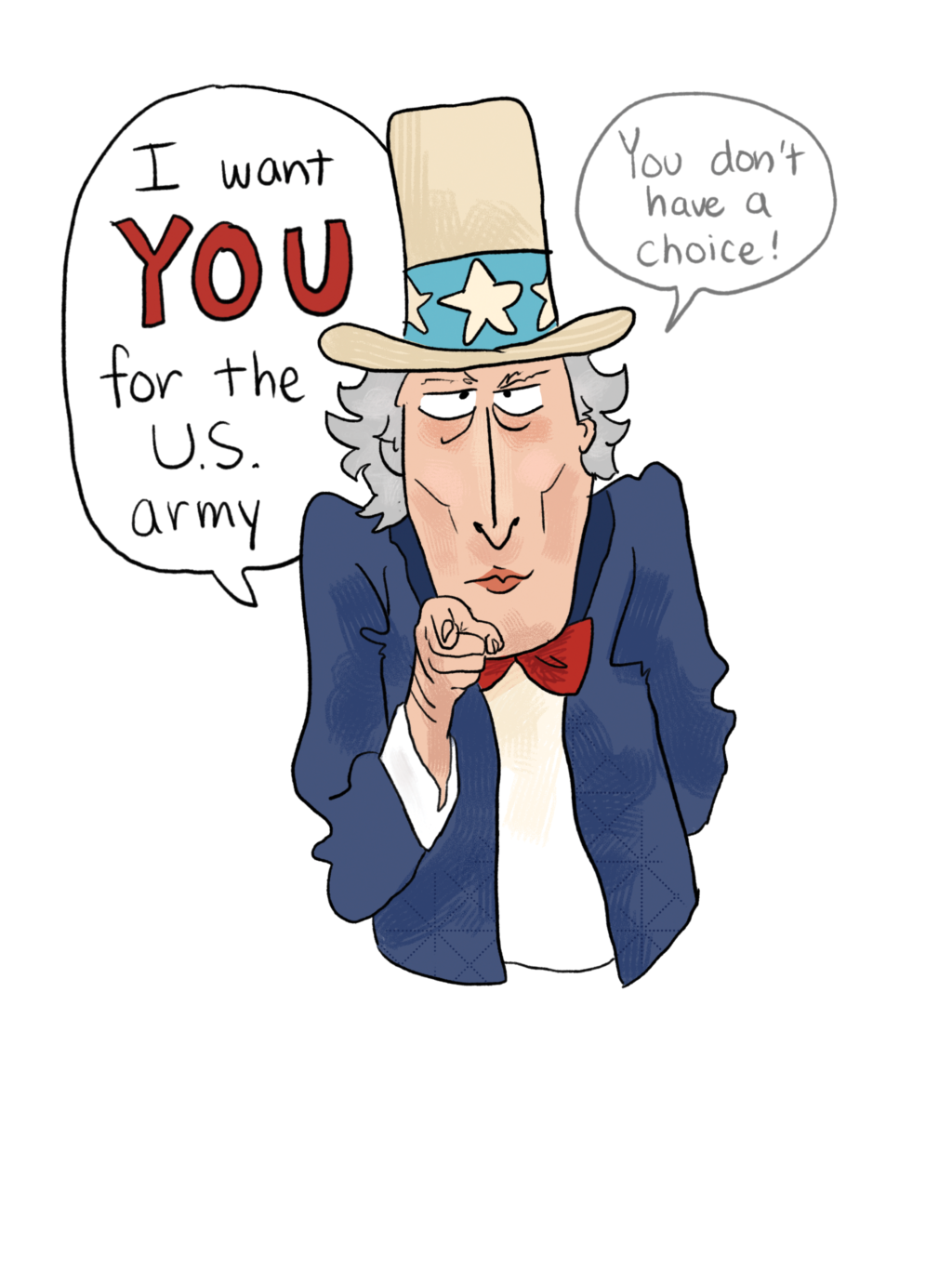
“I want you,” says Uncle Sam. But maybe you don’t have a choice.
“Mandatory military service impedes my freedom!” You’re right. But there’s more to it than that.
There are real scenarios where mandating military service, in reasonable quantity, is not only a good idea but necessary.
First, one must look at the question of what service, mandatory or not, offers to a nation to determine if there is a scenario where mandatory service makes sense.
An army definitely feels like a military necessity. At the very least, if the U.S. is using technology such as autonomous drones and missiles, they probably need commanders and high-level personnel making decisions. Assuming there is military necessity for breathing bodies, sovereignty practically requires the ability to defend oneself against foreign invaders.
Otherwise, a nation’s existence is a bet on the mercy of nations that can be assumed to have self-interest.
“To fight a war you need soldiers,” said senior Jake Wang. “If you … have no soldiers, then how powerful are you really?”
It’s also engrained in the Constitution that Congress has the power to maintain an army. The founding fathers believed that the federal government needed this power explicitly. With all that in mind, it seems fair to believe that an army (in particular warm bodies) are necessary for a country to have, at the very least in wartime, but more generally at the discretion of Congress.
Additionally, John Locke and Thomas Hobbes, philosophers who inspired many of the U.S.’ founding principles, argued that one cannot have liberty without security first. These philosophers are taught at Aragon, appreciated in academia. The logical extension of this is that security must be prioritized. Note that temporary suspension of liberty is a slippery slope — for instance, with Adolf Hitler’s rise to power. Still, in some scenarios such as imperative national defense, it is reasonable that if Congress can in no other capacity raise an army that they deem appropriate, then it suspends some liberties for the ultimate protection of the nation.
“If we are assuming enlistment is low, and the U.S. needs … soldiers, then yes, the draft is necessary,” said senior Nick Nasib.
One example is the Ukraine-Russia war. Ukraine is an interesting example for a few different reasons. They are currently fighting for their sovereignty. Mandatory service makes up about 75% of their army. On one hand, it seems reasonable that in such desperate times, an army of this composition is necessary. On the other hand, it requires that you believe the people of Ukraine are better off winning the war. If they are not, it seems like the needless risk of hundreds of thousands of lives for a war that is not supported enough to invoke voluntary service. Of course, a government will use whatever power necessary to preserve itself, so the fact that the Ukrainian government made the choice has no impact on its benefit to the people.
On the other side, Russia has a permanent draft, and yet their military is only about 25% drafted. However, unlike with Ukraine, this war is not a matter of self-defense for Russia.
Voluntary service is preferable to mandatory service because violating someone’s liberty is not a small matter. On both sides of this particular conflict, however, both are used. The difference is that one is a fight for its very sovereignty, and the other is an invasion of another nation. The question is different for both sides.
In the case of the US, wars are not totally out of the question for mandatory enrollment. People support the US involvement in beating the Nazis, and yet that required a draft. As an example, this proves that mandatory service can be a good thing beyond pure necessity. But with due limitation, as it’s hard to imagine a war in Iran being met with the same zeal; there is a right time and place for mandatory service.
“The draft should only be used when absolutely necessary,” Wang said.
Ultimately, mandatory service is a necessary power of a just government in times of crisis. The sovereignty of a nation depends on its ability to defend itself and mobilize its people. In other scenarios, there is a substantial case to be made, but no blanket statement is applicable.